Cold War Propaganda Posters
The Cold War had a lot to say. It was rarely interested in a second opinion.
Digitally restored reproductions from £19.99, printed on 200gsm Enhanced Matte Fine Art Paper with pigment inks. Printed locally and shipped from the UK, US and Canada. Supplied unframed.

-
Cieslewicz CCCP USA 1968
Roman Cieslewicz1968
From £19.99 -
Soviet Sputnik 1958
1958
From £19.99 -
Soviet Cosmonautics Day 1970s
1970s
From £19.99 -
Tereshkova Vostok-6 1963
1963
From £19.99 -
Soviet Propaganda Poster 1960s
1960s
From £19.99 -
Soviet Red Army Training 1950s
1950s
From £19.99 -
Soviet Soyuz-3 1968
1968
From £19.99 -
Soviet Voskhod-2 Spacewalk 1965
V. Ivanov1965
From £19.99 -
Soviet Five Year Plan 1980
1980
From £19.99 -
Soviet Soyuz 12 Cosmonauts 1973
Vladimir Sachkov1973
From £19.99 -
Soviet Red Army 1950s
1950s
From £19.99 -
Soviet Luna Moon Probe 1959
1959
From £19.99 -
Soviet Propaganda Poster 1960s
1960s
From £19.99 -
Chinese Border Defence 1977
1977
From £19.99 -
Soviet Sputnik 1977
Valentin Petrovich Viktorov1977
From £19.99 -
Soviet Cosmonautics Day 1973
Valentin Petrovich Viktorov1973
From £19.99 -
Soviet Space Race 1965
Vladimirov1965
From £19.99 -
Soviet Propaganda 1968
Valentin Petrovich Viktorov1968
From £19.99 -
Soviet Hydroelectric Dam 1950s
1950s
From £19.99 -
Soviet Space 1961
Valentin Petrovich Viktorov1961
From £19.99 -
Soviet CPSU Workers 1986
1986
From £19.99 -
Soviet Space Race 1961
1961
From £19.99 -
Soviet Vostok 1961
Boris Feokistovich Berezovsky1961
From £19.99 -
Soviet Peace Progress 1965
V. Ivanov1965
From £19.99 -
Soviet Space 1962
Mikhail Mikhailovich Soloviev1962
From £19.99 -
Soviet Propaganda Poster 1961
Vadim Petrovich Volikov1961
From £19.99 -
Soviet New Year 1960s
1960s
From £19.99 -
Soviet Kolkhoz Peasantry 1950s
1950s
From £19.99 -
Soviet Propaganda Poster 1967
1967
From £19.99 -
Soviet 9th Five-Year Plan 1971
K. Ivanov1971
From £19.99 -
Soviet Propaganda Poster 1987
N. Babin and I. Ovasapov1987
From £19.99 -
Soviet Space Propaganda 1962
V.P. Viktorov1962
From £19.99 -
Soviet Propaganda 1960s
Viktor Semyonovich Ivanov1960s
From £19.99 -
Soviet Propaganda Poster 1968
Vladimir Kalensky1968
From £19.99 -
Soviet Space Propaganda 1960s
Leonid Nepomnyashchy1960s
From £19.99 -
Lenin Lived Lives Will Live 1967
Viktor Semenovich Ivanov1967
From £19.99





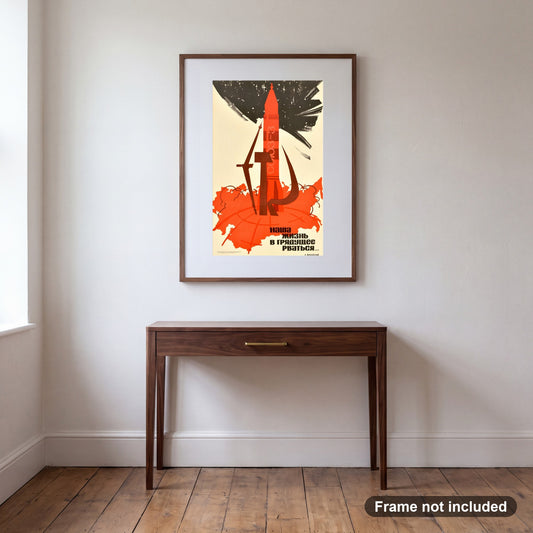


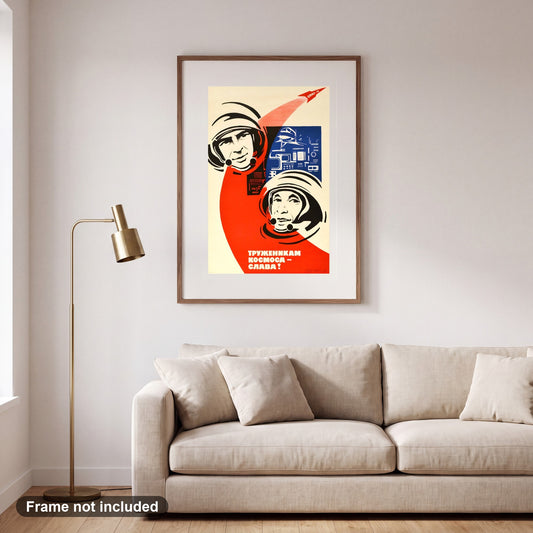


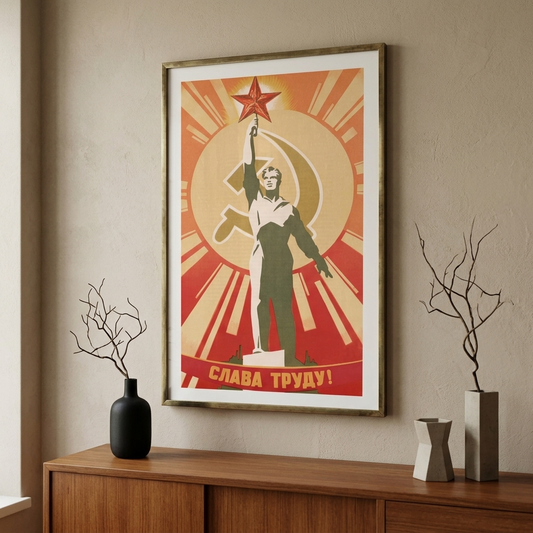


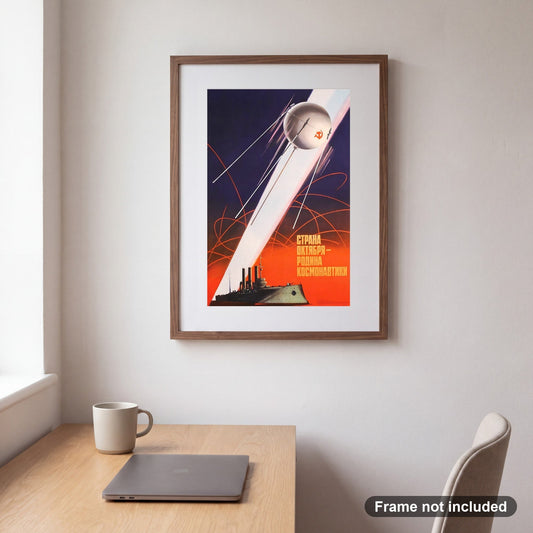





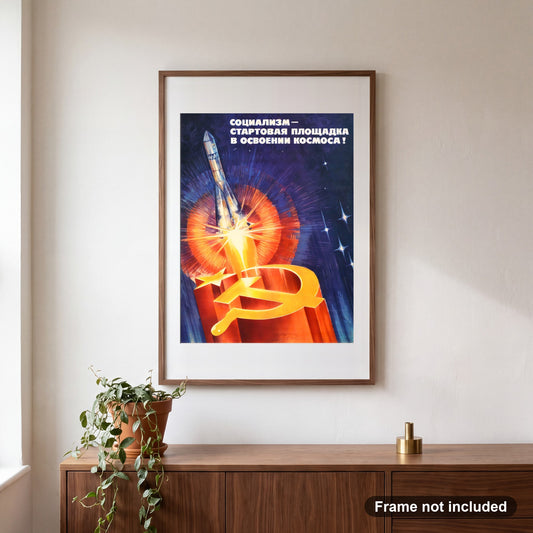




The Cold War propaganda posters here bring together Soviet visions of progress, Chinese political imagery, the space race and campaigns against nuclear weapons. A rocket might promise a magnificent future; another image might suggest that the future is in considerable danger. Read the slogan, then look at the choices behind it: who gets to be heroic, where the threat sits, how colour tells you what to feel.
The space race gets its own corner. Sputnik, Gagarin and the Voskhod spacewalk all made it onto posters, usually with a red flag not far away. See the full set in Soviet space posters.
Competing pictures of the future
The Cold War played out in images as well as speeches and policy. Space exploration could become evidence of a political system’s success. Workers and young people could stand for a country’s future. An opponent could be reduced to a symbol, a caricature or an approaching danger.
The collection includes Soviet labour and party imagery alongside cosmonauts and rockets. Chinese subjects place military and political themes within the same broader period. Other designs complicate the picture: the Stop H Bomb Poison election poster and the Nuclear Death vs Peace design put the fear of nuclear destruction at the centre of the appeal.
Space, peace and political argument
Space race posters link scientific achievement with a political argument. The subject may be a spacecraft or a cosmonaut, but the surrounding words and symbols ask the viewer to connect that achievement with something larger. The Soviet space poster collection lets you follow that particular thread.
Peace imagery makes another useful comparison. Look at the way a design defines danger and who it imagines can prevent it. An appeal to peace can carry its own political assumptions. Reading the slogan alongside the picture is essential to understanding what is being proposed.
Compare before you choose
For a study or a group of historical prints, pair works through a question: how is progress represented, who speaks for peace, or what does the future look like? That gives two images a useful relationship even when their styles differ. Compare the date and campaign information on each product page before treating them as direct counterparts.
For a broader view of one country’s poster design, continue to Soviet propaganda posters. The War & Propaganda collection includes material from other periods as well.