War & Propaganda Posters
A spade. A raised arm. A whole future promised in a few square feet of paper. Propaganda gives everyday objects and gestures an extraordinary amount of work to do.
Digitally restored reproductions from £19.99, printed on 200gsm Enhanced Matte Fine Art Paper with pigment inks. Printed locally and shipped from the UK, US and Canada. Supplied unframed.

-
Loose Lips Might Sink Ships 1942
Seymour R. Goff1942
From £19.99 -
We Can Do It 1943
J. Howard Miller1943
From £19.99 -
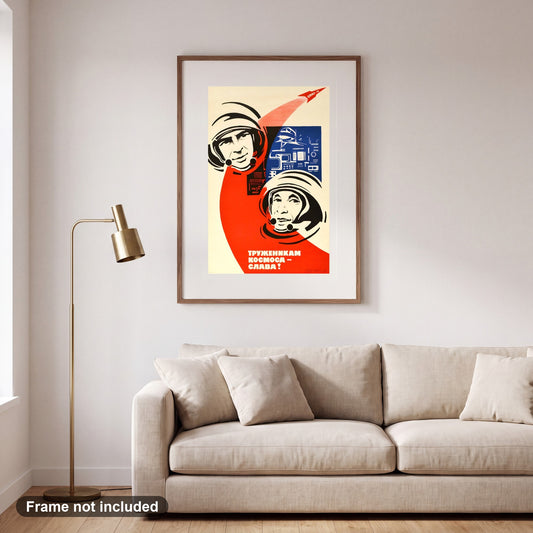
Soviet Cosmonautics Day 1970s
1970s
From £19.99 -
Kitchener "Your Country Needs You" 1914
Alfred Leete1914
From £19.99 -
Dig for Victory 1941
Mary Tunbridge1941
From £19.99 -
Cieslewicz CCCP USA 1968
Roman Cieslewicz1968
From £19.99 -
Wanted for Murder 1944
Victor Keppler1944
From £19.99 -
Uncle Sam I Want You 1917
James Montgomery Flagg1917
From £19.99 -
Women's Land Army 1943
1943
From £19.99 -
Tereshkova Vostok-6 1963
1963
From £19.99 -
Somebody Blabbed 1942
Albert Dorne1942
From £19.99 -
Make-Do and Mend 1943
1943
From £19.99 -
Soviet Sputnik 1958
1958
From £19.99 -
Cornwell Victory Loan 1945
Dean Cornwell1945
From £19.99 -
Soviet Soyuz 12 Cosmonauts 1973
Vladimir Sachkov1973
From £19.99 -
Liberty Bonds 1917
S.L. Bush1917
From £19.99 -
Sem Pour la Liberté du Monde 1917
Georges Goursat1917
From £19.99 -
V Invest c.1919
1910s
From £19.99 -
Baldwin Security Mixture 1929
1929
From £24.99 -
French WWI Recruitment 1914
Danilo1914
From £19.99 -
Il Lavoro 1917
G. Buccaro1917
From £19.99 -
Quiet Loose Talk 1942
Dal Holcomb1942
From £19.99 -
Soviet Space Propaganda 1957
Anatoliy Antonchenko1957
From £19.99 -
Soviet Red Army Training 1950s
1950s
From £19.99 -
Soviet Red Army 1950s
1950s
From £19.99 -
Chinese Sports Glory 1970s
1970s
From £19.99 -
WW2 Poster 1945
Cecil Calvert Beall1945
From £19.99 -
Americans Fight Liberty 1943
Bernard Perlin1943
From £19.99 -
Hirsch War Bonds 1943
Joseph Hirsch1943
From £19.99 -
RAF Air Training Corps 1940s
Jonathan Foss1940s
From £19.99 -
Army Nurse Corps 1943
Ruzzie Green1943
From £19.99 -
Americans All of Us 1943
Ralph Moses1943
From £19.99 -
British Proud of It 1928
1928
From £19.99 -
Give em Hell Malaria 1944
Theodor Seuss Geisel1944
From £19.99







The war and propaganda poster reproductions at Vintage Poster Archives bring together British wartime campaigns, Soviet visions of collective effort and Chinese images of industry and progress. Some persuade through reassurance; others depend on pressure or a sense of duty. Look at the visual invention and the argument behind it. A good place to begin is the detail that first caught your eye.
Browse by period: WW1 posters · WW1 recruitment posters · WW2 posters · British WW2 home front posters · Soviet propaganda posters · Cold War propaganda posters · Soviet space posters · Chinese propaganda posters.
What is the image asking you to do?
A propaganda poster is designed to move an audience towards a view or an action. It may ask people to enlist, save, work, keep quiet or believe in a promised future. The request can be direct, but the visual argument often begins before the words are read.
A heroic figure suggests an example to follow. An ordinary household object can make a national campaign feel close to home. A caricature can turn an opponent into something simple and threatening. Reading these devices alongside the slogan helps explain why the image takes the form it does.
Choose a period or follow a theme
The collection provides several routes into the subject. First World War posters introduce recruitment, finance and public appeals. WW2 posters add a wide range of wartime and home front campaigns. Soviet propaganda moves through work, public duty, political imagery and space exploration, while Chinese posters offer another view of collective effort and progress.
You can also compare a theme across periods. Food, secrecy, youth, industry and the future recur in different settings. The similarities are worth noticing, but so are the differences in audience and purpose. Two posters that use the same gesture may be making very different demands.
Looking closely without losing the context
Colour, lettering and composition are part of what makes these designs compelling. They are also the means through which the message operates. A visually striking image can contain a coercive, discriminatory or misleading claim. Historical context allows the design to be appreciated and examined with its argument still visible.
For a display or study group, begin with a clear reason for placing works together. One campaign seen through several images can be as useful as a comparison across countries. The product listings identify the individual designs and the available reproduction sizes.