Vintage Poster Archives
Cappiello Triple-Sec Fournier 1907 | Vintage Advertising Poster
This service is currently unavailable,
sorry for the inconvenience.
Pair it with a frame
Frame options are for visualization purposes only.
FRAME STYLE
MATTING SIZE
BUILDING YOUR EXPERIENCE
powered by Blankwall
Take a few steps back and let your camera see more of the scene.
powered by Blankwall
Was this experience helpful?
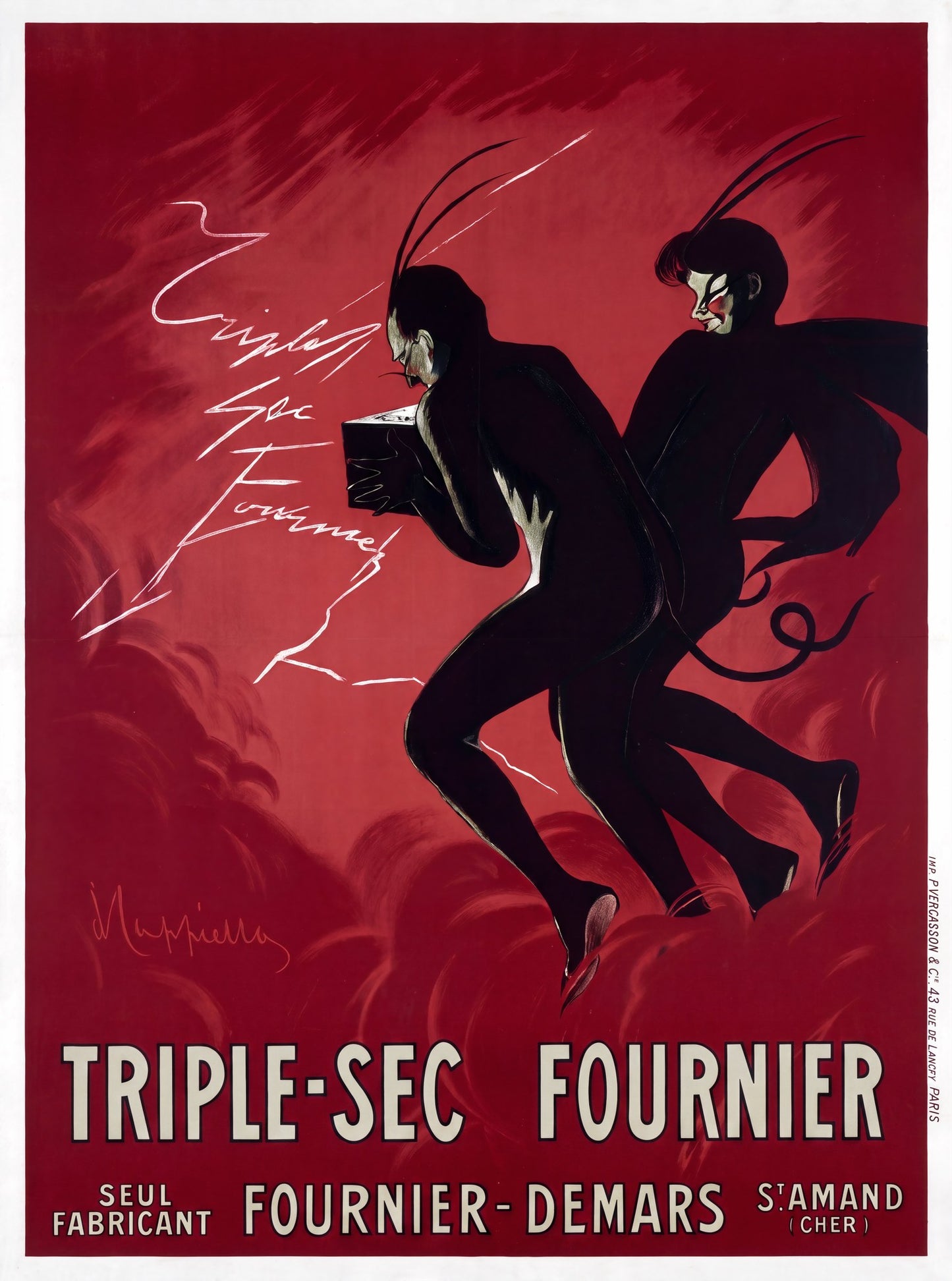
Two black-silhouetted devil figures bound across a saturated crimson ground, one clutching a small white product box, the other curling a spaded tail and insect antennae. Their pallid caricatured faces, rouged cheeks and red lips stand out with high-contrast clarity against the flat red field. A flowing cursive hand-inscription fills the upper-left corner; bold cream slab-serif capitals anchor the brand name across the full width at base. The composition carries the restless, two-second legibility that Cappiello had made his signature approach to the Paris street poster.
Designed by Leonetto Cappiello (1875–1942) for Fournier-Demars, the liqueur house founded in Saint-Amand-Montrond (Cher) in 1865, and produced through his publisher P. Vercasson, Paris. The year, 1907, places this squarely in the middle of Cappiello's most prolific decade under the Vercasson contract, a period during which he developed the flattened-silhouette-against-solid-ground method that would define commercial poster design for the next generation. The devil motif was already established in his vocabulary: a green devil had appeared for Maurin Quina in 1906. Here the archetype doubles, male and female, equally impish. The design is catalogued in Cappiello/Rennert at no. 122 and has appeared at Poster Auctions International, selling well above estimate.
This reproduction is printed using the Giclée process on 200gsm Enhanced Matte Fine Art Paper, preserving the depth of the original crimson lithographic ground and the precise hand-lettered cursive of the product name. Cappiello's transition away from the decorative complexity of the Belle Époque toward bold, flat graphic forms makes this poster a direct ancestor of the Art Deco commercial language that would follow two decades later. Collectors of early French advertising design, students of the history of the poster medium, and anyone with an appetite for the decorative arts of the 1900s will find this design holds its own on any wall.
Couldn't load pickup availability
Share
Two black-silhouetted devil figures bound across a saturated crimson ground, one clutching a small white product box, the other curling a spaded tail and insect antennae. Their pallid caricatured faces, rouged cheeks and red lips stand out with high-contrast clarity against the flat red field. A flowing cursive hand-inscription fills the upper-left corner; bold cream slab-serif capitals anchor the brand name across the full width at base. The composition carries the restless, two-second legibility that Cappiello had made his signature approach to the Paris street poster.
Designed by Leonetto Cappiello (1875–1942) for Fournier-Demars, the liqueur house founded in Saint-Amand-Montrond (Cher) in 1865, and produced through his publisher P. Vercasson, Paris. The year, 1907, places this squarely in the middle of Cappiello's most prolific decade under the Vercasson contract, a period during which he developed the flattened-silhouette-against-solid-ground method that would define commercial poster design for the next generation. The devil motif was already established in his vocabulary: a green devil had appeared for Maurin Quina in 1906. Here the archetype doubles, male and female, equally impish. The design is catalogued in Cappiello/Rennert at no. 122 and has appeared at Poster Auctions International, selling well above estimate.
This reproduction is printed using the Giclée process on 200gsm Enhanced Matte Fine Art Paper, preserving the depth of the original crimson lithographic ground and the precise hand-lettered cursive of the product name. Cappiello's transition away from the decorative complexity of the Belle Époque toward bold, flat graphic forms makes this poster a direct ancestor of the Art Deco commercial language that would follow two decades later. Collectors of early French advertising design, students of the history of the poster medium, and anyone with an appetite for the decorative arts of the 1900s will find this design holds its own on any wall.
