Vintage Poster Archives
Cappiello Maurin Quina 1906 | Vintage Advertising Poster
This service is currently unavailable,
sorry for the inconvenience.
Pair it with a frame
Frame options are for visualization purposes only.
FRAME STYLE
MATTING SIZE
BUILDING YOUR EXPERIENCE
powered by Blankwall
Take a few steps back and let your camera see more of the scene.
powered by Blankwall
Was this experience helpful?
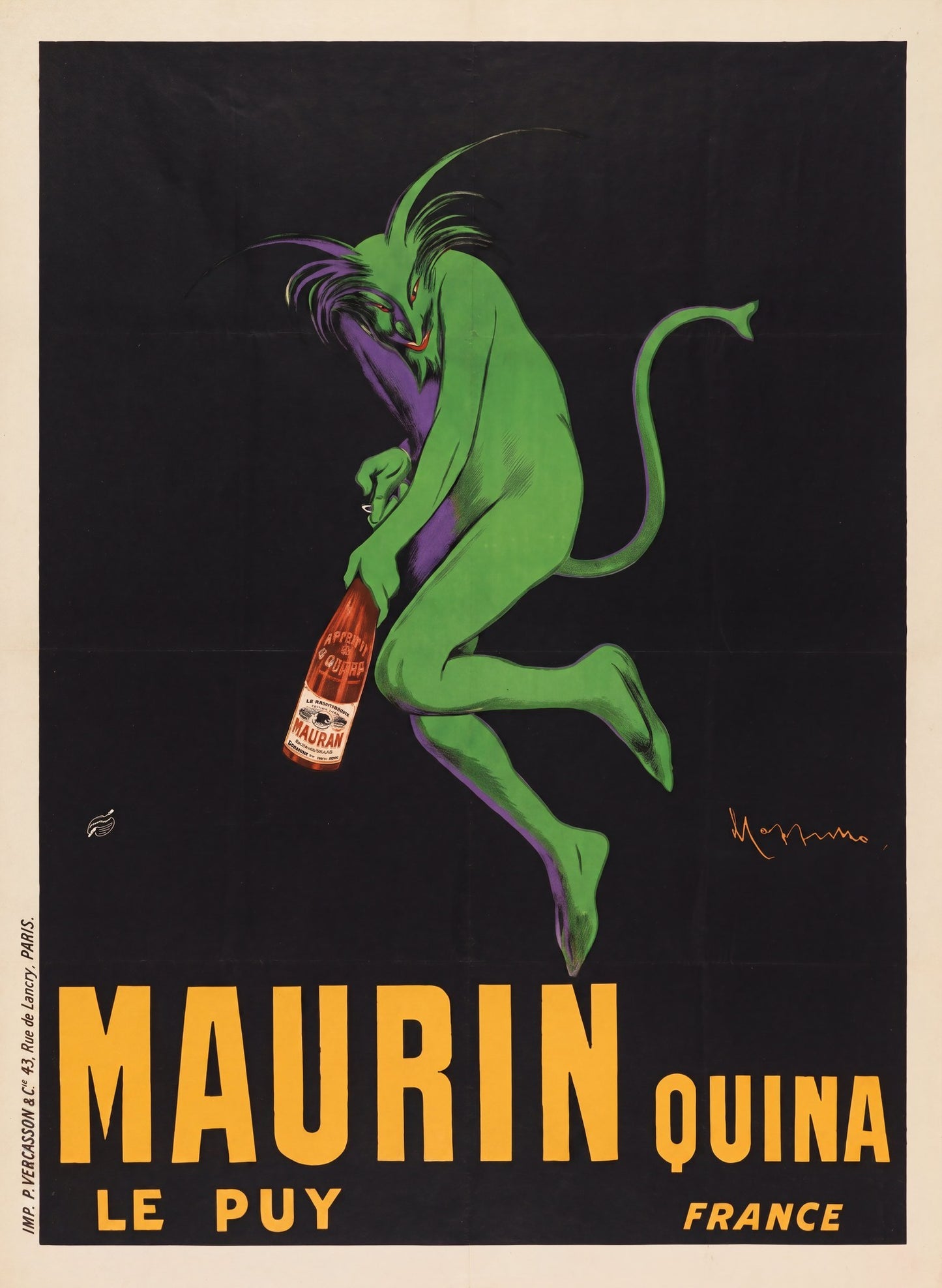
A green devil, limbs splayed mid-leap, spined head-crest, curling tail, clutches a labelled Quina bottle against an unbroken black ground. Cappiello set no scene, offered no context: just the figure, the product, and a sideways glance loaded with sly intent. The amber-gold slab-serif type below names the brand and its origin with equal directness: MAURIN QUINA / LE PUY / FRANCE.
Leonetto Cappiello designed this poster in 1906 for Maurin-Brenas of Le Puy-en-Velay, a quinine-based fortified aperitif flavoured with wild cherries, bitter almonds, and cherry brandy. The green devil was a deliberate echo of la fée verte, the green fairy that served as the popular euphemism for absinthe during the Belle Époque. Printed by Imp. P. Vercasson & Cie., 43 Rue de Lancry, Paris, under the contract Cappiello had held with Vercasson since 1900, the poster appeared at the height of absinthe culture and at the precise moment Cappiello was consolidating the bold-figure-on-black technique that would define his four-decade output. It is, by the consistent assessment of auction houses and gallery curators, the most recognised work he ever produced.
Cappiello (Livorno, 1875, Cannes, 1942) trained as a caricaturist, contributing to Le Rire and L'Assiette au Beurre before pivoting to poster work. He was the first poster artist to habitually isolate vivid figures against flat dark grounds, a device that separated his work from the decorative, vegetation-filled naturalism of Chéret and Mucha and that proved foundational for commercial graphic design through the first half of the twentieth century.
Reproduced as an archival print on 200gsm Enhanced Matte Fine Art Paper. A natural fit for a dining room, a bar corner, or a gallery wall where the Art Nouveau idiom is wanted at its most economical and most forceful.
Couldn't load pickup availability
Share
A green devil, limbs splayed mid-leap, spined head-crest, curling tail, clutches a labelled Quina bottle against an unbroken black ground. Cappiello set no scene, offered no context: just the figure, the product, and a sideways glance loaded with sly intent. The amber-gold slab-serif type below names the brand and its origin with equal directness: MAURIN QUINA / LE PUY / FRANCE.
Leonetto Cappiello designed this poster in 1906 for Maurin-Brenas of Le Puy-en-Velay, a quinine-based fortified aperitif flavoured with wild cherries, bitter almonds, and cherry brandy. The green devil was a deliberate echo of la fée verte, the green fairy that served as the popular euphemism for absinthe during the Belle Époque. Printed by Imp. P. Vercasson & Cie., 43 Rue de Lancry, Paris, under the contract Cappiello had held with Vercasson since 1900, the poster appeared at the height of absinthe culture and at the precise moment Cappiello was consolidating the bold-figure-on-black technique that would define his four-decade output. It is, by the consistent assessment of auction houses and gallery curators, the most recognised work he ever produced.
Cappiello (Livorno, 1875, Cannes, 1942) trained as a caricaturist, contributing to Le Rire and L'Assiette au Beurre before pivoting to poster work. He was the first poster artist to habitually isolate vivid figures against flat dark grounds, a device that separated his work from the decorative, vegetation-filled naturalism of Chéret and Mucha and that proved foundational for commercial graphic design through the first half of the twentieth century.
Reproduced as an archival print on 200gsm Enhanced Matte Fine Art Paper. A natural fit for a dining room, a bar corner, or a gallery wall where the Art Nouveau idiom is wanted at its most economical and most forceful.
