Vintage Poster Archives
Cuzco Peru 1947 | Agostinelli Vintage Travel Poster
This service is currently unavailable,
sorry for the inconvenience.
Pair it with a frame
Frame options are for visualization purposes only.
FRAME STYLE
MATTING SIZE
BUILDING YOUR EXPERIENCE
powered by Blankwall
Take a few steps back and let your camera see more of the scene.
powered by Blankwall
Was this experience helpful?
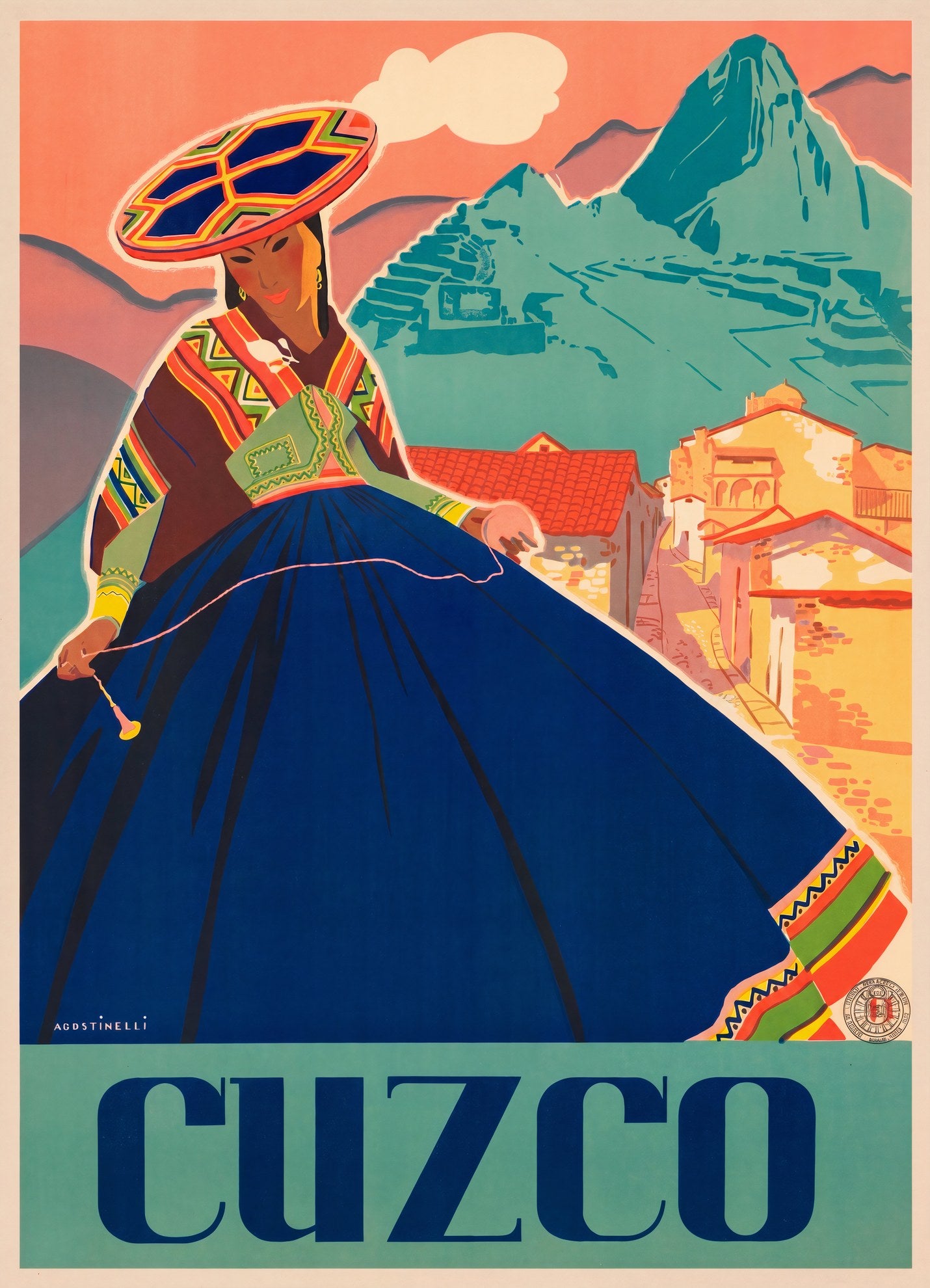
A Quechua woman in a wide-brimmed flat hat and a voluminous cobalt-blue skirt stands in the foreground, a drop-spindle trailing a fine thread from her right hand. Behind her, the terraced ruins of Machu Picchu are rendered in teal against a coral-pink sky; colonial Cuzco occupies the warm ochre middle distance. The composition is resolved in five flat, saturated colour keys, and the word CUZCO is set in bold condensed navy type across a sage-green footer, giving the design the confident graphic weight of mid-century tourism lithography at its most direct.
Designed by Mario Agostinelli (Arequipa, 1915, Rio de Janeiro, 2000), a Peruvian-born painter working in Brazil, the poster was produced for the Peruvian tourism authority around 1947. It belongs to a small body of officially commissioned work promoting Cuzco to post-war international visitors, at the moment Peru was beginning to build the Machu Picchu itinerary into its national tourism identity. Agostinelli's treatment draws on the European mid-century travel poster tradition, flat colour, confident outline, bold type, while grounding the composition in specifically Andean imagery: the Quechua textiles, the drop-spindle, the terraced stonework of the Inca citadel.
The figure of the spinning woman is a recurrent motif in Andean cultural tourism imagery of the 1940s and 1950s, in which national bodies presented indigenous textile traditions as emblems of regional identity. Agostinelli handles the figure with graphic confidence rather than documentary detail: the cobalt skirt sweeps across more than half the poster's surface, and the mountain behind her is reduced to a single teal silhouette. The result is one of the more visually resolved South American travel posters of the post-war decade.
Reproduced as an archival print on 200gsm Enhanced Matte Fine Art Paper, using pigment-based inks. A vintage travel poster for those drawn to mid-century Latin American graphic design or the history of Andean cultural tourism.
Couldn't load pickup availability
Share
A Quechua woman in a wide-brimmed flat hat and a voluminous cobalt-blue skirt stands in the foreground, a drop-spindle trailing a fine thread from her right hand. Behind her, the terraced ruins of Machu Picchu are rendered in teal against a coral-pink sky; colonial Cuzco occupies the warm ochre middle distance. The composition is resolved in five flat, saturated colour keys, and the word CUZCO is set in bold condensed navy type across a sage-green footer, giving the design the confident graphic weight of mid-century tourism lithography at its most direct.
Designed by Mario Agostinelli (Arequipa, 1915, Rio de Janeiro, 2000), a Peruvian-born painter working in Brazil, the poster was produced for the Peruvian tourism authority around 1947. It belongs to a small body of officially commissioned work promoting Cuzco to post-war international visitors, at the moment Peru was beginning to build the Machu Picchu itinerary into its national tourism identity. Agostinelli's treatment draws on the European mid-century travel poster tradition, flat colour, confident outline, bold type, while grounding the composition in specifically Andean imagery: the Quechua textiles, the drop-spindle, the terraced stonework of the Inca citadel.
The figure of the spinning woman is a recurrent motif in Andean cultural tourism imagery of the 1940s and 1950s, in which national bodies presented indigenous textile traditions as emblems of regional identity. Agostinelli handles the figure with graphic confidence rather than documentary detail: the cobalt skirt sweeps across more than half the poster's surface, and the mountain behind her is reduced to a single teal silhouette. The result is one of the more visually resolved South American travel posters of the post-war decade.
Reproduced as an archival print on 200gsm Enhanced Matte Fine Art Paper, using pigment-based inks. A vintage travel poster for those drawn to mid-century Latin American graphic design or the history of Andean cultural tourism.
