Vintage Poster Archives
Pneu Colonial 1910s | Belgian Cycling Sport Poster
Pneu Colonial 1910s | Belgian Cycling Sport Poster
Couldn't load pickup availability
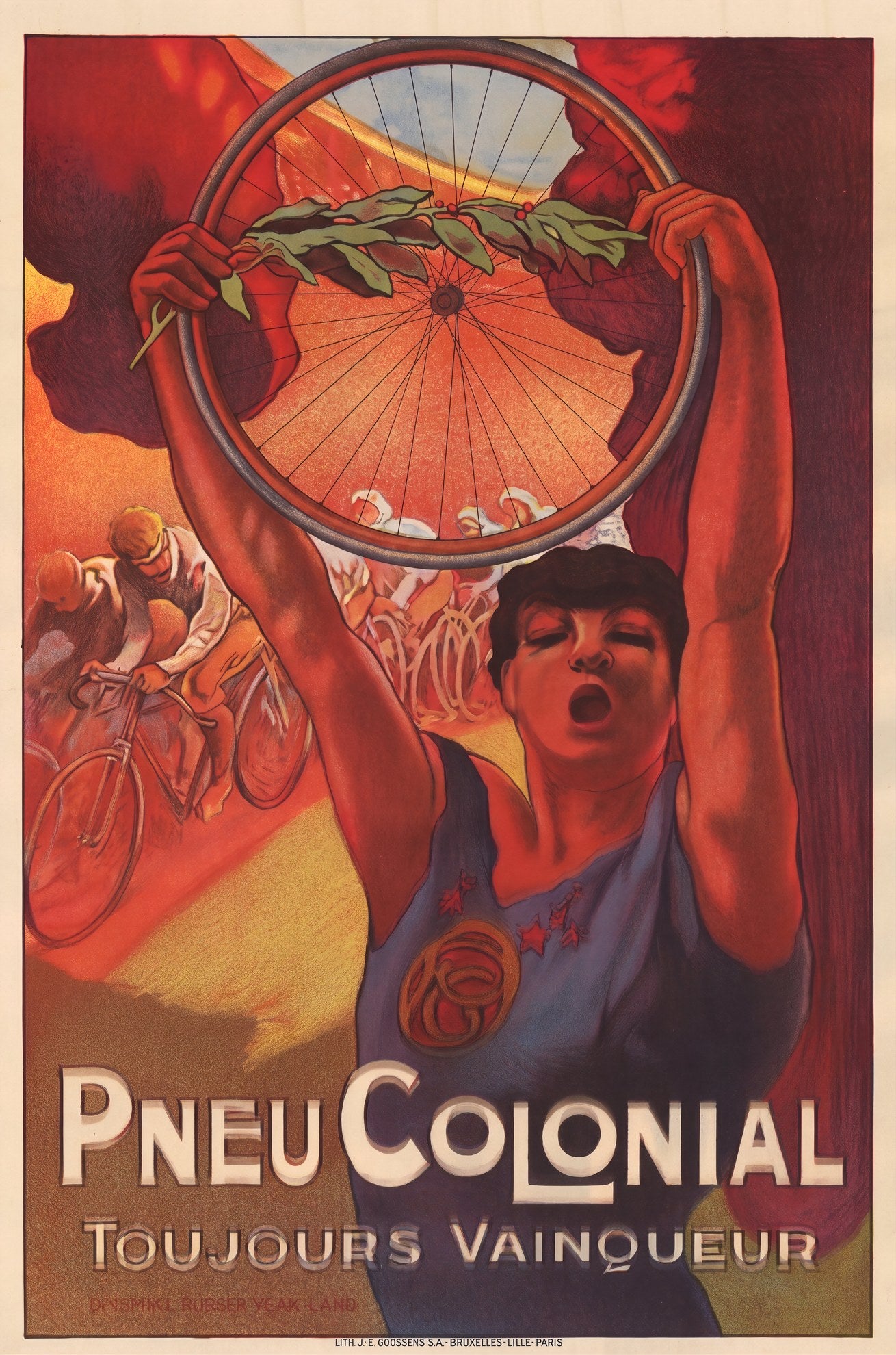
A female athlete raises a laurelled bicycle wheel above her head, arms fully extended, while two road-racing cyclists surge forward in the background against a field of crimson and amber. Red flag-drapes frame the scene on either side. The brand name 'Pneu Colonial' is set in bold white Art Nouveau capitals below, with the slogan 'Toujours Vainqueur', Always the Winner, in spaced lettering beneath it.
Lithographed by J.E. Goossens S.A. of Bruxelles, Lille and Paris, the house that became one of Europe's foremost large-format poster printers by the 1920s. The design dates from the 1910s, when Belgian and French tyre manufacturers backed road-racing at the highest level and used ambitious poster commissions to build brand identity. The upward diagonal energy of the figure, the saturated palette, and the victory iconography, laurel, raised trophy, receding field of competitors, all belong to the visual language of pre-war Belgian commercial art.
Pneu Colonial's 'Toujours Vainqueur' slogan tied the brand directly to the competitive cycling calendar, positioning the tyre as the choice of winners rather than merely a functional component. The design reads across that entire tradition: sport, ambition, and the graphic confidence of a decade when poster art and competitive cycling were deeply intertwined.
Reproduced as an archival print on 200gsm Enhanced Matte Fine Art Paper using pigment-based inks, from a digitally restored source. Natural-white, smooth matte finish. A coherent fit for anyone interested in the graphic history of European cycle sport or the commercial poster culture of the early twentieth century.