Vintage Poster Archives
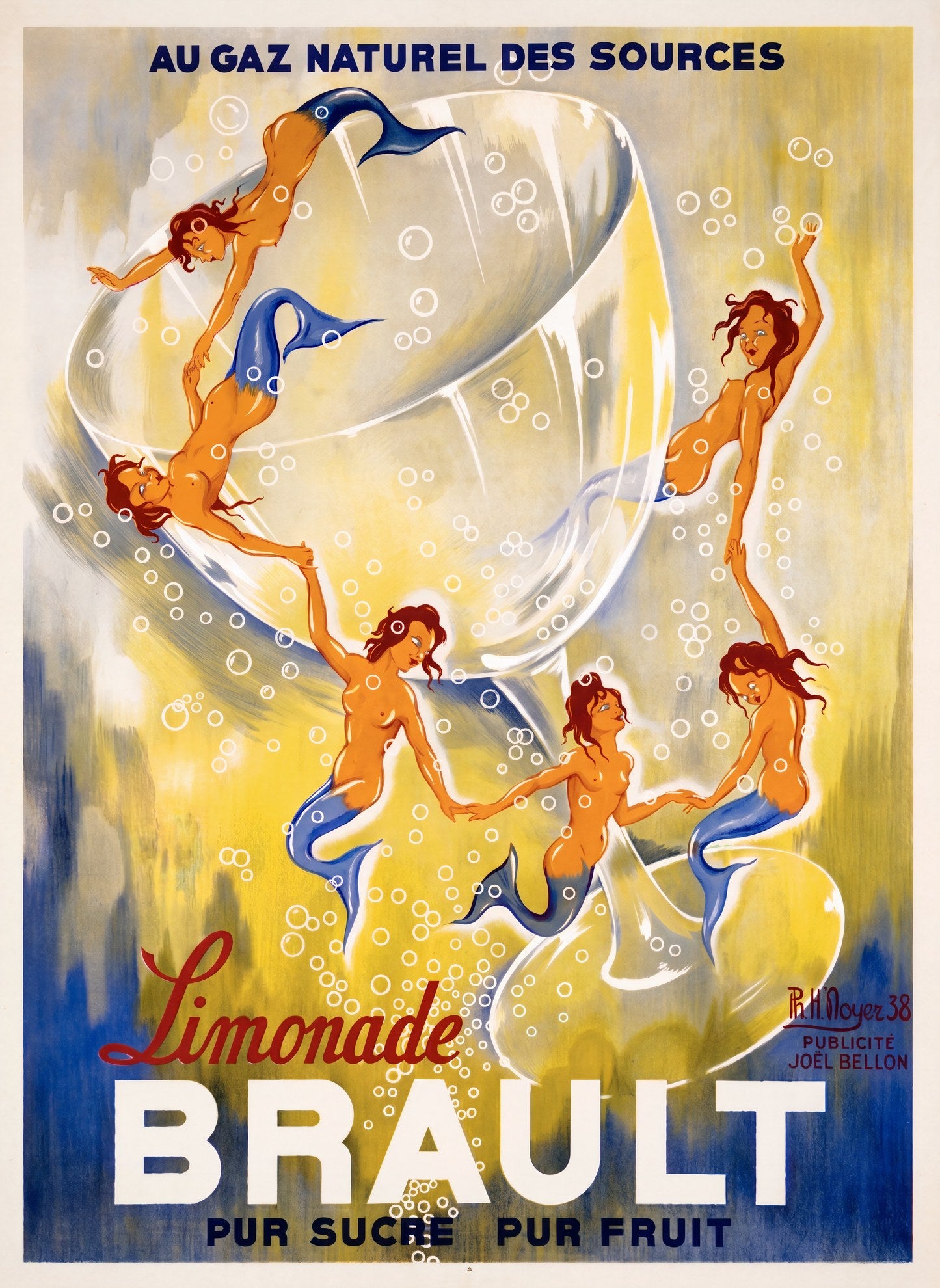
Limonade Brault 1938 | Noyer French Vintage Food Poster
This service is currently unavailable,
sorry for the inconvenience.
Pair it with a frame
Frame options are for visualization purposes only.
FRAME STYLE
MATTING SIZE
BUILDING YOUR EXPERIENCE
powered by Blankwall
Take a few steps back and let your camera see more of the scene.
powered by Blankwall
Was this experience helpful?
Five mermaids with cobalt-blue tails wheel around a tilted oversized glass, bubbles rising across a golden-yellow and brushstroke-blue ground. The figures are linked by gesture, one dives head-first into the glass, two clasp hands below it, two more spiral at the edges, giving the composition a continuous circular motion. BRAULT runs in bold white condensed type across the lower third; PUR SUCRE PUR FRUIT anchors the base; AU GAZ NATUREL DES SOURCES arcs across the top in navy caps. Signed Ph. H. Noyer 38, printed by Joël Bellon, Paris.
Philippe Henri Noyer (1917–1985) designed this lithograph at twenty-one, shortly after training at the École des Beaux-Arts in Lyon and the Paul Colin School of Art in Paris. The Brault commission is among his earliest advertising work. Source Brault was a French producer of naturally carbonated mineral water used in lemonade, and the mermaid motif, playful, aquatic, and deliberately light-hearted, translated the brand's natural-carbonation claim into a single coherent visual. Noyer's warm ochre figure palette against the yellow ground sets the illustration apart from the cooler, more geometric beverage advertising of the same decade.
This design sits in the tradition of French drinks advertising that ran from Cappiello's absinthes through Carlu's aperitifs: the product's qualities rendered as a cast of characters rather than a product rendered. The poster was produced as a large-format lithograph, approximately 160 x 120 cm, one of the most substantial formats used in French retail advertising of the period.
Reproduced on 200gsm Enhanced Matte Fine Art Paper using pigment-based archival inks. Suited to anyone interested in 1930s French commercial illustration, the history of European soft-drink advertising, or the broader tradition of mid-century figurative poster art.
Couldn't load pickup availability
Share
Five mermaids with cobalt-blue tails wheel around a tilted oversized glass, bubbles rising across a golden-yellow and brushstroke-blue ground. The figures are linked by gesture, one dives head-first into the glass, two clasp hands below it, two more spiral at the edges, giving the composition a continuous circular motion. BRAULT runs in bold white condensed type across the lower third; PUR SUCRE PUR FRUIT anchors the base; AU GAZ NATUREL DES SOURCES arcs across the top in navy caps. Signed Ph. H. Noyer 38, printed by Joël Bellon, Paris.
Philippe Henri Noyer (1917–1985) designed this lithograph at twenty-one, shortly after training at the École des Beaux-Arts in Lyon and the Paul Colin School of Art in Paris. The Brault commission is among his earliest advertising work. Source Brault was a French producer of naturally carbonated mineral water used in lemonade, and the mermaid motif, playful, aquatic, and deliberately light-hearted, translated the brand's natural-carbonation claim into a single coherent visual. Noyer's warm ochre figure palette against the yellow ground sets the illustration apart from the cooler, more geometric beverage advertising of the same decade.
This design sits in the tradition of French drinks advertising that ran from Cappiello's absinthes through Carlu's aperitifs: the product's qualities rendered as a cast of characters rather than a product rendered. The poster was produced as a large-format lithograph, approximately 160 x 120 cm, one of the most substantial formats used in French retail advertising of the period.
Reproduced on 200gsm Enhanced Matte Fine Art Paper using pigment-based archival inks. Suited to anyone interested in 1930s French commercial illustration, the history of European soft-drink advertising, or the broader tradition of mid-century figurative poster art.
