Vintage Poster Archives
Le Mandarin 1904 | Niez Vintage Advertising Poster
This service is currently unavailable,
sorry for the inconvenience.
Pair it with a frame
Frame options are for visualization purposes only.
FRAME STYLE
MATTING SIZE
BUILDING YOUR EXPERIENCE
powered by Blankwall
Take a few steps back and let your camera see more of the scene.
powered by Blankwall
Was this experience helpful?
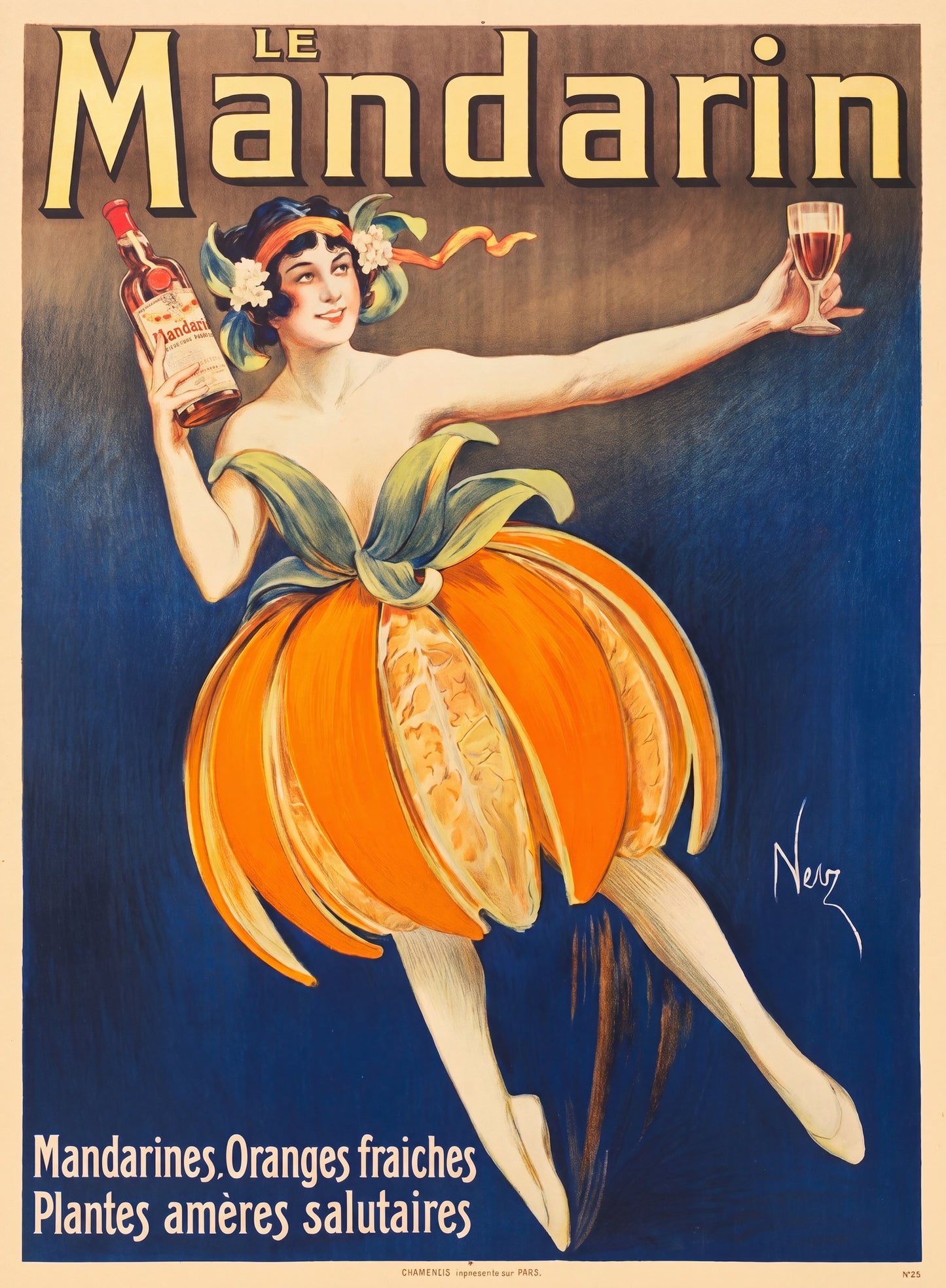
A dancer in a skirt formed from the exposed segments of a whole mandarin orange turns against a deep cobalt blue ground. In her left hand she holds an amber bottle labelled Le Mandarin; her right arm extends outward, a filled wine glass at the end of it. Green leaf forms knot at her waist where the fruit-skirt begins, and her dark hair is dressed with a ribbon headband and white flowers. The lower left of the composition carries the product's claim in white roman type: Mandarines. Oranges fraiches / Plantes ameres salutaires. The lithograph was produced by Chamelis, Paris, and is numbered No. 25.
Signed by the artist Niez and dated to approximately 1904, the poster belongs to the high period of the Parisian lithographic affiche, when advertisers of aperitifs and liqueurs competed for attention on the walls and kiosks of the city with a single arresting figure. The fruit-as-costume device, the dancer indistinguishable from the product, is a recurring motif in this tradition, and Niez uses it with particular economy: there is no background detail, no additional narrative. The figure, the bottle, and the deep cobalt field are the entire argument.
The design sits in the Art Nouveau current of early twentieth-century French commercial lithography: sinuous figural line, hand-lettered display type with shadow, and a saturated chromatic ground chosen for maximum legibility at distance. It occupies the same visual conversation as the better-documented works of Cheret and the younger Cappiello, whose celebrated 1921 Campari 'Lo Spiritello' revisited the orange-and-dancer combination.
Reproduced as an archival print on 200gsm Enhanced Matte Fine Art Paper, restored from an archival source. A natural fit for a kitchen, dining room, or bar wall, and for anyone who collects the graphic culture of the Belle Époque aperitif trade.
Couldn't load pickup availability
Share
A dancer in a skirt formed from the exposed segments of a whole mandarin orange turns against a deep cobalt blue ground. In her left hand she holds an amber bottle labelled Le Mandarin; her right arm extends outward, a filled wine glass at the end of it. Green leaf forms knot at her waist where the fruit-skirt begins, and her dark hair is dressed with a ribbon headband and white flowers. The lower left of the composition carries the product's claim in white roman type: Mandarines. Oranges fraiches / Plantes ameres salutaires. The lithograph was produced by Chamelis, Paris, and is numbered No. 25.
Signed by the artist Niez and dated to approximately 1904, the poster belongs to the high period of the Parisian lithographic affiche, when advertisers of aperitifs and liqueurs competed for attention on the walls and kiosks of the city with a single arresting figure. The fruit-as-costume device, the dancer indistinguishable from the product, is a recurring motif in this tradition, and Niez uses it with particular economy: there is no background detail, no additional narrative. The figure, the bottle, and the deep cobalt field are the entire argument.
The design sits in the Art Nouveau current of early twentieth-century French commercial lithography: sinuous figural line, hand-lettered display type with shadow, and a saturated chromatic ground chosen for maximum legibility at distance. It occupies the same visual conversation as the better-documented works of Cheret and the younger Cappiello, whose celebrated 1921 Campari 'Lo Spiritello' revisited the orange-and-dancer combination.
Reproduced as an archival print on 200gsm Enhanced Matte Fine Art Paper, restored from an archival source. A natural fit for a kitchen, dining room, or bar wall, and for anyone who collects the graphic culture of the Belle Époque aperitif trade.
