Vintage Poster Archives
Parfums Djemil 1925 | Geo Cad Art Deco Poster
This service is currently unavailable,
sorry for the inconvenience.
Pair it with a frame
Frame options are for visualization purposes only.
FRAME STYLE
MATTING SIZE
BUILDING YOUR EXPERIENCE
powered by Blankwall
Take a few steps back and let your camera see more of the scene.
powered by Blankwall
Was this experience helpful?
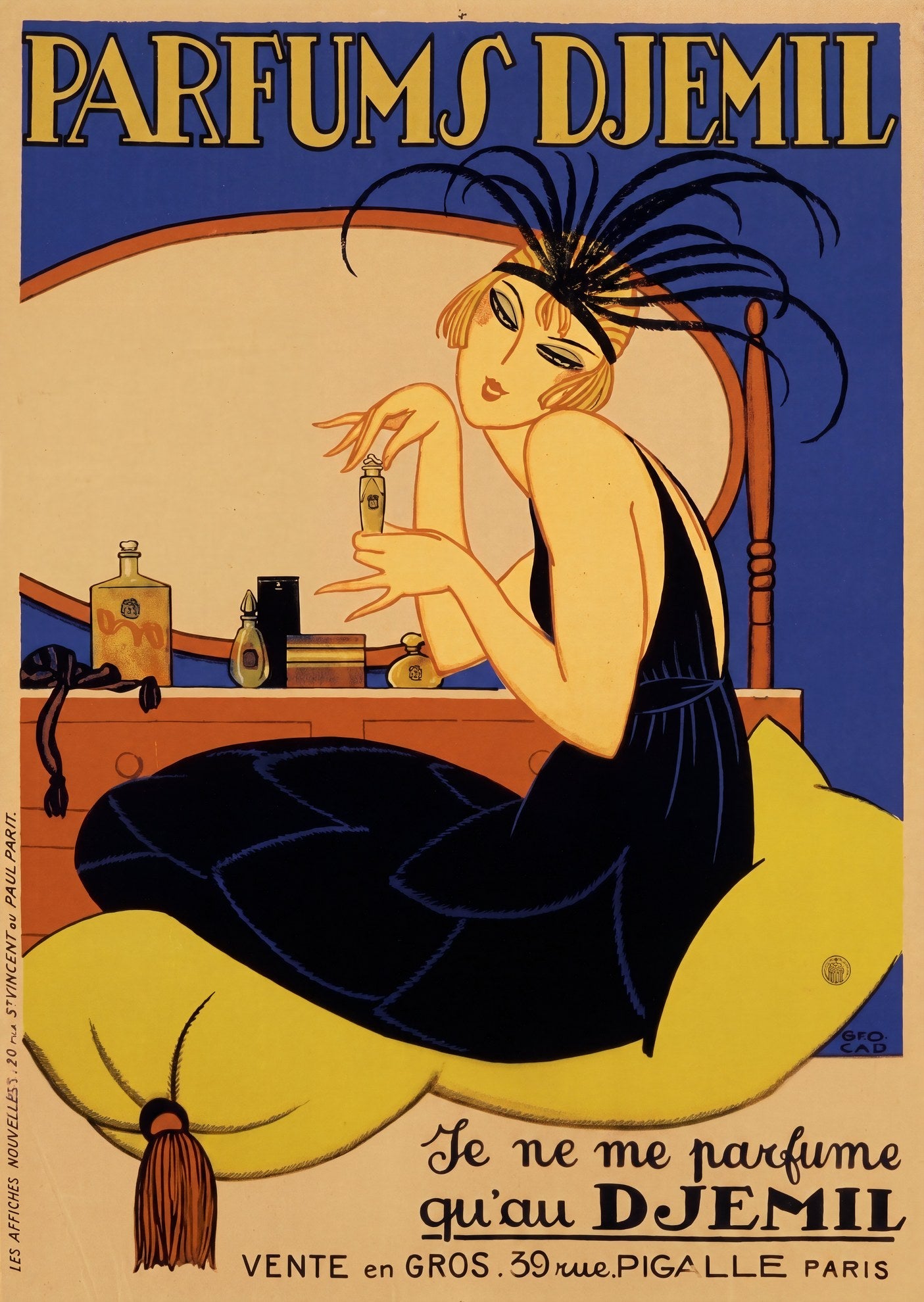
A bobbed blonde in a sleeveless navy gown reclines on oversized yellow cushions at her dressing table, a small perfume bottle raised in her right hand. The feather headdress fans upward against a flat cobalt blue ground. Three further bottles and a compact rest on the table behind her, reflected in a warm cream oval mirror. The whole composition works in broad, unmodulated colour blocks: cobalt, cadmium yellow, deep navy, warm cream. Geo Cad's line is spare and the palette does the work.
Designed for Parfums Djemil, a Paris fragrance house with wholesale premises at 39 rue Pigalle, the poster was printed by Les Affiches Nouvelles in the mid-1920s. The Pigalle address is telling: the 18th arrondissement was then the centre of Parisian cabaret and night-life, and the perfume house positioned its product squarely within that world of evening glamour. The 1925 Exposition Internationale des Arts Decoratifs had just fixed the Art Deco aesthetic as the commercial language of Parisian luxury, and Geo Cad's flat graphic treatment reflects that moment exactly.
Geo Cad worked in the tradition of French consumer poster design that Cappiello had established in the preceding decade: silhouette-led, colour-saturated, resolved quickly on the eye. Applied here to the intimate register of perfume and the dressing table, it produces a composition that is self-contained and considered rather than loud. The cursive tagline, Je ne me parfume qu'au DJEMIL, is set in deliberate contrast to the bold gilded display headline above.
Reproduced as an archival print on 200gsm Enhanced Matte Fine Art Paper. The poster sits naturally alongside other French 1920s advertising and fashion illustration, and draws an audience from both Art Deco graphic design collectors and those furnishing spaces with mid-decade Paris references.
Couldn't load pickup availability
Share
A bobbed blonde in a sleeveless navy gown reclines on oversized yellow cushions at her dressing table, a small perfume bottle raised in her right hand. The feather headdress fans upward against a flat cobalt blue ground. Three further bottles and a compact rest on the table behind her, reflected in a warm cream oval mirror. The whole composition works in broad, unmodulated colour blocks: cobalt, cadmium yellow, deep navy, warm cream. Geo Cad's line is spare and the palette does the work.
Designed for Parfums Djemil, a Paris fragrance house with wholesale premises at 39 rue Pigalle, the poster was printed by Les Affiches Nouvelles in the mid-1920s. The Pigalle address is telling: the 18th arrondissement was then the centre of Parisian cabaret and night-life, and the perfume house positioned its product squarely within that world of evening glamour. The 1925 Exposition Internationale des Arts Decoratifs had just fixed the Art Deco aesthetic as the commercial language of Parisian luxury, and Geo Cad's flat graphic treatment reflects that moment exactly.
Geo Cad worked in the tradition of French consumer poster design that Cappiello had established in the preceding decade: silhouette-led, colour-saturated, resolved quickly on the eye. Applied here to the intimate register of perfume and the dressing table, it produces a composition that is self-contained and considered rather than loud. The cursive tagline, Je ne me parfume qu'au DJEMIL, is set in deliberate contrast to the bold gilded display headline above.
Reproduced as an archival print on 200gsm Enhanced Matte Fine Art Paper. The poster sits naturally alongside other French 1920s advertising and fashion illustration, and draws an audience from both Art Deco graphic design collectors and those furnishing spaces with mid-decade Paris references.
