Vintage Poster Archives
Goodrich Le Ballon 1925 | Garcigoy Advertising Poster
This service is currently unavailable,
sorry for the inconvenience.
Pair it with a frame
Frame options are for visualization purposes only.
FRAME STYLE
MATTING SIZE
BUILDING YOUR EXPERIENCE
powered by Blankwall
Take a few steps back and let your camera see more of the scene.
powered by Blankwall
Was this experience helpful?
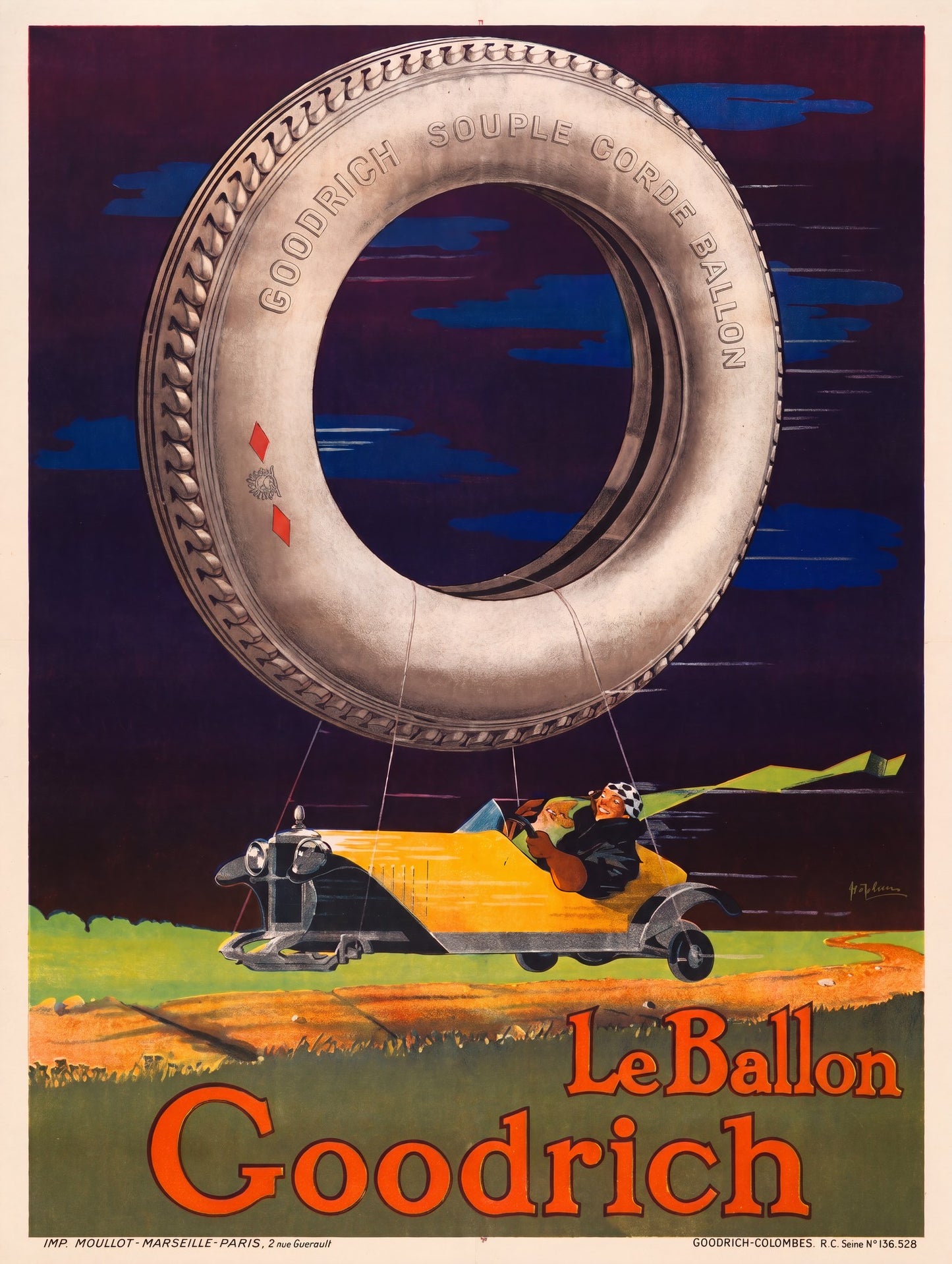
A giant Goodrich Souple Corde Ballon tyre rises against a deep purple-maroon sky, its silver sidewall lettered with the product name, held aloft by wire stays above a green French landscape. Beneath it, a streamlined yellow open-top racing automobile speeds at full tilt, its two occupants leaning into the wind in goggles and a chequered driving cap, the car's rear fitted with small green aeroplane wings. The product name is taken literally: the balloon tyre becomes a balloon. The composition operates as both advertisement and visual joke, and holds the joke without explaining it.
Designed by Garcigoy in 1925 and lithographed by Imprimerie Moullot of Marseille and Paris, the poster was commissioned by Goodrich-Colombes, the French subsidiary of the American B.F. Goodrich Company, which had established its factory in Colombes in 1910. The 'Souple Corde Ballon' was Goodrich's balloon-section low-pressure tyre, marketed in mid-1920s France as a superior road-holding product. Garcigoy's approach belongs to the French interwar advertising tradition: bold flat colour, saturated palette, stylised motion lines, and a product given personality through visual metaphor rather than technical claim.
The bold slab-serif 'Le Ballon / Goodrich' in cadmium orange-red at the base, set against the cream paper ground, gives the typography the same graphic weight as the illustration above. The foot of the poster carries the Moullot imprint and the Goodrich-Colombes commercial registration, grounding the playful image in the industrial and commercial France of 1925.
Reproduced from the original lithograph using archival pigment inks on 200gsm Enhanced Matte Fine Art Paper. A natural fit for those drawn to French interwar advertising design, early automotive history, or the particular graphic wit of the Art Deco decade.
Couldn't load pickup availability
Share
A giant Goodrich Souple Corde Ballon tyre rises against a deep purple-maroon sky, its silver sidewall lettered with the product name, held aloft by wire stays above a green French landscape. Beneath it, a streamlined yellow open-top racing automobile speeds at full tilt, its two occupants leaning into the wind in goggles and a chequered driving cap, the car's rear fitted with small green aeroplane wings. The product name is taken literally: the balloon tyre becomes a balloon. The composition operates as both advertisement and visual joke, and holds the joke without explaining it.
Designed by Garcigoy in 1925 and lithographed by Imprimerie Moullot of Marseille and Paris, the poster was commissioned by Goodrich-Colombes, the French subsidiary of the American B.F. Goodrich Company, which had established its factory in Colombes in 1910. The 'Souple Corde Ballon' was Goodrich's balloon-section low-pressure tyre, marketed in mid-1920s France as a superior road-holding product. Garcigoy's approach belongs to the French interwar advertising tradition: bold flat colour, saturated palette, stylised motion lines, and a product given personality through visual metaphor rather than technical claim.
The bold slab-serif 'Le Ballon / Goodrich' in cadmium orange-red at the base, set against the cream paper ground, gives the typography the same graphic weight as the illustration above. The foot of the poster carries the Moullot imprint and the Goodrich-Colombes commercial registration, grounding the playful image in the industrial and commercial France of 1925.
Reproduced from the original lithograph using archival pigment inks on 200gsm Enhanced Matte Fine Art Paper. A natural fit for those drawn to French interwar advertising design, early automotive history, or the particular graphic wit of the Art Deco decade.
