Vintage Poster Archives
Chanteclair Embrocation 1910 | Mich Vintage Advertising Poster
Chanteclair Embrocation 1910 | Mich Vintage Advertising Poster
Couldn't load pickup availability
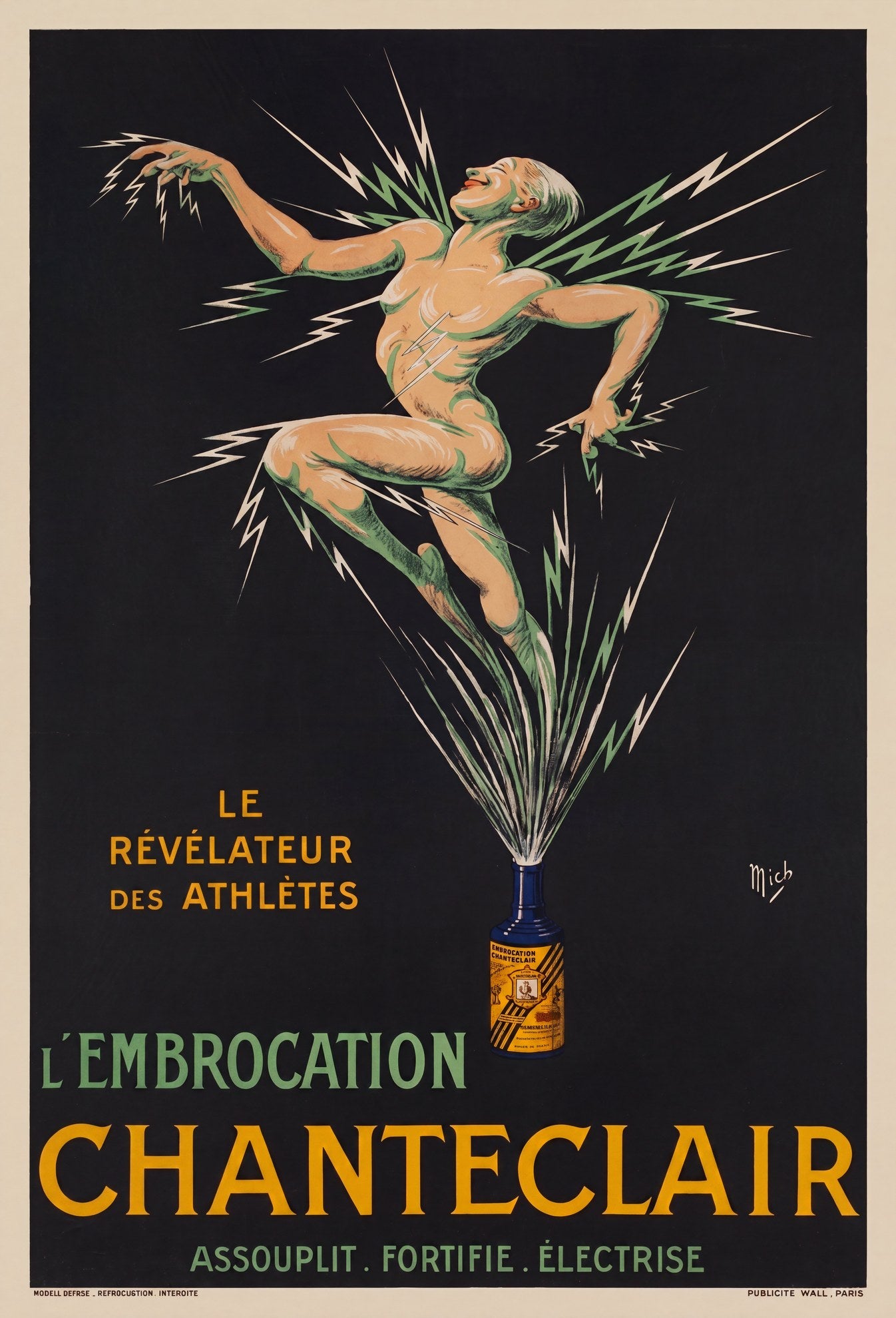
A nude male athlete erupts from the neck of a cobalt-blue product bottle, arms thrown wide, body arched back against a deep black ground. Lightning bolts in white and green radiate outward from his torso and fingertips, rendered with the kind of kinetic confidence that was rare in pre-war French commercial art. Below the figure, the product name 'CHANTECLAIR' is set in large amber-gold slab-serif capitals; the tagline 'ASSOUPLIT. FORTIFIE. ÉLECTRISE' runs along the base in spaced green caps.
Designed by Michel Liebeaux (1881–1923), who signed under the pseudonym 'Mich', and printed by Publicité Wall, Paris in 1910. Liebeaux was by that point a prolific presence in French advertising, producing posters for cycling brands, automobile manufacturers, and health products. The Chanteclair commission, for a rubbing liniment marketed to athletes, gave him a subject perfectly suited to his draughtsmanship: the idealised male body at the moment of maximum exertion. The conceit of the bottle as the source of superhuman energy is one of the more inventive visual arguments in early twentieth-century product advertising.
The design occupies a transitional moment in French poster art, working within Art Nouveau figuration while reaching toward the bolder graphic economy of what would follow. Liebeaux's figure has genuine anatomical weight; the green shadow modelling and radial composition give the black ground purpose rather than emptiness. The poster is held in the permanent collection of the Philadelphia Museum of Art.
Reproduced as a fine art archival print from the 1910 original. The poster resonates with collectors of early French commercial art, sports historians, and anyone interested in how the body was sold before modernism flattened the figure into geometry.