Vintage Poster Archives
Cappiello Remington 1910 | Vintage Advertising Poster
This service is currently unavailable,
sorry for the inconvenience.
Pair it with a frame
Frame options are for visualization purposes only.
FRAME STYLE
MATTING SIZE
BUILDING YOUR EXPERIENCE
powered by Blankwall
Take a few steps back and let your camera see more of the scene.
powered by Blankwall
Was this experience helpful?
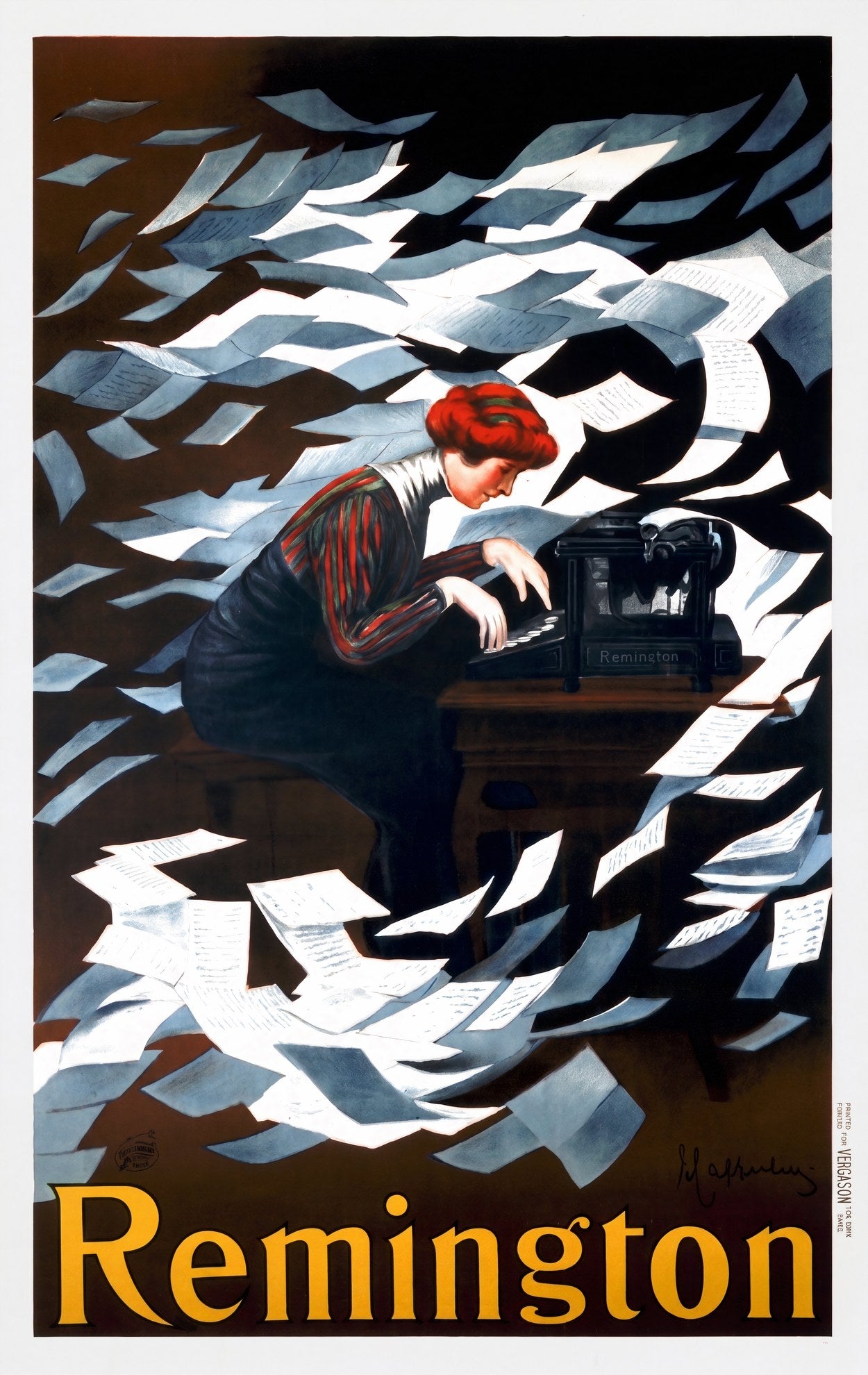
A red-haired woman leans into a black Remington typewriter as typed sheets spiral outward from the keys in a broad centrifugal sweep, filling the deep brown-black ground. Pale blue-white paper forms arc from the desk to the upper corners of the composition, the movement condensing Cappiello's central idea, speed, output, modernity, into a single visual gesture. Bold golden-yellow lettering runs across the base.
Leonetto Cappiello (1875–1942) produced this poster in 1910 for the Paris publisher P. Vercasson, under the long-running contract that defined his poster career. Born in Livorno in 1875 and permanently settled in Paris from 1898, Cappiello developed the device of isolating a bold figure against a dark ground, which separated his work from the ornate Belle Époque tradition. By 1910 that approach was fully formed. The Remington commission is catalogued in the Cappiello/Rennert monograph at reference 169 and measures 129.6 x 199.4 cm in the original lithograph.
Remington had begun as a firearms manufacturer in upstate New York; its typewriter division, launched in the 1870s, became the dominant office machine supplier on both sides of the Atlantic by the early 20th century. Cappiello's composition reinforced that position by translating mechanical efficiency into a visual language that owed nothing to technical illustration and everything to theatrical flair.
Reproduced as a fine art archival print on 200gsm Enhanced Matte Fine Art Paper with pigment-based inks. The natural-white matte surface holds the poster's high-contrast palette without glare, keeping the deep ground dense and the golden type legible. A considered addition to any collection focused on early 20th-century French commercial art, Art Nouveau graphic design, or the history of modern office culture.
Couldn't load pickup availability
Share
A red-haired woman leans into a black Remington typewriter as typed sheets spiral outward from the keys in a broad centrifugal sweep, filling the deep brown-black ground. Pale blue-white paper forms arc from the desk to the upper corners of the composition, the movement condensing Cappiello's central idea, speed, output, modernity, into a single visual gesture. Bold golden-yellow lettering runs across the base.
Leonetto Cappiello (1875–1942) produced this poster in 1910 for the Paris publisher P. Vercasson, under the long-running contract that defined his poster career. Born in Livorno in 1875 and permanently settled in Paris from 1898, Cappiello developed the device of isolating a bold figure against a dark ground, which separated his work from the ornate Belle Époque tradition. By 1910 that approach was fully formed. The Remington commission is catalogued in the Cappiello/Rennert monograph at reference 169 and measures 129.6 x 199.4 cm in the original lithograph.
Remington had begun as a firearms manufacturer in upstate New York; its typewriter division, launched in the 1870s, became the dominant office machine supplier on both sides of the Atlantic by the early 20th century. Cappiello's composition reinforced that position by translating mechanical efficiency into a visual language that owed nothing to technical illustration and everything to theatrical flair.
Reproduced as a fine art archival print on 200gsm Enhanced Matte Fine Art Paper with pigment-based inks. The natural-white matte surface holds the poster's high-contrast palette without glare, keeping the deep ground dense and the golden type legible. A considered addition to any collection focused on early 20th-century French commercial art, Art Nouveau graphic design, or the history of modern office culture.
