Vintage Poster Archives
Pour la Liberté 1943 | WW2 Allied Propaganda Poster
This service is currently unavailable,
sorry for the inconvenience.
Pair it with a frame
Frame options are for visualization purposes only.
FRAME STYLE
MATTING SIZE
BUILDING YOUR EXPERIENCE
powered by Blankwall
Take a few steps back and let your camera see more of the scene.
powered by Blankwall
Was this experience helpful?
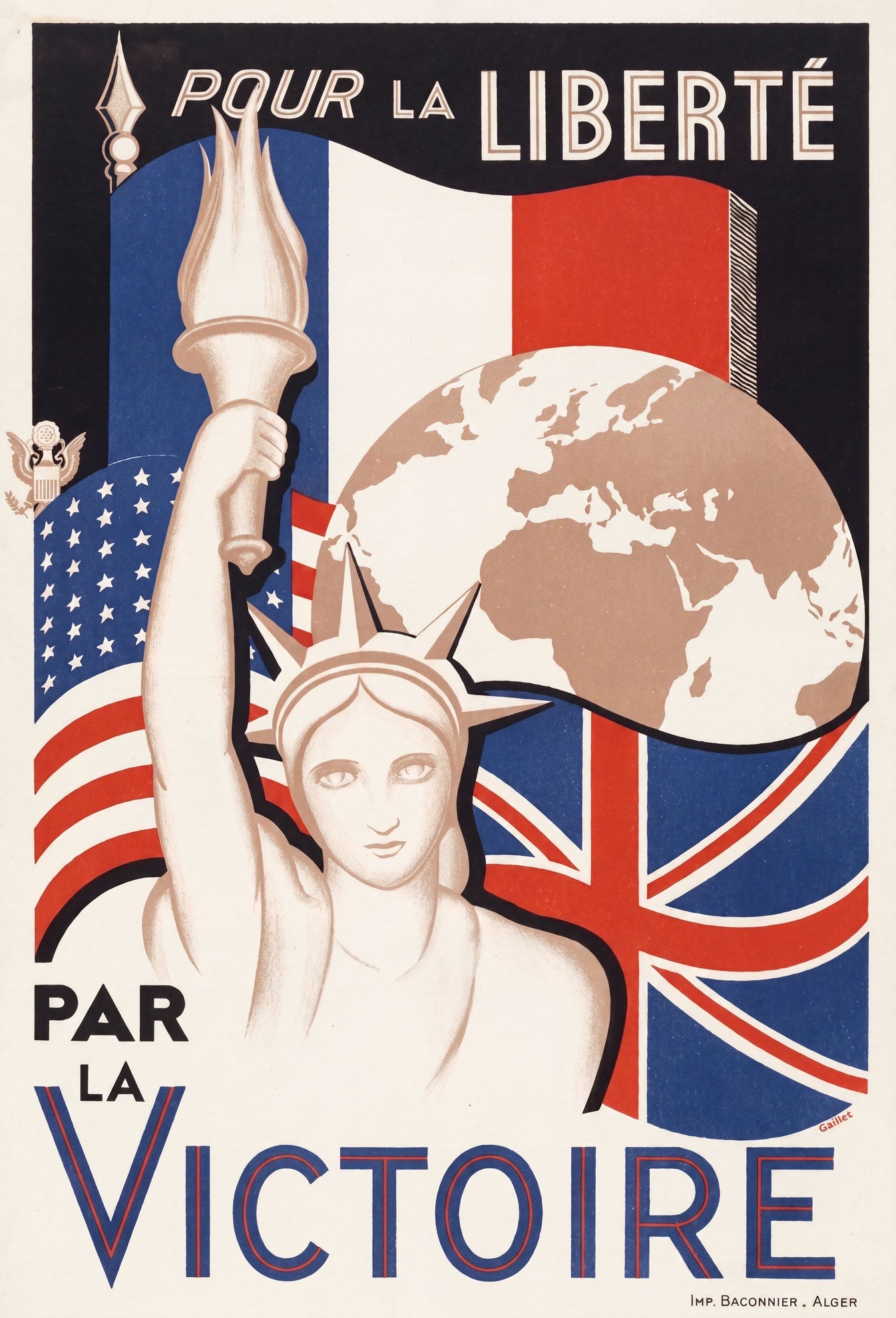
The Statue of Liberty occupies the centre of this 1943 Allied propaganda poster, torch raised, the flags of France, the United States, and Great Britain layered behind her in bold, flat colour. A globe fills the upper right quadrant, its continents rendered in tan against cream. The typography is unambiguous: 'Pour la LIBERTÉ' across the black sky above, 'PAR LA VICTOIRE' in large cobalt inline capitals below, the word VICTOIRE spanning almost the full width of the composition.
Designed by Gaillet and printed by the Imprimerie Baconnier in Algiers, this poster dates to 1943, the year Algiers became the operational centre of the French Committee of National Liberation. The Baconnier printing house had been producing work of this scale since the 1890s, and its wartime output served the Allied communication effort across French North Africa. The three-flag composition is a direct visual argument: France, the United States, and the United Kingdom standing together, with the Statue of Liberty as the shared emblem of the alliance, a figure that belonged to both nations by history and by gift.
Gaillet's approach is restrained for wartime propaganda. The Liberty figure is classical and deliberate, the palette limited to five tones, the layout governed by a clear vertical axis. Where British and American wartime posters of the period used photographic urgency or aggressive text-first design, this poster is composed more like a commemorative broadside, the flat graphic language of Art Deco still present in the streamlined figures and the clean geometric typography.
Reproduced from the archival source as a fine art print on 200gsm Enhanced Matte Fine Art Paper. A natural choice for those drawn to the graphic history of the Second World War or the poster tradition of French North Africa.
Couldn't load pickup availability
Share
The Statue of Liberty occupies the centre of this 1943 Allied propaganda poster, torch raised, the flags of France, the United States, and Great Britain layered behind her in bold, flat colour. A globe fills the upper right quadrant, its continents rendered in tan against cream. The typography is unambiguous: 'Pour la LIBERTÉ' across the black sky above, 'PAR LA VICTOIRE' in large cobalt inline capitals below, the word VICTOIRE spanning almost the full width of the composition.
Designed by Gaillet and printed by the Imprimerie Baconnier in Algiers, this poster dates to 1943, the year Algiers became the operational centre of the French Committee of National Liberation. The Baconnier printing house had been producing work of this scale since the 1890s, and its wartime output served the Allied communication effort across French North Africa. The three-flag composition is a direct visual argument: France, the United States, and the United Kingdom standing together, with the Statue of Liberty as the shared emblem of the alliance, a figure that belonged to both nations by history and by gift.
Gaillet's approach is restrained for wartime propaganda. The Liberty figure is classical and deliberate, the palette limited to five tones, the layout governed by a clear vertical axis. Where British and American wartime posters of the period used photographic urgency or aggressive text-first design, this poster is composed more like a commemorative broadside, the flat graphic language of Art Deco still present in the streamlined figures and the clean geometric typography.
Reproduced from the archival source as a fine art print on 200gsm Enhanced Matte Fine Art Paper. A natural choice for those drawn to the graphic history of the Second World War or the poster tradition of French North Africa.
