Vintage Poster Archives
WW1 US Marines Recruitment 1914–18 | Admiral Dewey
This service is currently unavailable,
sorry for the inconvenience.
Pair it with a frame
Frame options are for visualization purposes only.
FRAME STYLE
MATTING SIZE
BUILDING YOUR EXPERIENCE
powered by Blankwall
Take a few steps back and let your camera see more of the scene.
powered by Blankwall
Was this experience helpful?
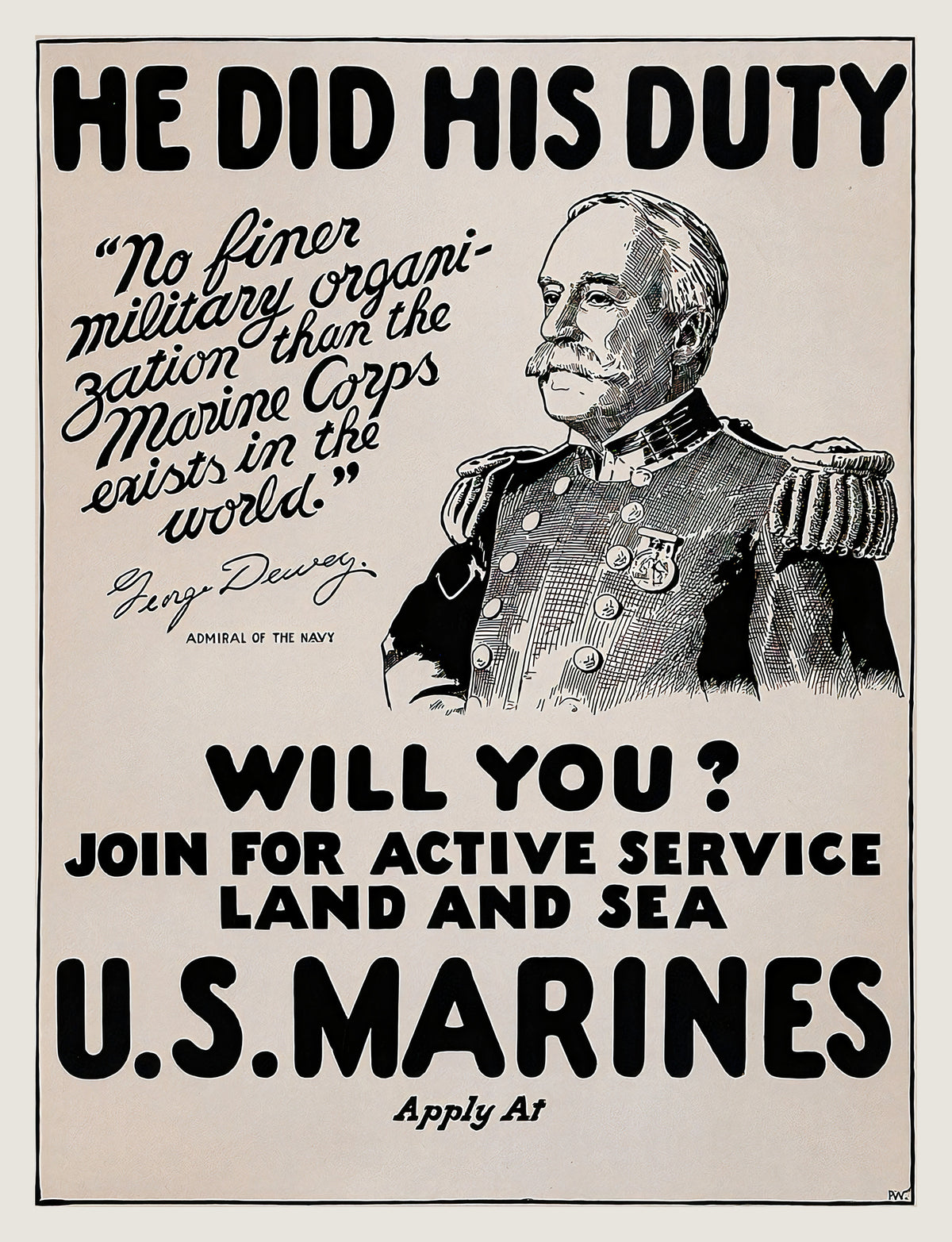
A half-length portrait of Admiral George Dewey, rendered in the engraved illustration style favoured by American government printers, anchors the right side of the composition. He faces left in three-quarter view, his dress uniform heavy with medals and epaulettes. To his left, a flowing italic script carries his endorsement: 'No finer military organization than the Marine Corps exists in the world.' His facsimile signature follows, with his rank, 'ADMIRAL OF THE NAVY', set in spaced capitals beneath. Bold condensed headlines frame the portrait above and below, the lower third dominated by the large slab-serif 'U.S. MARINES.' The palette is uncompromising: black on cream, no colour, no ornament beyond a ruled border and the initials 'PW' at the lower right.
Produced for the United States Marine Corps between 1914 and 1918, the poster is catalogued at the Library of Congress (POS-WWI-US no.94), held in the National Archives (NARA 512468), and documented in the Smithsonian Institution's Princeton University Poster Collection. Dewey (1837–1917) was the only person ever to hold the rank of Admiral of the Navy: his 1898 victory at the Battle of Manila Bay had made him a national hero two decades before this poster was printed. His endorsement was not decorative, it was a deliberate deployment of one of the most recognised military figures of the age at a moment when the Marine Corps was actively expanding its ranks for the Western Front.
The design belongs to the tradition of American lithographic recruitment work characterised by engraved portraiture, high-contrast two-tone printing, and condensed display type, a style produced at scale by the U.S. government printing apparatus across 1914–1918. The absence of colour is itself a statement: this is not a persuasive appeal to sentiment, but a direct address, backed by named authority.
This archival print is reproduced on 200gsm Enhanced Matte Fine Art Paper using pigment-based inks. It sits naturally in a study, a reading room, or alongside other WW1-era graphic material.
Couldn't load pickup availability
Share
A half-length portrait of Admiral George Dewey, rendered in the engraved illustration style favoured by American government printers, anchors the right side of the composition. He faces left in three-quarter view, his dress uniform heavy with medals and epaulettes. To his left, a flowing italic script carries his endorsement: 'No finer military organization than the Marine Corps exists in the world.' His facsimile signature follows, with his rank, 'ADMIRAL OF THE NAVY', set in spaced capitals beneath. Bold condensed headlines frame the portrait above and below, the lower third dominated by the large slab-serif 'U.S. MARINES.' The palette is uncompromising: black on cream, no colour, no ornament beyond a ruled border and the initials 'PW' at the lower right.
Produced for the United States Marine Corps between 1914 and 1918, the poster is catalogued at the Library of Congress (POS-WWI-US no.94), held in the National Archives (NARA 512468), and documented in the Smithsonian Institution's Princeton University Poster Collection. Dewey (1837–1917) was the only person ever to hold the rank of Admiral of the Navy: his 1898 victory at the Battle of Manila Bay had made him a national hero two decades before this poster was printed. His endorsement was not decorative, it was a deliberate deployment of one of the most recognised military figures of the age at a moment when the Marine Corps was actively expanding its ranks for the Western Front.
The design belongs to the tradition of American lithographic recruitment work characterised by engraved portraiture, high-contrast two-tone printing, and condensed display type, a style produced at scale by the U.S. government printing apparatus across 1914–1918. The absence of colour is itself a statement: this is not a persuasive appeal to sentiment, but a direct address, backed by named authority.
This archival print is reproduced on 200gsm Enhanced Matte Fine Art Paper using pigment-based inks. It sits naturally in a study, a reading room, or alongside other WW1-era graphic material.
