Vintage Poster Archives
Würbel Berlin 1936 Olympics | Jeux Olympiques Poster
This service is currently unavailable,
sorry for the inconvenience.
Pair it with a frame
Frame options are for visualization purposes only.
FRAME STYLE
MATTING SIZE
BUILDING YOUR EXPERIENCE
powered by Blankwall
Take a few steps back and let your camera see more of the scene.
powered by Blankwall
Was this experience helpful?
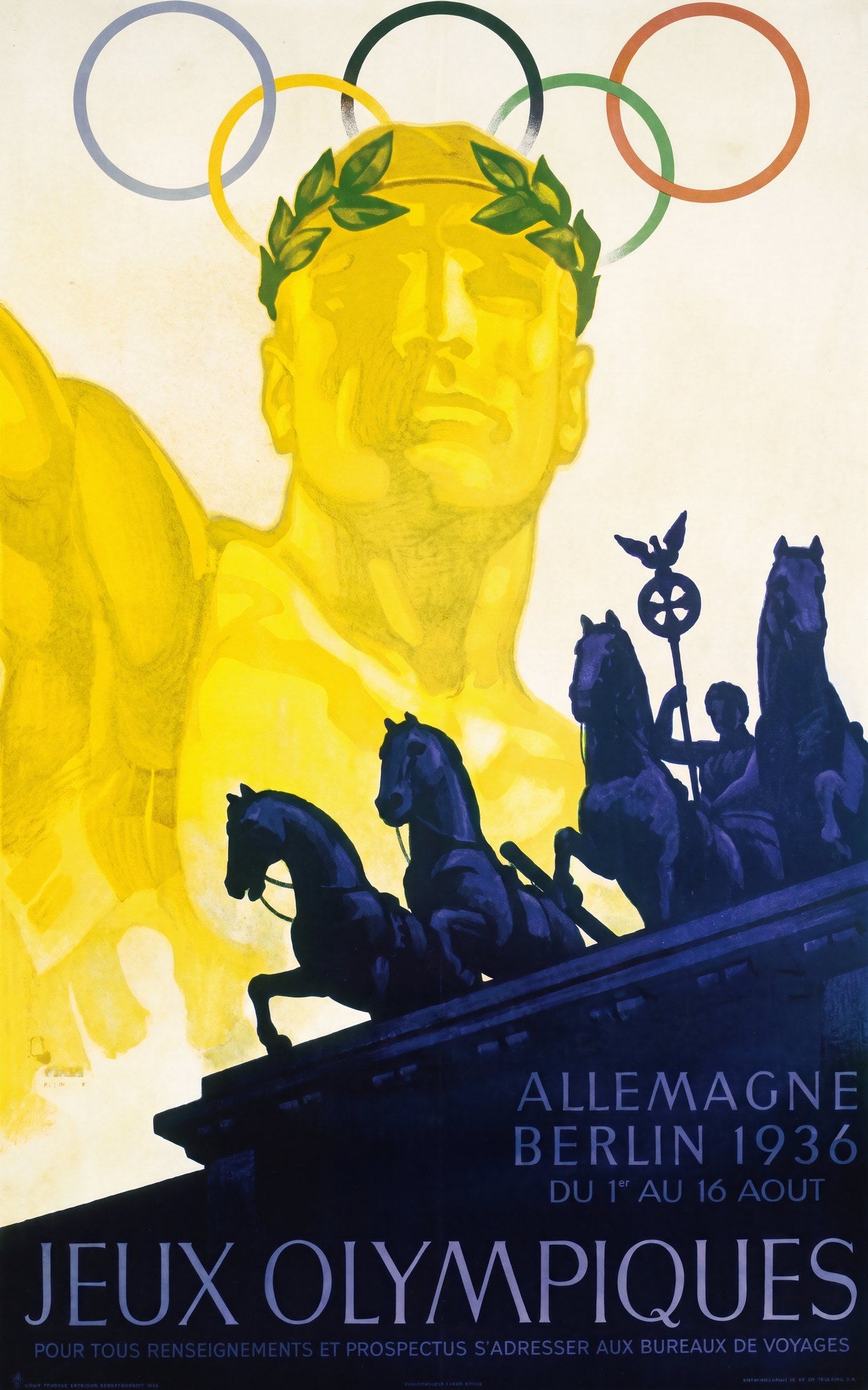
A golden classical athlete, laurel-crowned, rises across the upper half of the composition, rendered in warm yellow washes against an ivory ground. The five Olympic rings arc behind him in their canonical colours. Below, the Brandenburg Gate Quadriga, Schadow's charioteer driving four horses in deep navy silhouette, fills the foreground in bold upward diagonal. French text announces the Games: ALLEMAGNE / BERLIN 1936 / DU 1er AU 16 AOUT, with JEUX OLYMPIQUES set in large condensed sans-serif across the base.
Designed by Franz Würbel and published in 1936 by the Reichsbahnzentrale für den Deutschen Reiseverkehr alongside the Propaganda Committee for the Olympic Games, this French-language version was one of 243,000 copies printed across 19 languages and distributed in 34 countries. The V&A holds a copy in its Prints and Drawings Study Room, reattributed to Würbel following the 1937 official Games report. Margaret Timmers' A Century of Olympic Posters (V&A Publishing, 2008) records it as among the most consequential Olympic poster designs of the century, noted for meeting three objectives simultaneously: communicating the Olympiad's scale, fixing Berlin as host city, and functioning across language editions through a composition of purely visual authority.
The design sits at the intersection of Art Deco graphic economy and classical figurative tradition. The two-tone colour field, the silhouetted Quadriga against the luminous gold athlete, and the high-contrast text block gave the poster a visual legibility that held at street scale and at print scale alike. Printed in the medium of colour lithograph on paper approximately 101 x 64 cm, it remains the defining illustration of the XI Olympiad.
Reproduced as a fine art archival print on 200gsm Enhanced Matte Fine Art Paper, the saturated navy and warm gold of the original lithograph are faithfully restored. Collectors of Olympic history, enthusiasts of 1930s German graphic design, and those drawn to Berlin's cultural heritage each find their own entry point into this design.
Couldn't load pickup availability
Share
A golden classical athlete, laurel-crowned, rises across the upper half of the composition, rendered in warm yellow washes against an ivory ground. The five Olympic rings arc behind him in their canonical colours. Below, the Brandenburg Gate Quadriga, Schadow's charioteer driving four horses in deep navy silhouette, fills the foreground in bold upward diagonal. French text announces the Games: ALLEMAGNE / BERLIN 1936 / DU 1er AU 16 AOUT, with JEUX OLYMPIQUES set in large condensed sans-serif across the base.
Designed by Franz Würbel and published in 1936 by the Reichsbahnzentrale für den Deutschen Reiseverkehr alongside the Propaganda Committee for the Olympic Games, this French-language version was one of 243,000 copies printed across 19 languages and distributed in 34 countries. The V&A holds a copy in its Prints and Drawings Study Room, reattributed to Würbel following the 1937 official Games report. Margaret Timmers' A Century of Olympic Posters (V&A Publishing, 2008) records it as among the most consequential Olympic poster designs of the century, noted for meeting three objectives simultaneously: communicating the Olympiad's scale, fixing Berlin as host city, and functioning across language editions through a composition of purely visual authority.
The design sits at the intersection of Art Deco graphic economy and classical figurative tradition. The two-tone colour field, the silhouetted Quadriga against the luminous gold athlete, and the high-contrast text block gave the poster a visual legibility that held at street scale and at print scale alike. Printed in the medium of colour lithograph on paper approximately 101 x 64 cm, it remains the defining illustration of the XI Olympiad.
Reproduced as a fine art archival print on 200gsm Enhanced Matte Fine Art Paper, the saturated navy and warm gold of the original lithograph are faithfully restored. Collectors of Olympic history, enthusiasts of 1930s German graphic design, and those drawn to Berlin's cultural heritage each find their own entry point into this design.
