Vintage Poster Archives
Toulouse-Lautrec Bruant 1892 | Ambassadeurs Poster
This service is currently unavailable,
sorry for the inconvenience.
Pair it with a frame
Frame options are for visualization purposes only.
FRAME STYLE
MATTING SIZE
BUILDING YOUR EXPERIENCE
powered by Blankwall
Take a few steps back and let your camera see more of the scene.
powered by Blankwall
Was this experience helpful?
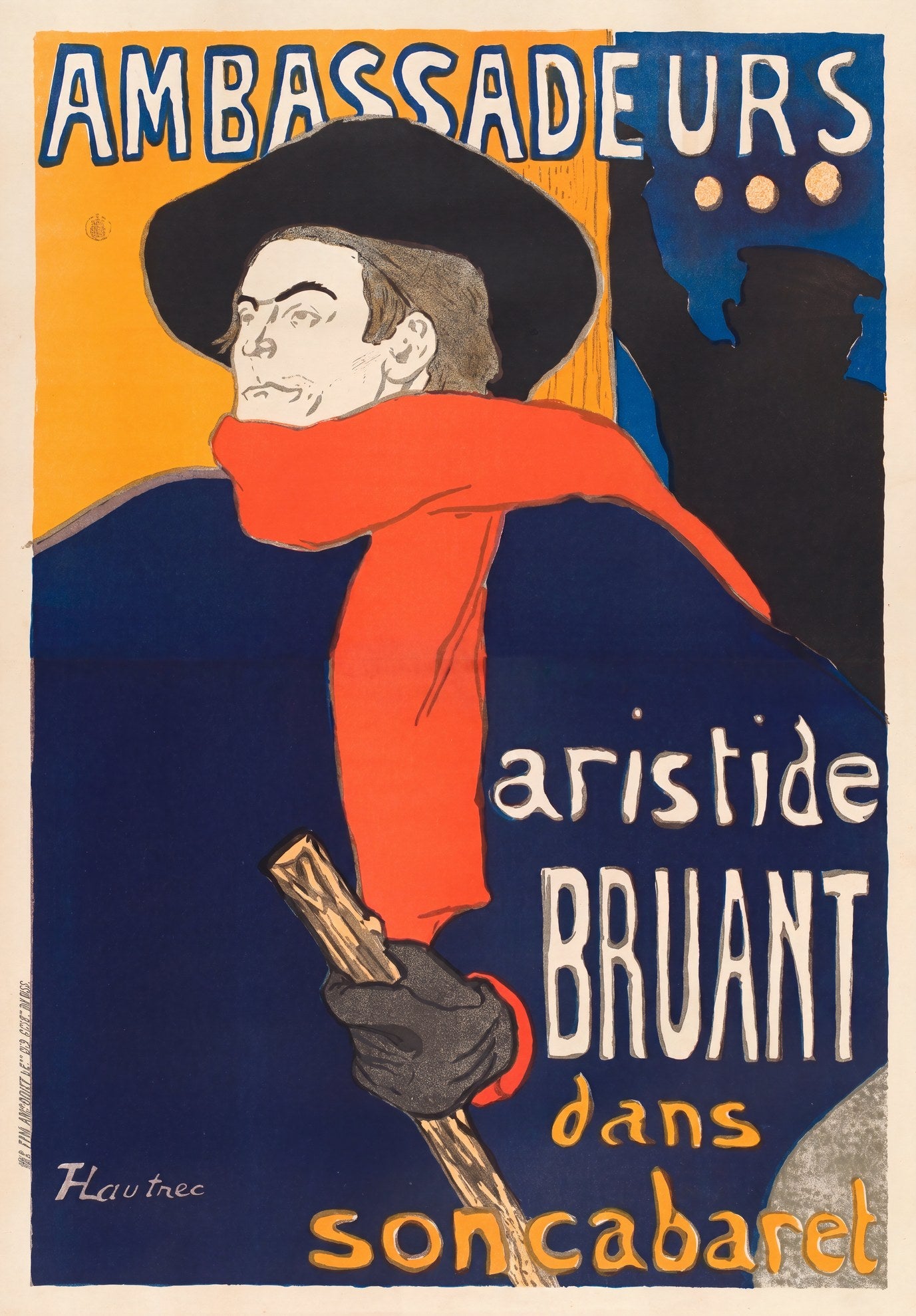
Aristide Bruant occupies the foreground in three-quarter bust: black wide-brimmed hat, navy cape, and the scarlet red scarf that had become his stage identity across Montmartre. Behind him, a bold black silhouette arm rises against a cobalt blue background; to his left, the field is cadmium orange-yellow. Five flat colours, almost no tonal modelling, hand-lettered type woven directly into the composition. The white compressed caps of AMBASSADEURS run across the top; BRUANT sits in large bold white below; the orange script of 'aristide' and 'dans son cabaret' completes the typographic structure. Lautrec signed the lower left in his characteristic abbreviated hand.
Commissioned by Bruant personally for his debut at the Ambassadeurs on the Champs-Élysées in June 1892, the poster met immediate resistance from the club's director, who reportedly refused to display it. Bruant's response was unequivocal: no poster, no performance. The director relented. The design was pasted across Paris and mounted on the proscenium arch itself. Toulouse-Lautrec (1864–1901) was working at the peak of his poster output, bringing the Japanese ukiyo-e influence, flat colour areas, strong outline, asymmetric cropping, into the commercial lithograph. The five-colour impression on wove paper is catalogued as Delteil 343 and held in the permanent collections of the Metropolitan Museum of Art, the Art Institute of Chicago, and the V&A.
This reproduction is printed on 200gsm Enhanced Matte Fine Art Paper. The matte surface reads well in natural and gallery light and holds the lithographic palette cleanly, from the deep navy of the cape to the saturated orange of the background field. A natural fit for a study, reading room, or dining space where graphic design history earns its place on the wall.
Couldn't load pickup availability
Share
Aristide Bruant occupies the foreground in three-quarter bust: black wide-brimmed hat, navy cape, and the scarlet red scarf that had become his stage identity across Montmartre. Behind him, a bold black silhouette arm rises against a cobalt blue background; to his left, the field is cadmium orange-yellow. Five flat colours, almost no tonal modelling, hand-lettered type woven directly into the composition. The white compressed caps of AMBASSADEURS run across the top; BRUANT sits in large bold white below; the orange script of 'aristide' and 'dans son cabaret' completes the typographic structure. Lautrec signed the lower left in his characteristic abbreviated hand.
Commissioned by Bruant personally for his debut at the Ambassadeurs on the Champs-Élysées in June 1892, the poster met immediate resistance from the club's director, who reportedly refused to display it. Bruant's response was unequivocal: no poster, no performance. The director relented. The design was pasted across Paris and mounted on the proscenium arch itself. Toulouse-Lautrec (1864–1901) was working at the peak of his poster output, bringing the Japanese ukiyo-e influence, flat colour areas, strong outline, asymmetric cropping, into the commercial lithograph. The five-colour impression on wove paper is catalogued as Delteil 343 and held in the permanent collections of the Metropolitan Museum of Art, the Art Institute of Chicago, and the V&A.
This reproduction is printed on 200gsm Enhanced Matte Fine Art Paper. The matte surface reads well in natural and gallery light and holds the lithographic palette cleanly, from the deep navy of the cape to the saturated orange of the background field. A natural fit for a study, reading room, or dining space where graphic design history earns its place on the wall.
