Vintage Poster Archives
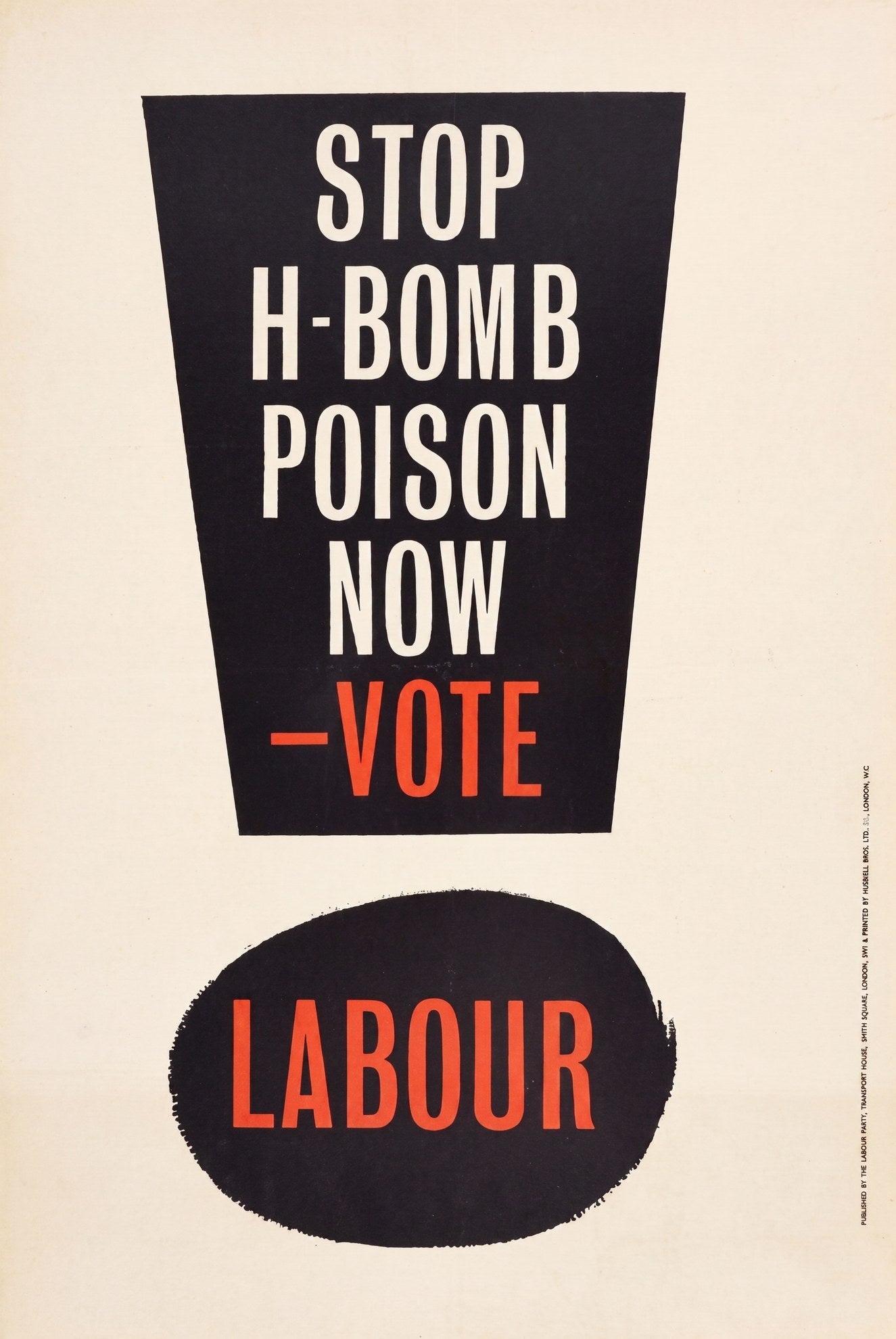
Stop H-Bomb Poison 1959 | Labour Party Election Poster
This service is currently unavailable,
sorry for the inconvenience.
Pair it with a frame
Frame options are for visualization purposes only.
FRAME STYLE
MATTING SIZE
BUILDING YOUR EXPERIENCE
powered by Blankwall
Take a few steps back and let your camera see more of the scene.
powered by Blankwall
Was this experience helpful?
A black shield demanding nuclear disarmament in stark white typography. Commissioned by the Labour Party for the 1959 General Election, when the hydrogen bomb dominated British political discourse and mass protests demanded unilateral disarmament.
Printed by Weddell Bros Ltd during the height of Cold War tensions, when the Campaign for Nuclear Disarmament organised marches drawing tens of thousands from Aldermaston to London. The high-contrast design reflects the stark political choice between nuclear escalation and peace.
The poster depicts Labour's positioning as the anti-nuclear alternative to Conservative defence policy, when Hugh Gaitskell's party campaigned on nuclear disarmament before the realities of electoral defeat reshaped their stance. The typography strips the message to its core urgency.
A document of the moment when nuclear policy became a mass political issue, restored from archival sources as an archival print on 200gsm Enhanced Matte Fine Art Paper.
Couldn't load pickup availability
Share
A black shield demanding nuclear disarmament in stark white typography. Commissioned by the Labour Party for the 1959 General Election, when the hydrogen bomb dominated British political discourse and mass protests demanded unilateral disarmament.
Printed by Weddell Bros Ltd during the height of Cold War tensions, when the Campaign for Nuclear Disarmament organised marches drawing tens of thousands from Aldermaston to London. The high-contrast design reflects the stark political choice between nuclear escalation and peace.
The poster depicts Labour's positioning as the anti-nuclear alternative to Conservative defence policy, when Hugh Gaitskell's party campaigned on nuclear disarmament before the realities of electoral defeat reshaped their stance. The typography strips the message to its core urgency.
A document of the moment when nuclear policy became a mass political issue, restored from archival sources as an archival print on 200gsm Enhanced Matte Fine Art Paper.
