Vintage Poster Archives
Soviet Propaganda Poster 1959 | Kokorekin Metallurgists
This service is currently unavailable,
sorry for the inconvenience.
Pair it with a frame
Frame options are for visualization purposes only.
FRAME STYLE
MATTING SIZE
BUILDING YOUR EXPERIENCE
powered by Blankwall
Take a few steps back and let your camera see more of the scene.
powered by Blankwall
Was this experience helpful?
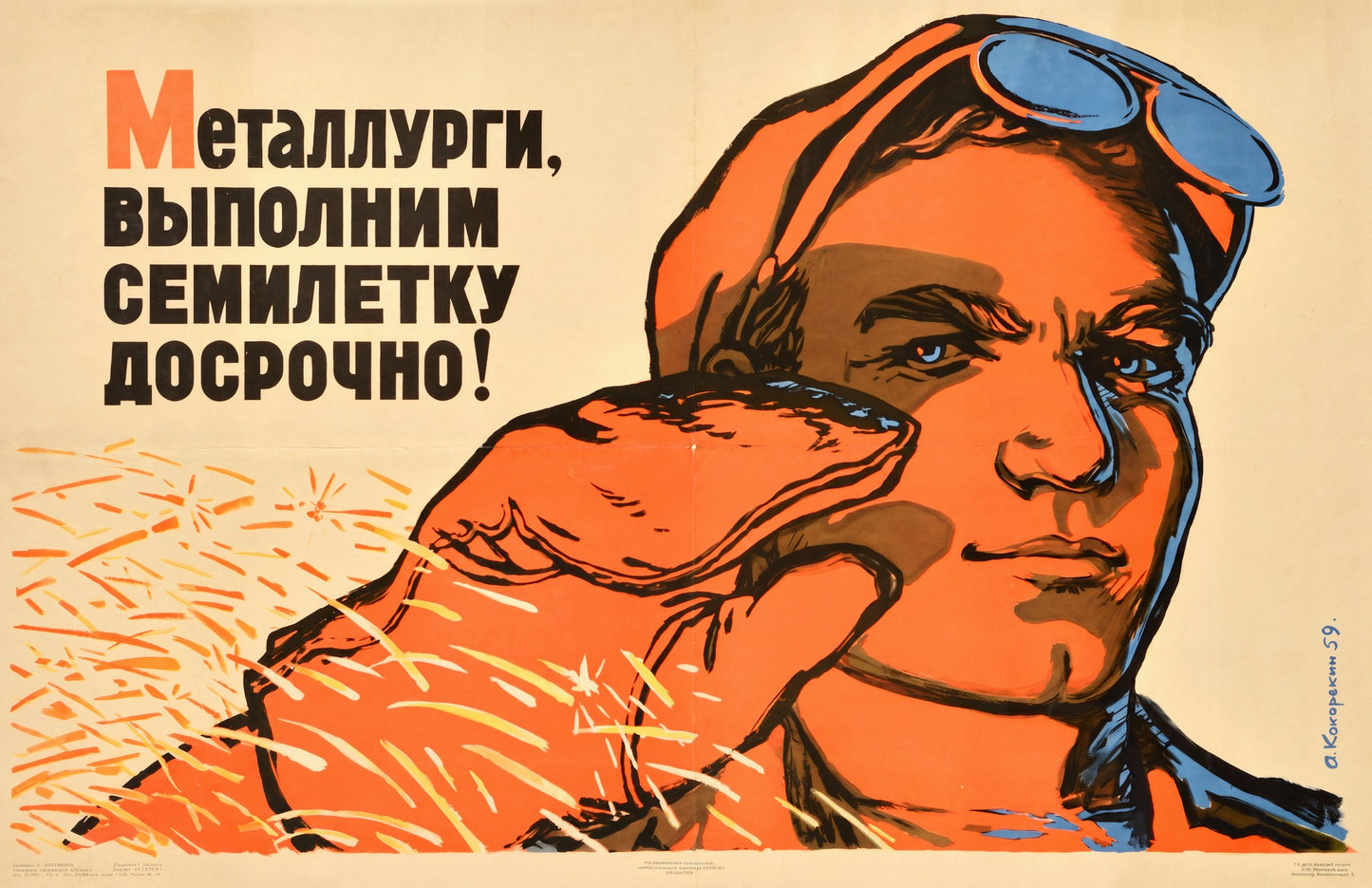
A metallurgist in a leather work glove fills the right half of the composition, viewed from below, blue welding goggles pushed up on his forehead. Burnt-orange fills, modelled with dark brown shadow, render the figure against a cream ground. Yellow-orange sparks scatter across the lower left, the only kinetic element in an otherwise contained design. Bold black Cyrillic sans-serif declares across the upper left: "Металлурги, выполним семилетку досрочно!", Metallurgists, let us fulfil the Seven-Year Plan ahead of schedule! The opening capital М is printed in coral-red, the sole colour break in the typographic block.
Aleksei Alekseevich Kokorekin (1906–1959) was among the most honoured Soviet poster artists of the mid-twentieth century, awarded the Stalin Prize twice: in 1946 for his wartime poster series and in 1949 for post-war graphic work. He contributed extensively to TASS Windows during the Second World War and continued as a leading figure in Soviet political poster design through the 1950s. This work, signed and dated 1959 in the lower right margin, was produced at the launch of Khrushchev's Seven-Year Plan (1959–1965), the economic programme introduced to replace the abandoned Sixth Five-Year Plan, with steel output targets that called on the USSR's metallurgical workforce directly. It is one of Kokorekin's final commissions: he died in Moscow on 29 December 1959.
The compositional strategy is characteristic of Kokorekin's mature work: a single worker at close range, low angle, direct gaze, the figure large enough to read across a factory or public space. The flat graphic palette and bold Cyrillic typography place it squarely in the Soviet poster tradition of the late 1950s, when Socialist Realism had absorbed some of the formal economy of earlier Constructivist design without abandoning its figurative heroics.
Reproduced from archival sources on 200gsm Enhanced Matte Fine Art Paper using the giclée process. Holds well in a study, office, or alongside mid-century graphic design collections.
Couldn't load pickup availability
Share
A metallurgist in a leather work glove fills the right half of the composition, viewed from below, blue welding goggles pushed up on his forehead. Burnt-orange fills, modelled with dark brown shadow, render the figure against a cream ground. Yellow-orange sparks scatter across the lower left, the only kinetic element in an otherwise contained design. Bold black Cyrillic sans-serif declares across the upper left: "Металлурги, выполним семилетку досрочно!", Metallurgists, let us fulfil the Seven-Year Plan ahead of schedule! The opening capital М is printed in coral-red, the sole colour break in the typographic block.
Aleksei Alekseevich Kokorekin (1906–1959) was among the most honoured Soviet poster artists of the mid-twentieth century, awarded the Stalin Prize twice: in 1946 for his wartime poster series and in 1949 for post-war graphic work. He contributed extensively to TASS Windows during the Second World War and continued as a leading figure in Soviet political poster design through the 1950s. This work, signed and dated 1959 in the lower right margin, was produced at the launch of Khrushchev's Seven-Year Plan (1959–1965), the economic programme introduced to replace the abandoned Sixth Five-Year Plan, with steel output targets that called on the USSR's metallurgical workforce directly. It is one of Kokorekin's final commissions: he died in Moscow on 29 December 1959.
The compositional strategy is characteristic of Kokorekin's mature work: a single worker at close range, low angle, direct gaze, the figure large enough to read across a factory or public space. The flat graphic palette and bold Cyrillic typography place it squarely in the Soviet poster tradition of the late 1950s, when Socialist Realism had absorbed some of the formal economy of earlier Constructivist design without abandoning its figurative heroics.
Reproduced from archival sources on 200gsm Enhanced Matte Fine Art Paper using the giclée process. Holds well in a study, office, or alongside mid-century graphic design collections.
