Vintage Poster Archives
Soviet Cold War 1959 | Protect Native Country Propaganda
Soviet Cold War 1959 | Protect Native Country Propaganda
Couldn't load pickup availability
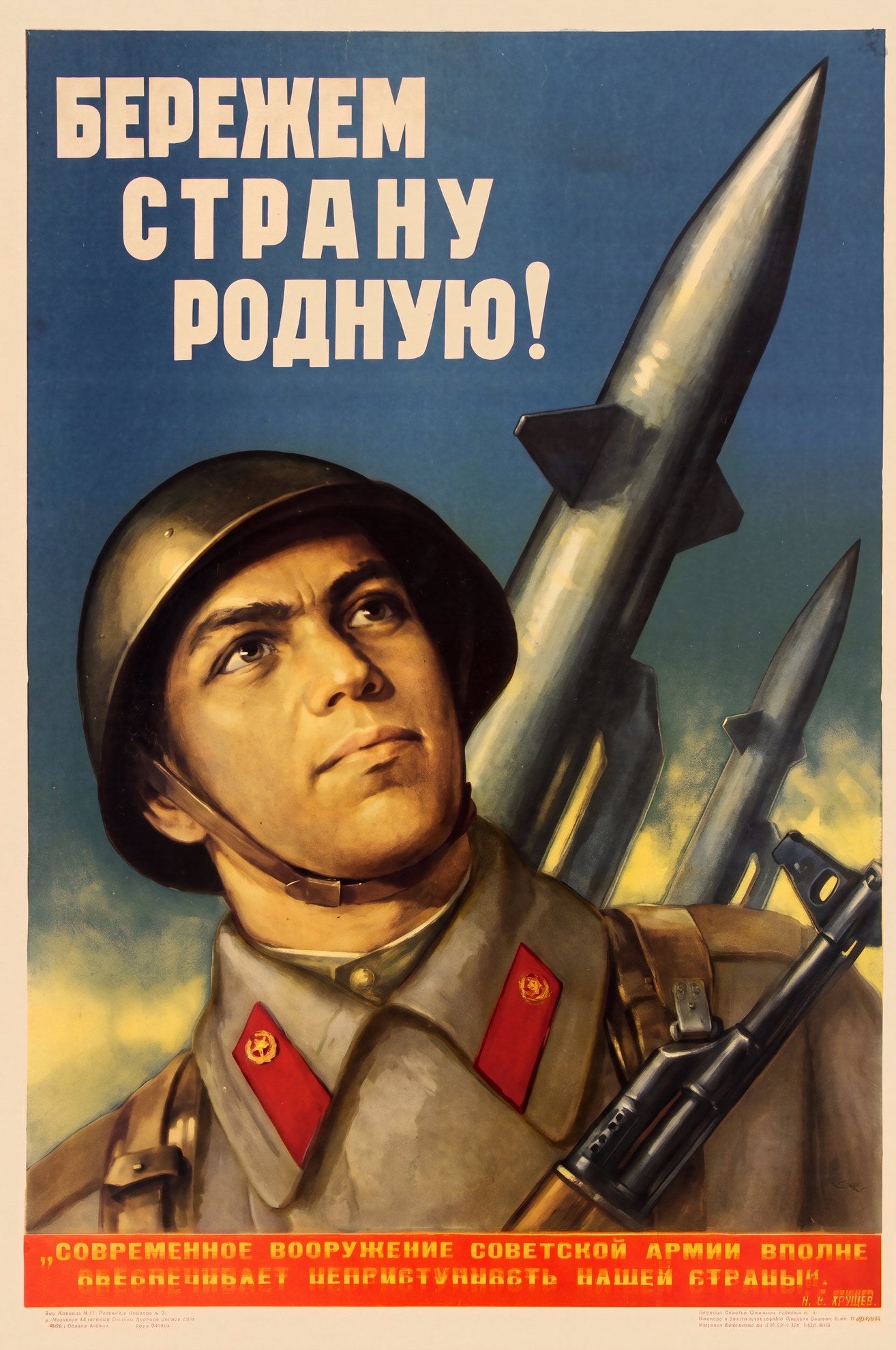
A helmeted Soviet soldier occupies the foreground, his gaze directed upward and to the left, his collar bearing the red tabs and gold star of the Red Army. Two ballistic missiles rise behind him through pale cloud, the larger centred against a steel-blue sky that grades to yellow-white at the horizon. The Cyrillic headline, БЕРЕЖЕМ СТРАНУ РОДНУЮ!, fills the upper third in white condensed block capitals. At the base, a red banner carries Khrushchev's own words in small caps: the modern weaponry of the Soviet Army fully ensures the inviolability of our country.
Produced c.1959–1960, almost certainly by Voenizdat, the USSR's principal military publishing house, this poster sits precisely at the moment when Soviet strategic communications shifted from infantry heroism to missile supremacy. Sputnik had flown in 1957. The R-7 ICBM was operational. Khrushchev's doctrine of nuclear deterrence through superior armament was the new state orthodoxy, and the poster maker's task was to make that doctrine visible to every Soviet citizen. The composition does that directly: one soldier, two missiles, one unambiguous quotation.
The style is late Socialist Realism, with the figure rendered in the high realist tradition of Soviet poster art from the 1950s. The missiles are treated as near-architectural objects, their smooth silver-grey forms contrasting with the painterly depth of the soldier's face and uniform. The palette is held to four tones: steel blue, olive khaki, cream white, and cadmium red, the same vocabulary used across the Voenizdat military poster series of this decade.
This restoration is reproduced on 200gsm Enhanced Matte Fine Art Paper, recovering the white headline type and the graduated sky from the archival source. The poster is a primary document of Cold War visual culture.