Vintage Poster Archives
Seefahrt ist Not 1935 | German Maritime Propaganda
This service is currently unavailable,
sorry for the inconvenience.
Pair it with a frame
Frame options are for visualization purposes only.
FRAME STYLE
MATTING SIZE
BUILDING YOUR EXPERIENCE
powered by Blankwall
Take a few steps back and let your camera see more of the scene.
powered by Blankwall
Was this experience helpful?
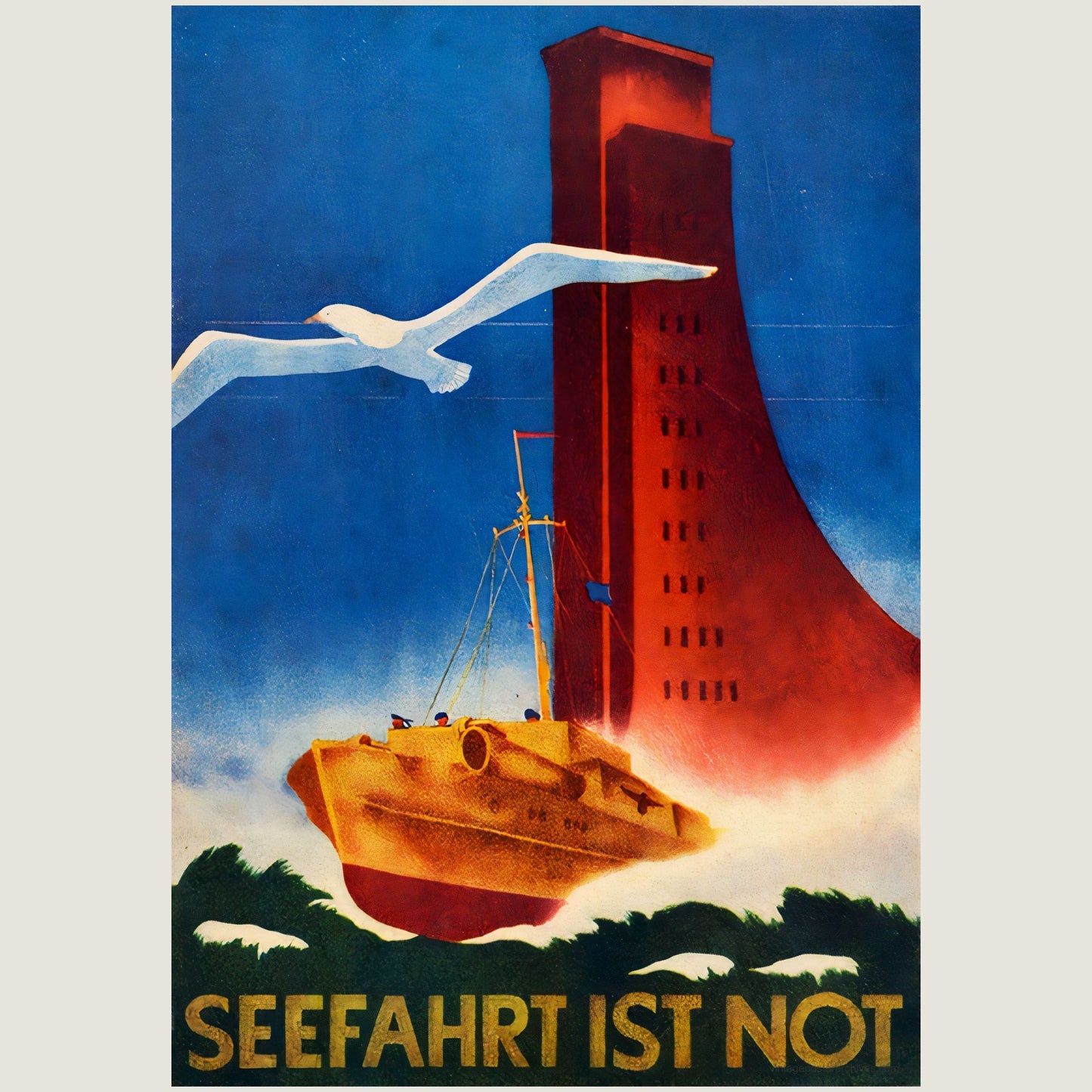
A towering red lighthouse dominates stormy blue waters as a German naval vessel cuts through white-capped waves. Above, a white seagull soars against the azure sky, while bold yellow lettering proclaims "SEEFAHRT IST NOT" in the Art Deco style of 1930s German design.
Commissioned for the Tag der deutschen Seefahrt campaign of May 25-26, 1935, this propaganda poster promoted Germany's maritime ambitions. The phrase "Seefahrt ist Not" originated from Johann Wilhelm Kinau's 1913 novel about North Sea fishermen but was adopted as a Nazi propaganda slogan emphasising naval necessity.
The composition employs classic propaganda techniques: the lighthouse as symbol of maritime strength, the ship representing naval capability. The Art Deco influence appears in the geometric forms, bold colour blocking, and streamlined typography characteristic of mid-1930s German graphic design.
This archival print depicts a significant moment in German maritime propaganda, when the regime built public support for naval expansion through visual messaging connecting national identity with sea power.
Couldn't load pickup availability
Share
A towering red lighthouse dominates stormy blue waters as a German naval vessel cuts through white-capped waves. Above, a white seagull soars against the azure sky, while bold yellow lettering proclaims "SEEFAHRT IST NOT" in the Art Deco style of 1930s German design.
Commissioned for the Tag der deutschen Seefahrt campaign of May 25-26, 1935, this propaganda poster promoted Germany's maritime ambitions. The phrase "Seefahrt ist Not" originated from Johann Wilhelm Kinau's 1913 novel about North Sea fishermen but was adopted as a Nazi propaganda slogan emphasising naval necessity.
The composition employs classic propaganda techniques: the lighthouse as symbol of maritime strength, the ship representing naval capability. The Art Deco influence appears in the geometric forms, bold colour blocking, and streamlined typography characteristic of mid-1930s German graphic design.
This archival print depicts a significant moment in German maritime propaganda, when the regime built public support for naval expansion through visual messaging connecting national identity with sea power.
