Vintage Poster Archives
Save Waste Fats for Explosives 1943 | Home Front Poster
This service is currently unavailable,
sorry for the inconvenience.
Pair it with a frame
Frame options are for visualization purposes only.
FRAME STYLE
MATTING SIZE
BUILDING YOUR EXPERIENCE
powered by Blankwall
Take a few steps back and let your camera see more of the scene.
powered by Blankwall
Was this experience helpful?
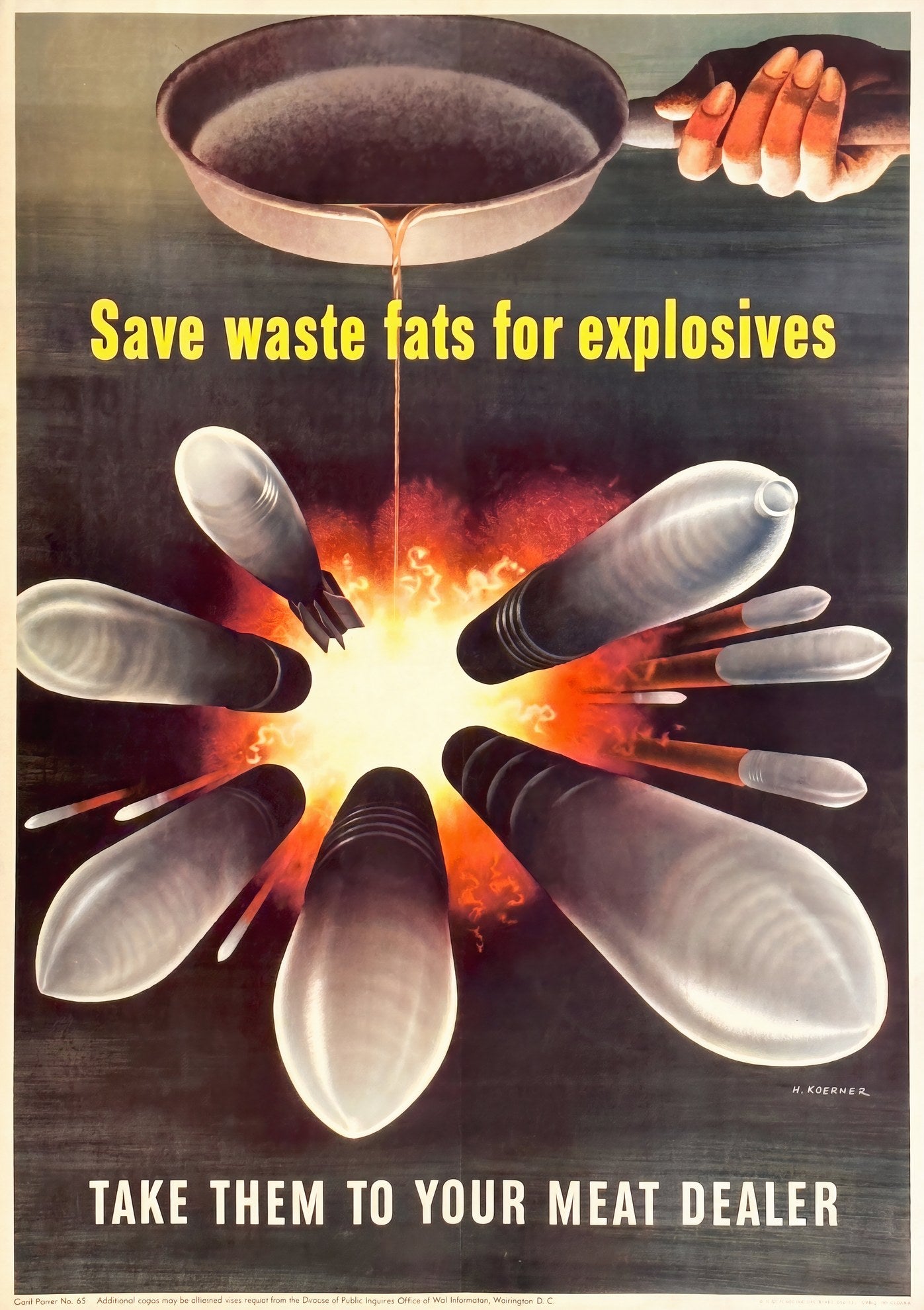
A hand grips a cast-iron skillet from the upper right and tilts it so cooking fat pours in a single thread toward the centre of the poster. Below, thirteen artillery shells and bombs converge tail-first on a white-orange explosion, the fat stream connecting directly to the blast. Yellow sans-serif type states the directive: 'Save waste fats for explosives.' A black footer band in white capitals adds the instruction: 'Take them to your meat dealer.'
Designed by Henry Koerner in 1943, the poster was commissioned by the US Office of War Information as part of the War Production Board's campaign to collect household cooking fats as a glycerin source for munitions. Koerner, born in Vienna in 1915, had trained in graphic design at Vienna's Graphische Lehr- und Versuchsanstalt before fleeing Austria after the 1938 Anschluss. Working in New York as a commercial artist, he produced several notable OWI posters before his later career as a painter and Time magazine cover artist. This design, OWI Poster No. 63, is held in the permanent collections of MoMA, the Imperial War Museum London, and the Intrepid Sea, Air & Space Museum.
The visual argument is set out with economy: one unbroken line from domestic kitchen to military ordnance. The War Production Board had begun urging American women to save waste cooking fats in 1942. By 1945, American households had contributed nearly 380 million pounds. The poster's graphic logic, a radial starburst of munitions fed by a domestic act, distils an entire mobilisation campaign into a single image.
Reproduced as an archival print on 200gsm Enhanced Matte Fine Art Paper using pigment-based inks, from a digitally restored source. A natural fit for anyone interested in the graphic design of wartime communication, mid-century American illustration, or the visual history of the home front.
Couldn't load pickup availability
Share
A hand grips a cast-iron skillet from the upper right and tilts it so cooking fat pours in a single thread toward the centre of the poster. Below, thirteen artillery shells and bombs converge tail-first on a white-orange explosion, the fat stream connecting directly to the blast. Yellow sans-serif type states the directive: 'Save waste fats for explosives.' A black footer band in white capitals adds the instruction: 'Take them to your meat dealer.'
Designed by Henry Koerner in 1943, the poster was commissioned by the US Office of War Information as part of the War Production Board's campaign to collect household cooking fats as a glycerin source for munitions. Koerner, born in Vienna in 1915, had trained in graphic design at Vienna's Graphische Lehr- und Versuchsanstalt before fleeing Austria after the 1938 Anschluss. Working in New York as a commercial artist, he produced several notable OWI posters before his later career as a painter and Time magazine cover artist. This design, OWI Poster No. 63, is held in the permanent collections of MoMA, the Imperial War Museum London, and the Intrepid Sea, Air & Space Museum.
The visual argument is set out with economy: one unbroken line from domestic kitchen to military ordnance. The War Production Board had begun urging American women to save waste cooking fats in 1942. By 1945, American households had contributed nearly 380 million pounds. The poster's graphic logic, a radial starburst of munitions fed by a domestic act, distils an entire mobilisation campaign into a single image.
Reproduced as an archival print on 200gsm Enhanced Matte Fine Art Paper using pigment-based inks, from a digitally restored source. A natural fit for anyone interested in the graphic design of wartime communication, mid-century American illustration, or the visual history of the home front.
