Vintage Poster Archives
RAF Recruitment c.1950 | British Propaganda Poster
RAF Recruitment c.1950 | British Propaganda Poster
Couldn't load pickup availability
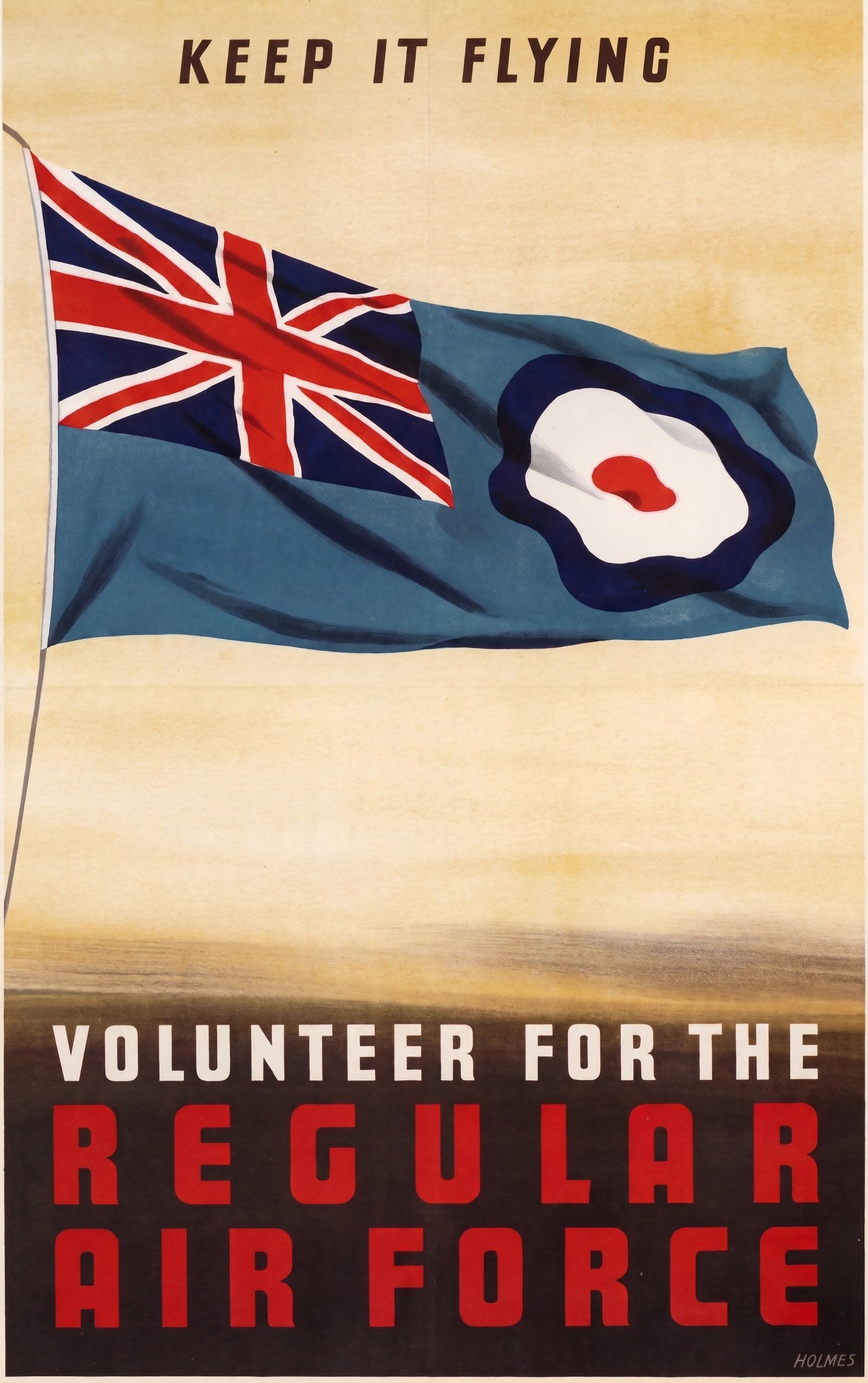
The RAF Ensign fills the upper two-thirds of this post-war British recruitment poster: pale blue ground, Union Jack canton, and the RAF roundel in full colour, the fabric rendered in smooth semi-realist shading with soft fold-shadows across the fly. Behind it, an amber-cream sky graduates toward a dark horizon. At the top, the slogan 'KEEP IT FLYING' in spaced condensed dark type; at the base, the call 'VOLUNTEER FOR THE REGULAR AIR FORCE' in white and oversized red condensed capitals across a near-black band. The artist signs simply as HOLMES in the lower-right corner.
Designed for the Royal Air Force in the late 1940s or early 1950s, the poster belongs to the post-demobilisation recruitment campaign, when the service was rebuilding its peacetime regular establishment after the rapid draw-down of wartime personnel. The word 'REGULAR', set at three times the scale of the surrounding words, was deliberate: it distinguished the permanent career RAF from the National Service conscription that ran concurrently until 1960. The focus on the Ensign rather than on aircraft or combat situations marks a shift toward institutional identity and continuity of service.
The design sits within a consistent strand of British official graphic communication in the late 1940s, characterised by clean central composition, a single dominant motif, and typographic hierarchy doing the rhetorical work. Robin Day's 1948 'They Rely on Me in the RAF' lithograph and several Tom Eckersley pieces from the same period share the same restraint. Holmes's composition, flag, sky, and type, nothing else, is among the more pared-back of the series.
Reproduced from an archival source as a fine art print on 200gsm Enhanced Matte Fine Art Paper. A concise document of British post-war public communication design, and of the moment the RAF began presenting itself as a peacetime career rather than a wartime obligation.