Vintage Poster Archives
Panorama Nova-Zembla 1896 | Dutch Arctic Exhibition Poster
This service is currently unavailable,
sorry for the inconvenience.
Pair it with a frame
Frame options are for visualization purposes only.
FRAME STYLE
MATTING SIZE
BUILDING YOUR EXPERIENCE
powered by Blankwall
Take a few steps back and let your camera see more of the scene.
powered by Blankwall
Was this experience helpful?
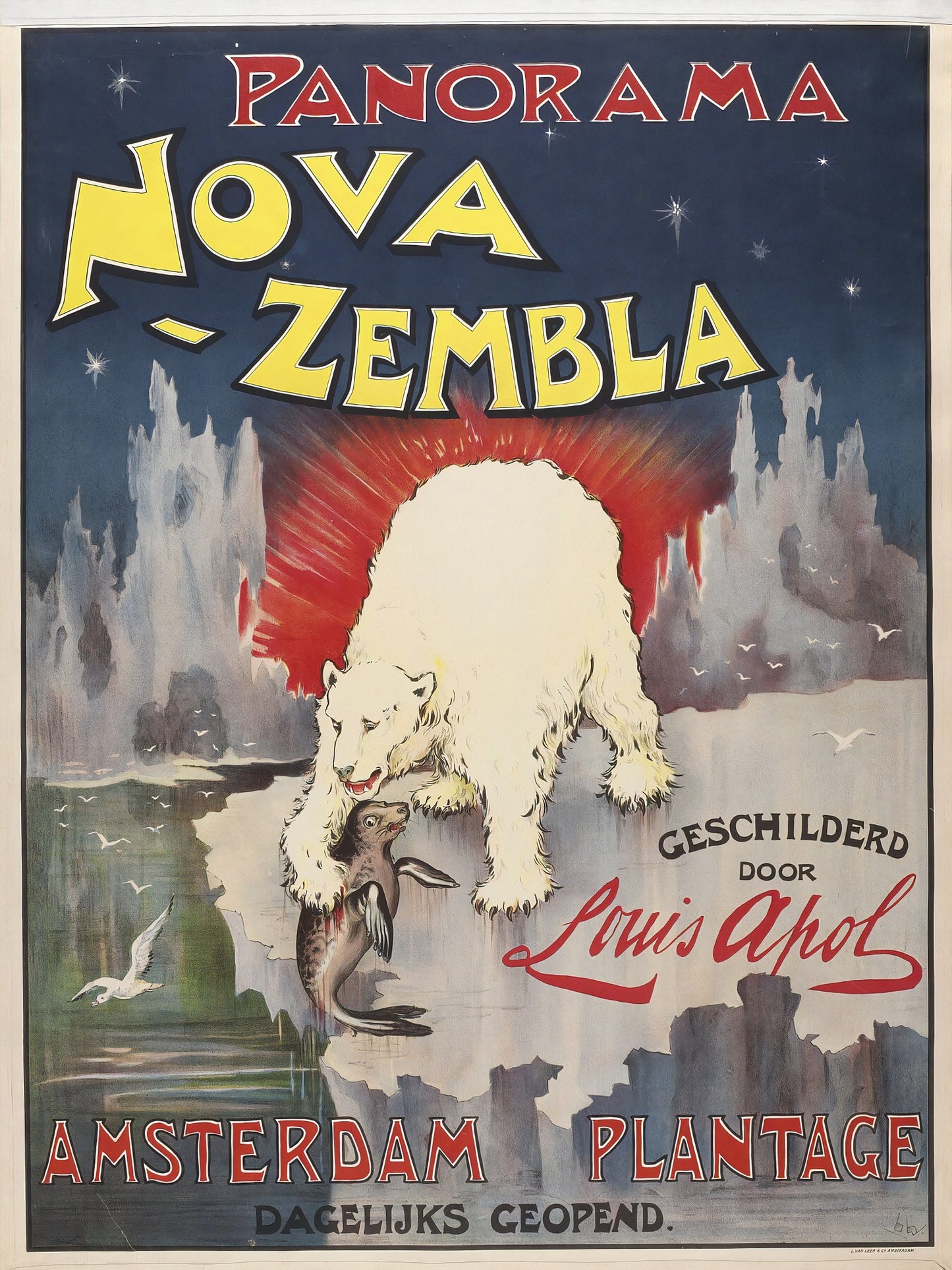
A white polar bear, rendered in thick fur-like strokes, bears down on a seal against a radiating burst of cadmium red, with grey-green arctic ice formations rising on either side under a deep navy sky. The yellow shadow-lettered title 'NOVA-ZEMBLA' dominates the upper field; below, 'AMSTERDAM PLANTAGE' in bold red serif announces the venue, and a flowing red script names the painter: Louis Apol.
This lithograph was produced to advertise Louis Apol's cyclorama of Nova Zembla, exhibited at the Panorama building on the Plantage Middenlaan in Amsterdam from 1896. Apol (1850–1936), the leading Dutch winter-landscape painter of the Hague School, had sailed to the Arctic archipelago in 1880 aboard the polar schooner Willem Barents, spending four months producing more than 200 sketches and watercolours. Sixteen years later, he translated those studies into a panoramic painting measuring 120 metres long and 14 metres high, a direct rival to Mesdag's celebrated Panorama in The Hague. The poster is attributed by the Rijksmuseum (RP-P-1912-2384) to Bernard Willem Wierink (1856–1939), and printed by L. van Leer & Co., Amsterdam.
Apol's panorama drew audiences throughout its run before disappearing around 1930 and is now considered lost. This advertising lithograph, held at the Rijksmuseum and in Dutch auction records, is among the few visual records of the exhibition that survive. The 2019 photographic reconstruction at the Panorama Mesdag in The Hague, built from the eight surviving photographs of the work, underlines what was at stake when the painting vanished.
The poster's flat colour fields, predatory central scene, and hand-lettered display typography sit comfortably within Dutch Belle Époque graphic production of the 1890s. It resonates with those who collect polar exploration material, Dutch graphic art of the Hague School era, or the broader 19th-century panorama tradition.
Couldn't load pickup availability
Share
A white polar bear, rendered in thick fur-like strokes, bears down on a seal against a radiating burst of cadmium red, with grey-green arctic ice formations rising on either side under a deep navy sky. The yellow shadow-lettered title 'NOVA-ZEMBLA' dominates the upper field; below, 'AMSTERDAM PLANTAGE' in bold red serif announces the venue, and a flowing red script names the painter: Louis Apol.
This lithograph was produced to advertise Louis Apol's cyclorama of Nova Zembla, exhibited at the Panorama building on the Plantage Middenlaan in Amsterdam from 1896. Apol (1850–1936), the leading Dutch winter-landscape painter of the Hague School, had sailed to the Arctic archipelago in 1880 aboard the polar schooner Willem Barents, spending four months producing more than 200 sketches and watercolours. Sixteen years later, he translated those studies into a panoramic painting measuring 120 metres long and 14 metres high, a direct rival to Mesdag's celebrated Panorama in The Hague. The poster is attributed by the Rijksmuseum (RP-P-1912-2384) to Bernard Willem Wierink (1856–1939), and printed by L. van Leer & Co., Amsterdam.
Apol's panorama drew audiences throughout its run before disappearing around 1930 and is now considered lost. This advertising lithograph, held at the Rijksmuseum and in Dutch auction records, is among the few visual records of the exhibition that survive. The 2019 photographic reconstruction at the Panorama Mesdag in The Hague, built from the eight surviving photographs of the work, underlines what was at stake when the painting vanished.
The poster's flat colour fields, predatory central scene, and hand-lettered display typography sit comfortably within Dutch Belle Époque graphic production of the 1890s. It resonates with those who collect polar exploration material, Dutch graphic art of the Hague School era, or the broader 19th-century panorama tradition.
