Vintage Poster Archives
Nijni et Stone c.1930 | Nicolitch Vintage Theatre Poster
This service is currently unavailable,
sorry for the inconvenience.
Pair it with a frame
Frame options are for visualization purposes only.
FRAME STYLE
MATTING SIZE
BUILDING YOUR EXPERIENCE
powered by Blankwall
Take a few steps back and let your camera see more of the scene.
powered by Blankwall
Was this experience helpful?
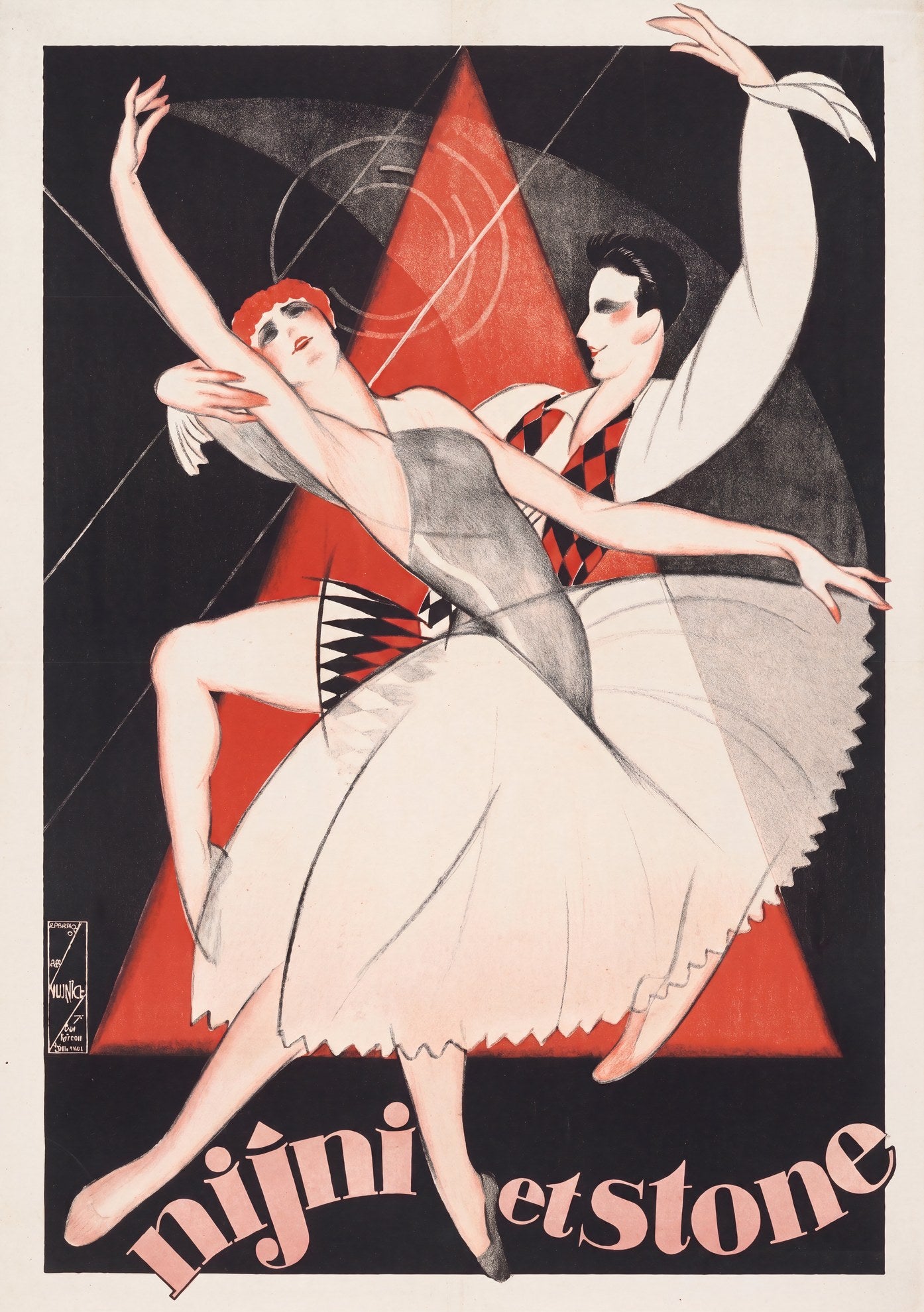
A woman in a white serrated tutu and a man in a harlequin diamond costume fill the composition with arms raised, caught in the suspended geometry of their routine. Behind them, a red equilateral triangle rises from the base against a solid black ground; a large grey circle and diagonal ruled lines complete the background, turning the stage space into a Constructivist diagram of motion.
Designed by Obrad Nicolitch (1898–1976) and printed by Quintce, Imprimerie Artres, Brussels, the poster promoted the touring dance duo Nijni and Stone, with space left at the lower edge for venue overprinting of dates and locations. Nicolitch, who also published under the Affiches Nicolitch imprint, was one of the more versatile French commercial lithographers of the interwar period, moving fluently between entertainment promotion, brand advertising, and beverages. This work applies the formal vocabulary he shared with Constructivist-influenced European design, the triangle, the circle, the diagonal, to a popular performance context.
The pale pink cursive lettering of the title at the base holds its own against the geometric severity above it, demonstrating the characteristic Art Deco synthesis of decorative script with modernist composition. The harlequin patterning on the costumes, a recurring motif in European cabaret and ballet promotion of the period, connects the performers visually to a lineage running from commedia dell'arte through the Ballets Russes.
A considered choice for anyone interested in the poster design of the French and Belgian entertainment circuit in the 1930s, the Art Deco figure tradition, or the graphic language of European avant-garde performance. Reproduced using pigment-based inks on 200gsm Enhanced Matte Fine Art Paper, from a digitally restored archival source.
Couldn't load pickup availability
Share
A woman in a white serrated tutu and a man in a harlequin diamond costume fill the composition with arms raised, caught in the suspended geometry of their routine. Behind them, a red equilateral triangle rises from the base against a solid black ground; a large grey circle and diagonal ruled lines complete the background, turning the stage space into a Constructivist diagram of motion.
Designed by Obrad Nicolitch (1898–1976) and printed by Quintce, Imprimerie Artres, Brussels, the poster promoted the touring dance duo Nijni and Stone, with space left at the lower edge for venue overprinting of dates and locations. Nicolitch, who also published under the Affiches Nicolitch imprint, was one of the more versatile French commercial lithographers of the interwar period, moving fluently between entertainment promotion, brand advertising, and beverages. This work applies the formal vocabulary he shared with Constructivist-influenced European design, the triangle, the circle, the diagonal, to a popular performance context.
The pale pink cursive lettering of the title at the base holds its own against the geometric severity above it, demonstrating the characteristic Art Deco synthesis of decorative script with modernist composition. The harlequin patterning on the costumes, a recurring motif in European cabaret and ballet promotion of the period, connects the performers visually to a lineage running from commedia dell'arte through the Ballets Russes.
A considered choice for anyone interested in the poster design of the French and Belgian entertainment circuit in the 1930s, the Art Deco figure tradition, or the graphic language of European avant-garde performance. Reproduced using pigment-based inks on 200gsm Enhanced Matte Fine Art Paper, from a digitally restored archival source.
