Vintage Poster Archives
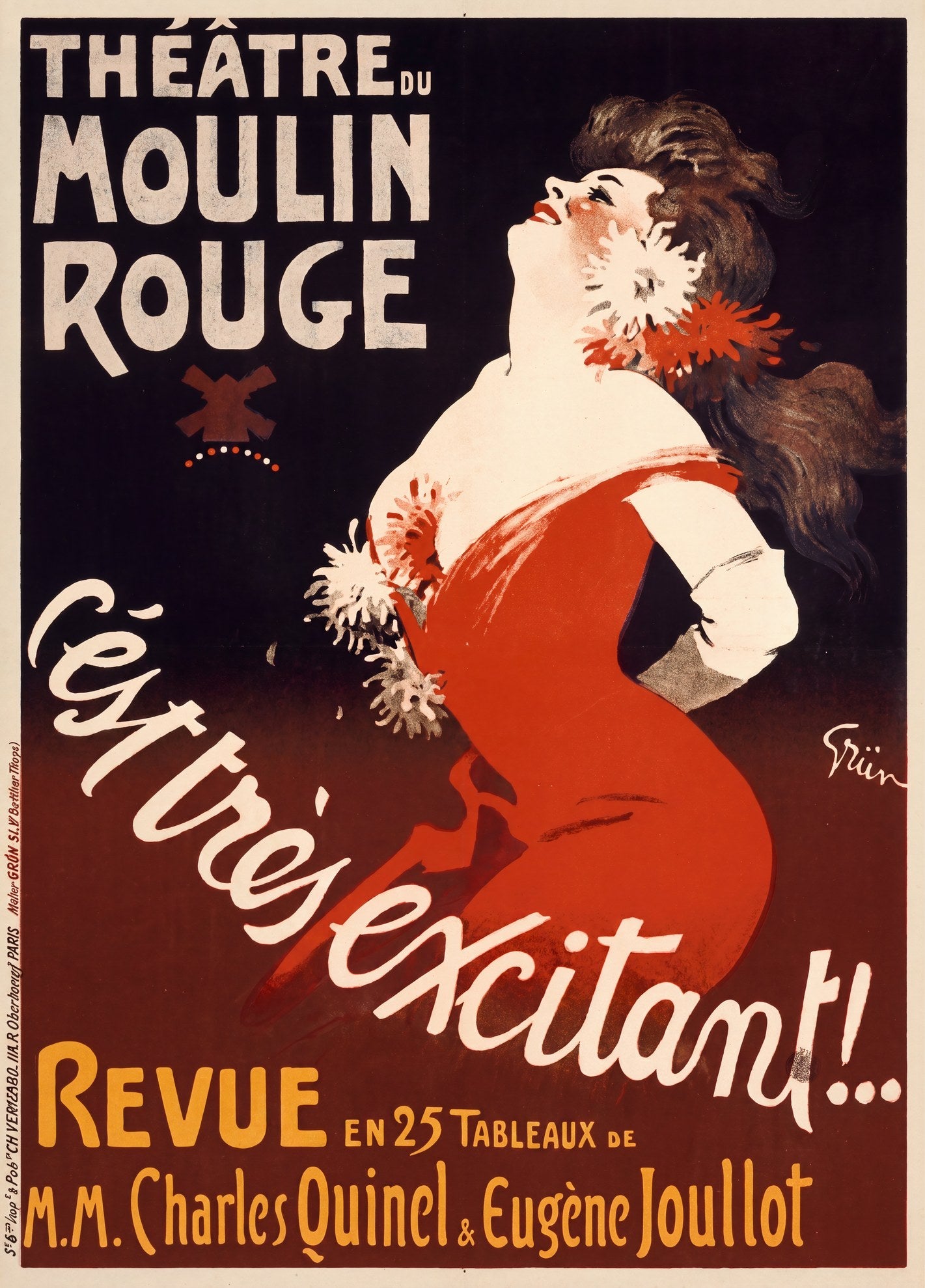
Moulin Rouge 1911 | Grün Belle Époque Theatre Poster
Moulin Rouge 1911 | Grün Belle Époque Theatre Poster
Couldn't load pickup availability
A female revue performer in a full crimson-red gown arches backward against a deep black ground, head thrown back, hair streaming behind her, white ruffled corsage at her bosom and wrist. The curve of her body fills the composition; the italic cream script of 'c'est très excitant!...' flows beneath her, and bold ochre gold credits name the revue's writers, M.M. Charles Quinel and Eugène Joullot, across the lower band.
Designed by Jules-Alexandre Grün (1868–1938) for the revue that opened at the Moulin Rouge on 24 January 1911, this lithograph sits at the close of the Belle Époque poster tradition. Grün had trained under Jules Chéret at a large Paris printing house and went on to produce around 2,000 posters in a forty-year career. His approach here is notably spare for the period: two dominant colours, black and crimson, with cream and gold for contrast, and a single ecstatic figure placed against flat black rather than the decorative floral grounds his contemporaries favoured. That restraint makes the composition read with a directness that distances it from the busier affiche style of the 1890s.
The poster advertises a revue in 25 tableaux, the format of large-scale variety entertainment that defined Moulin Rouge programming in the early 1900s. Grün was a regular presence in Montmartre, commissioned repeatedly by the cabaret venues whose atmosphere he documented in both poster and painting.
Reproduced as an archival print on 200gsm Enhanced Matte Fine Art Paper, this is a considered choice for anyone with a serious interest in French Belle Époque lithography, the graphic history of Parisian cabaret, or the period between Toulouse-Lautrec's early 1890s Moulin Rouge posters and the Art Deco work that followed in the 1920s.