Vintage Poster Archives
Metlicovitz Milan 1906 | Simplon Tunnel Exhibition Poster
This service is currently unavailable,
sorry for the inconvenience.
Pair it with a frame
Frame options are for visualization purposes only.
FRAME STYLE
MATTING SIZE
BUILDING YOUR EXPERIENCE
powered by Blankwall
Take a few steps back and let your camera see more of the scene.
powered by Blankwall
Was this experience helpful?
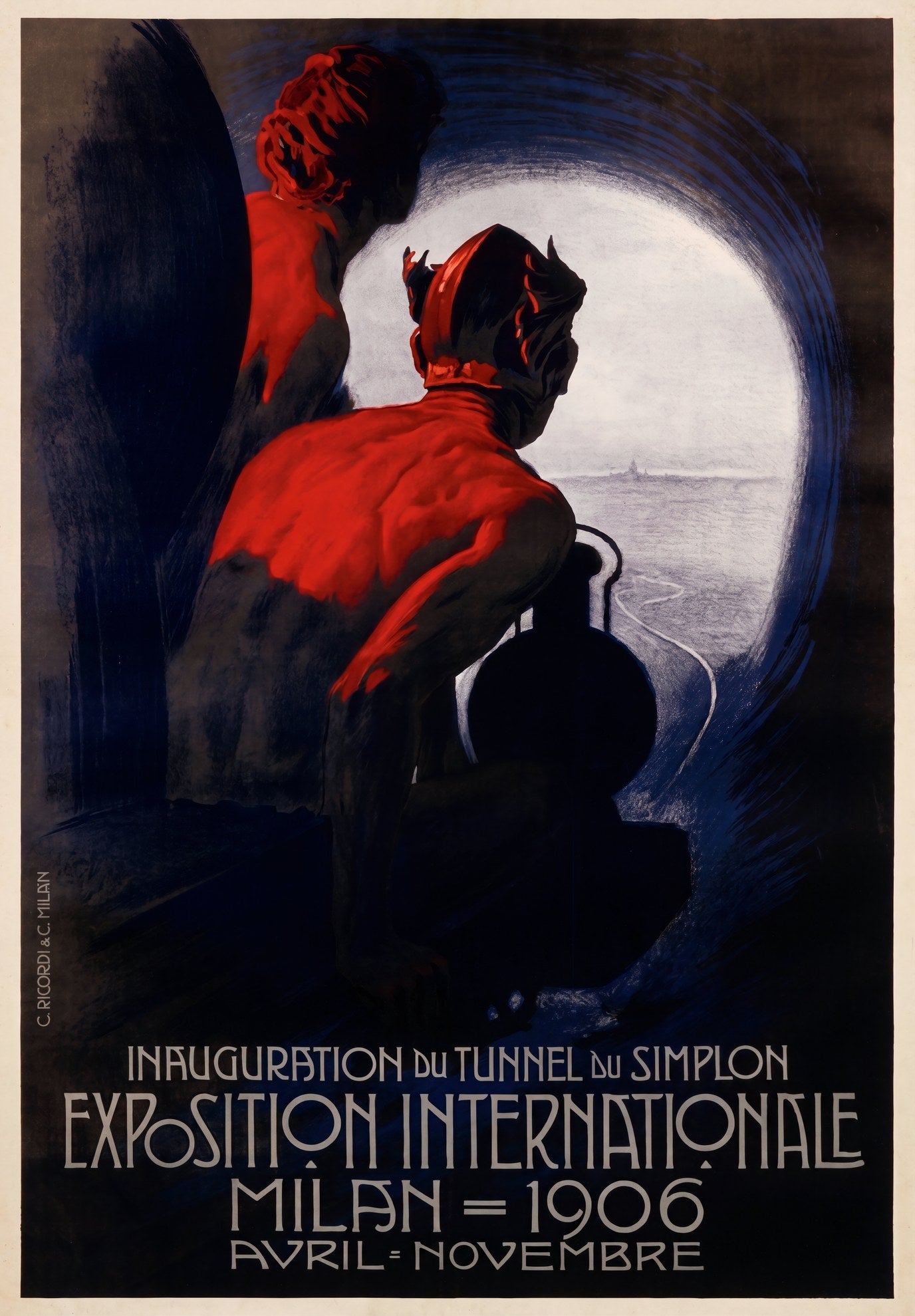
Mercury and Vulcan, rendered in saturated vermilion against a near-black ground, ride the fender of a steam locomotive as it clears the mouth of the Simplon Tunnel, the pale Italian plain and the distant silhouette of Milan's Duomo visible ahead. The tunnel opening forms a luminous white circle, ringed by swirling navy brushstrokes that carry the eye inward. Below, Metlicovitz's Belle Époque display lettering announces the occasion in silver-white caps: 'Inauguration du Tunnel du Simplon / EXPOSITION INTERNATIONALE / MILAN = 1906 / AVRIL = NOVEMBRE.'
Leopoldo Metlicovitz (1868–1944), working as technical director and principal poster designer at Officine Grafiche Ricordi in Milan, won the open competition for the official poster of Italy's first World's Fair. The 1906 Esposizione Internazionale del Sempione was held to mark the inauguration of the Simplon Tunnel, which, spanning 19.8 kilometres beneath the Alps between Switzerland and Italy, held the record as the world's longest railway tunnel from its opening until 1982. The poster was printed by G. Ricordi and C., Milan, and issued in multiple languages; the French-language version shown here is the variant held in the permanent collection of the Victoria and Albert Museum, London.
Metlicovitz chose allegory over engineering. Speed and commerce are embodied by Mercury; fire and craft by Vulcan. The composition, built on a stark opposition of saturated red and deep navy, with a single luminous aperture at its centre, sits at the transition between stile Liberty and the modernist poster language that would follow. Metlicovitz, who counted Giacomo Puccini among his collaborators and created over a hundred posters for Ricordi across four decades, is regarded alongside Leonetto Cappiello and Marcello Dudovich as one of the founding figures of Italian graphic design. This is the competition-winning work that made his name.
Reproduced as a giclée print on 200gsm Enhanced Matte Fine Art Paper. A natural choice for collectors of early twentieth-century Italian design, for anyone drawn to the poster tradition of the Belle Époque, or for rooms where the history of industrial Europe belongs on the wall.
Couldn't load pickup availability
Share
Mercury and Vulcan, rendered in saturated vermilion against a near-black ground, ride the fender of a steam locomotive as it clears the mouth of the Simplon Tunnel, the pale Italian plain and the distant silhouette of Milan's Duomo visible ahead. The tunnel opening forms a luminous white circle, ringed by swirling navy brushstrokes that carry the eye inward. Below, Metlicovitz's Belle Époque display lettering announces the occasion in silver-white caps: 'Inauguration du Tunnel du Simplon / EXPOSITION INTERNATIONALE / MILAN = 1906 / AVRIL = NOVEMBRE.'
Leopoldo Metlicovitz (1868–1944), working as technical director and principal poster designer at Officine Grafiche Ricordi in Milan, won the open competition for the official poster of Italy's first World's Fair. The 1906 Esposizione Internazionale del Sempione was held to mark the inauguration of the Simplon Tunnel, which, spanning 19.8 kilometres beneath the Alps between Switzerland and Italy, held the record as the world's longest railway tunnel from its opening until 1982. The poster was printed by G. Ricordi and C., Milan, and issued in multiple languages; the French-language version shown here is the variant held in the permanent collection of the Victoria and Albert Museum, London.
Metlicovitz chose allegory over engineering. Speed and commerce are embodied by Mercury; fire and craft by Vulcan. The composition, built on a stark opposition of saturated red and deep navy, with a single luminous aperture at its centre, sits at the transition between stile Liberty and the modernist poster language that would follow. Metlicovitz, who counted Giacomo Puccini among his collaborators and created over a hundred posters for Ricordi across four decades, is regarded alongside Leonetto Cappiello and Marcello Dudovich as one of the founding figures of Italian graphic design. This is the competition-winning work that made his name.
Reproduced as a giclée print on 200gsm Enhanced Matte Fine Art Paper. A natural choice for collectors of early twentieth-century Italian design, for anyone drawn to the poster tradition of the Belle Époque, or for rooms where the history of industrial Europe belongs on the wall.
