Vintage Poster Archives
Lawson Wood WW1 Recruitment 1914 | British Propaganda Poster
This service is currently unavailable,
sorry for the inconvenience.
Pair it with a frame
Frame options are for visualization purposes only.
FRAME STYLE
MATTING SIZE
BUILDING YOUR EXPERIENCE
powered by Blankwall
Take a few steps back and let your camera see more of the scene.
powered by Blankwall
Was this experience helpful?
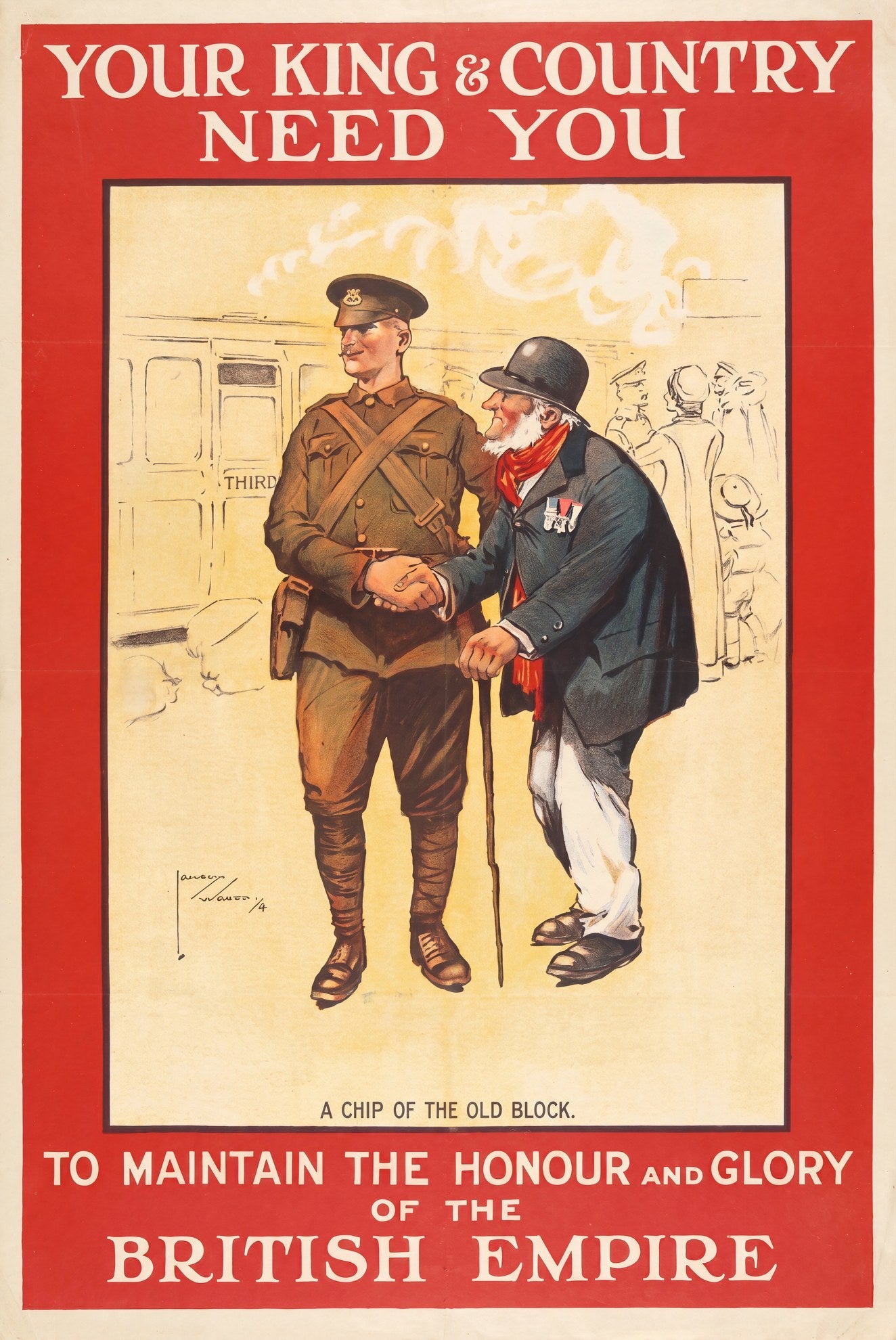
A khaki-uniformed British infantryman clasps the hand of a stooped elderly veteran at a railway station. The old man's campaign medals are pinned to a dark civilian coat; his free hand rests on a walking stick. Behind the pair, a railway carriage door marked THIRD dissolves into the cream ground. Beneath the central illustration panel, in small black serif type: A CHIP OF THE OLD BLOCK.
Drawn by Lawson Wood in 1914 and issued as Parliamentary Recruiting Committee Poster No. 18, printed by Dobson, Molle and Co. of Edinburgh and London. Wood was one of Britain's leading commercial illustrators at the time, published regularly in The Graphic, Punch, and The Illustrated London News, and produced multiple designs for the PRC's opening recruitment campaign. Where many PRC posters addressed the viewer directly, this one addresses him obliquely. The old veteran's medals are doing the work. He has served; the handshake is his verdict on the younger man's choice. The cadmium red border and bold white serifs carry the government's voice above and below; the illustration, rendered in Wood's characteristically warm and naturalistic style, carries something more personal.
The Parliamentary Recruiting Committee commissioned over a hundred poster designs between August 1914 and the introduction of conscription in January 1916. Poster No. 18 sits within a well-documented strand of generational appeal within that campaign, pairing the service record of one generation with the unspoken expectation of the next. The railway station setting locates the design precisely in the civilian world of 1914 Britain: departure as an ordinary act, made meaningful by the man already wearing medals.
Reproduced as an archival print on 200gsm Enhanced Matte Fine Art Paper, restored from an archival source. Smooth matte finish, natural white ground, pigment-based inks. Held in the collections of the Australian War Memorial and referenced in the Imperial War Museum's Dobson, Molle and Co. printer records.
Couldn't load pickup availability
Share
A khaki-uniformed British infantryman clasps the hand of a stooped elderly veteran at a railway station. The old man's campaign medals are pinned to a dark civilian coat; his free hand rests on a walking stick. Behind the pair, a railway carriage door marked THIRD dissolves into the cream ground. Beneath the central illustration panel, in small black serif type: A CHIP OF THE OLD BLOCK.
Drawn by Lawson Wood in 1914 and issued as Parliamentary Recruiting Committee Poster No. 18, printed by Dobson, Molle and Co. of Edinburgh and London. Wood was one of Britain's leading commercial illustrators at the time, published regularly in The Graphic, Punch, and The Illustrated London News, and produced multiple designs for the PRC's opening recruitment campaign. Where many PRC posters addressed the viewer directly, this one addresses him obliquely. The old veteran's medals are doing the work. He has served; the handshake is his verdict on the younger man's choice. The cadmium red border and bold white serifs carry the government's voice above and below; the illustration, rendered in Wood's characteristically warm and naturalistic style, carries something more personal.
The Parliamentary Recruiting Committee commissioned over a hundred poster designs between August 1914 and the introduction of conscription in January 1916. Poster No. 18 sits within a well-documented strand of generational appeal within that campaign, pairing the service record of one generation with the unspoken expectation of the next. The railway station setting locates the design precisely in the civilian world of 1914 Britain: departure as an ordinary act, made meaningful by the man already wearing medals.
Reproduced as an archival print on 200gsm Enhanced Matte Fine Art Paper, restored from an archival source. Smooth matte finish, natural white ground, pigment-based inks. Held in the collections of the Australian War Memorial and referenced in the Imperial War Museum's Dobson, Molle and Co. printer records.
