Vintage Poster Archives
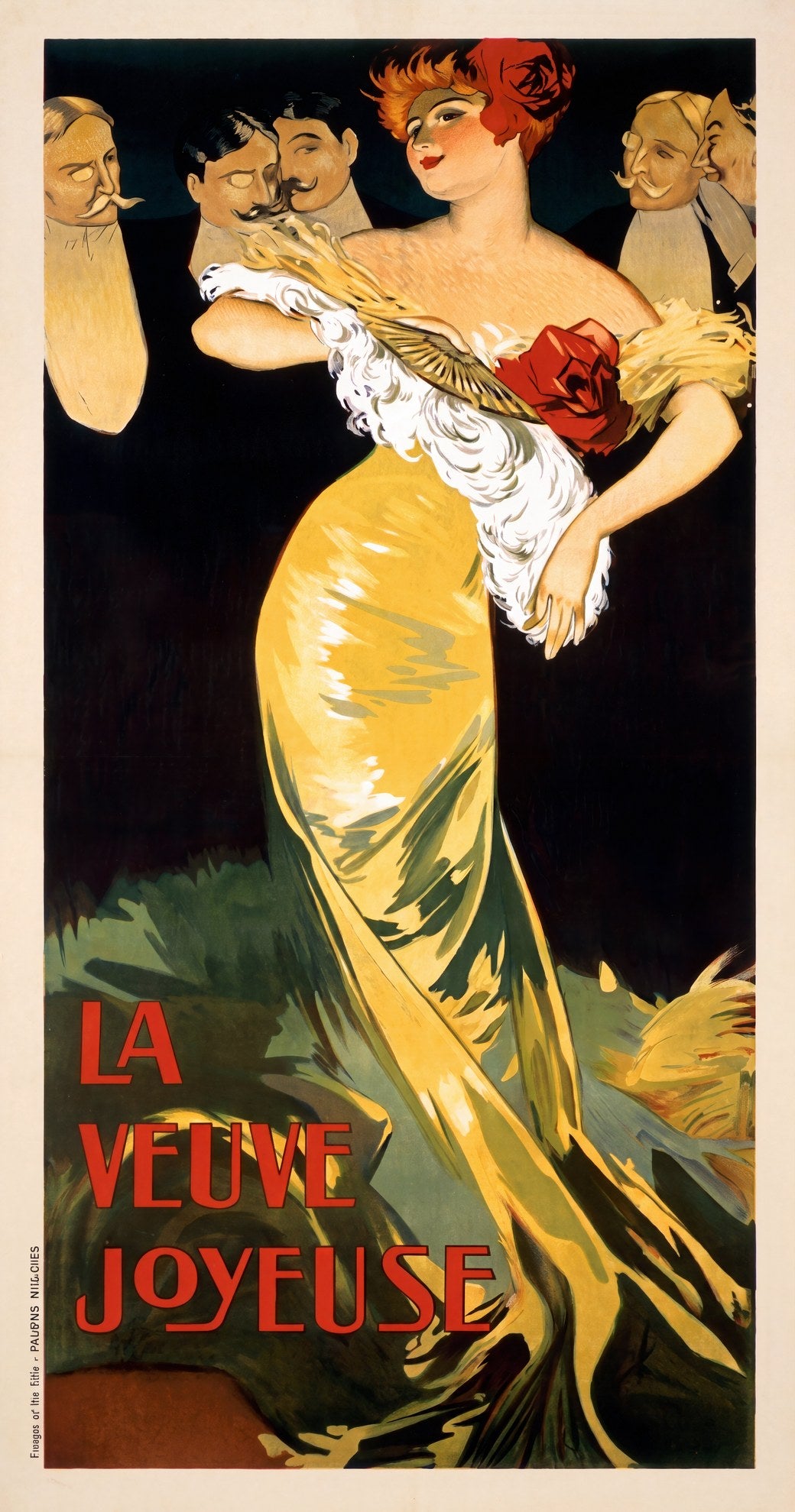
La Veuve Joyeuse 1909 | French Operetta Theatre Poster
This service is currently unavailable,
sorry for the inconvenience.
Pair it with a frame
Frame options are for visualization purposes only.
FRAME STYLE
MATTING SIZE
BUILDING YOUR EXPERIENCE
powered by Blankwall
Take a few steps back and let your camera see more of the scene.
powered by Blankwall
Was this experience helpful?
A woman in a golden-yellow silk gown occupies the full height of this French Belle Époque lithograph, a white feather boa across bare shoulders, a large crimson rose at her side, and a gold fan held loosely at the hip. Behind her, four male figures emerge from a near-black ground: a bearded elder at far left, a moustachioed dandy pressing close, a jowl-faced figure in the centre, and a pale admirer at the right edge. The bold red capitals of LA VEUVE JOYEUSE stack in three lines at lower left. The printer credit 'Nil-Gies' appears in the left margin, identifying a Paris lithographic house. No artist signature is legible on this example.
Franz Lehár's operetta Die lustige Witwe premiered in Vienna on 30 December 1905. By the time this poster was produced for the French premiere at the Théâtre Apollo on 28 April 1909, the work had already run 778 performances at Daly's Theatre in London and 416 on Broadway. The French adaptation, titled La Veuve Joyeuse, was itself well-received, running 186 performances in Paris. Lehár's Merry Widow Waltz and the aria 'Je vais chez Maxim' had by then become the defining musical idiom of the Edwardian era.
The handling of the central figure, loose confident brushwork rendering the satin gown, flat decorative foliage at the hem, and the massed admirers pressed into the dark ground, reflects the Belle Époque tradition of French theatrical lithography at the turn of the century, where the female lead was rendered as a luminous presence emerging from darkness.
Reproduced on 200gsm Enhanced Matte Fine Art Paper, this design is well-suited to those who collect early French theatrical printing, follow the history of Viennese operetta, or are drawn to the warm palette and figurative confidence of the Belle Époque affiche.
Couldn't load pickup availability
Share
A woman in a golden-yellow silk gown occupies the full height of this French Belle Époque lithograph, a white feather boa across bare shoulders, a large crimson rose at her side, and a gold fan held loosely at the hip. Behind her, four male figures emerge from a near-black ground: a bearded elder at far left, a moustachioed dandy pressing close, a jowl-faced figure in the centre, and a pale admirer at the right edge. The bold red capitals of LA VEUVE JOYEUSE stack in three lines at lower left. The printer credit 'Nil-Gies' appears in the left margin, identifying a Paris lithographic house. No artist signature is legible on this example.
Franz Lehár's operetta Die lustige Witwe premiered in Vienna on 30 December 1905. By the time this poster was produced for the French premiere at the Théâtre Apollo on 28 April 1909, the work had already run 778 performances at Daly's Theatre in London and 416 on Broadway. The French adaptation, titled La Veuve Joyeuse, was itself well-received, running 186 performances in Paris. Lehár's Merry Widow Waltz and the aria 'Je vais chez Maxim' had by then become the defining musical idiom of the Edwardian era.
The handling of the central figure, loose confident brushwork rendering the satin gown, flat decorative foliage at the hem, and the massed admirers pressed into the dark ground, reflects the Belle Époque tradition of French theatrical lithography at the turn of the century, where the female lead was rendered as a luminous presence emerging from darkness.
Reproduced on 200gsm Enhanced Matte Fine Art Paper, this design is well-suited to those who collect early French theatrical printing, follow the history of Viennese operetta, or are drawn to the warm palette and figurative confidence of the Belle Époque affiche.
