Vintage Poster Archives
La Française Diamant 1911 | Paris-Brest-Paris Cycling Poster
This service is currently unavailable,
sorry for the inconvenience.
Pair it with a frame
Frame options are for visualization purposes only.
FRAME STYLE
MATTING SIZE
BUILDING YOUR EXPERIENCE
powered by Blankwall
Take a few steps back and let your camera see more of the scene.
powered by Blankwall
Was this experience helpful?
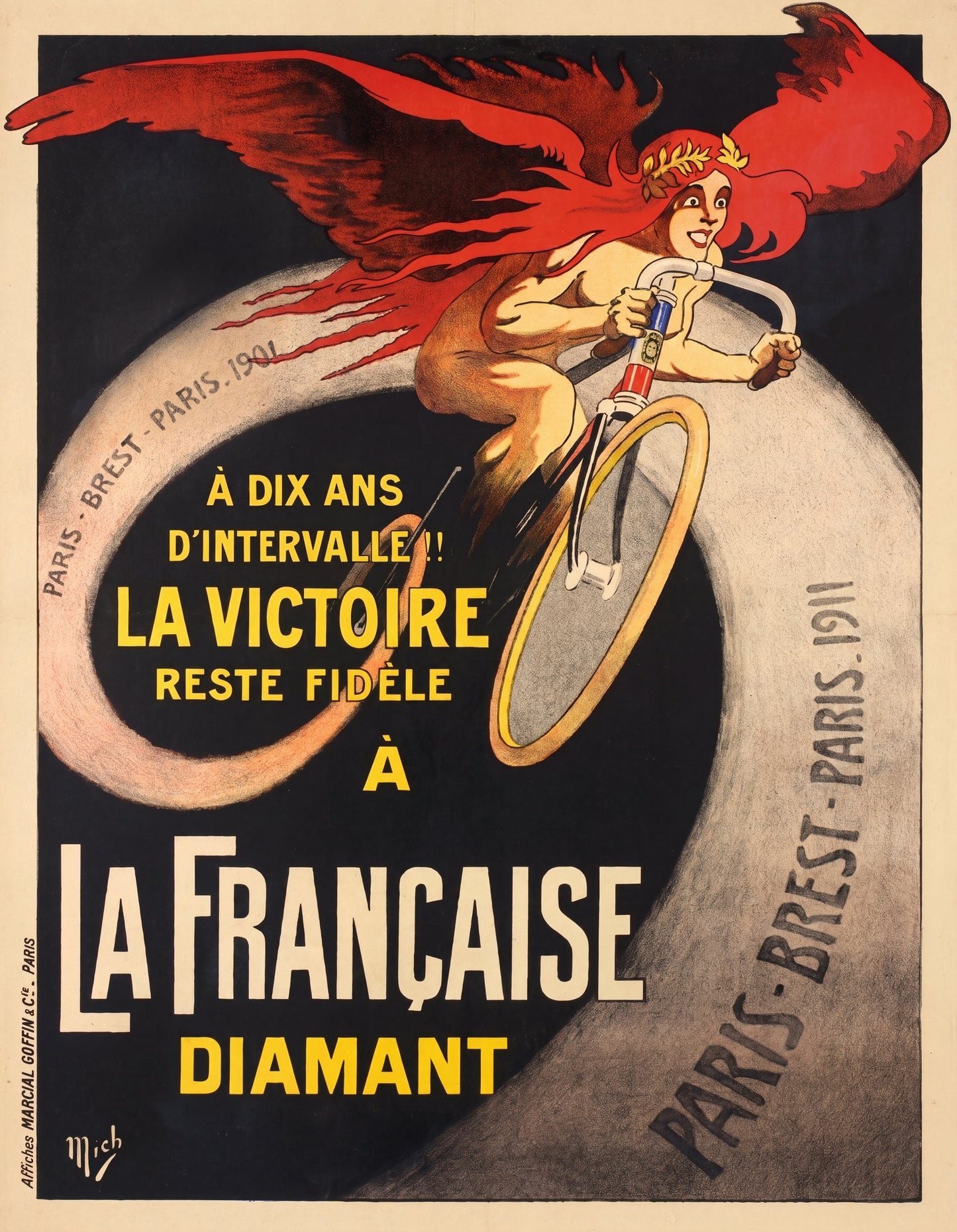
A winged allegorical Victory, red-haired and laurel-crowned, rides a racing bicycle at speed across a near-black ground. A great curving tyre arc sweeps through the composition, inscribed at two points: 'Paris-Brest-Paris. 1901' on the inner curve and 'Paris-Brest-Paris. 1911' on the outer. Yellow display lettering between them reads 'À Dix Ans d'Intervalle!! La Victoire Reste Fidèle à La Française Diamant.' The bold white serif of the brand name anchors the base; the artist's monogram, 'Mich,' sits in the lower-left corner.
Designed by Michel Liebeaux (1881–1923), who worked as 'Mich' and was one of the foremost French poster artists of the early twentieth century, with a particular focus on cycling and automobile subjects. The poster was produced by Affiches Marcial Goffin & Cie, Paris, in 1911, to mark La Française Diamant's second Paris-Brest-Paris victory: the 1901 win by Maurice Garin and the 1911 win by Emile Georget, each ten years apart. The headline copy, 'ten years apart, victory remains faithful', made the two victories the structural argument of the advertisement.
The Paris-Brest-Paris, first run in 1891, covered approximately 1,200 kilometres from the French capital to the Atlantic port and back, and was among the most demanding road events of the Belle Époque. La Française Diamant's repeated wins gave the brand one of the most commercially persuasive narratives in French cycle sport. Liebeaux's classically derived Nike figure, wings spread and hair streaming, translates that narrative into the assured idiom of Belle Époque lithography: allegorical authority in the service of commercial speed.
Reproduced from an archival source print on 200gsm Enhanced Matte Fine Art Paper. Well suited to anyone drawn to early French cycling history, Belle Époque graphic design, or the poster art of the golden age of road racing.
Couldn't load pickup availability
Share
A winged allegorical Victory, red-haired and laurel-crowned, rides a racing bicycle at speed across a near-black ground. A great curving tyre arc sweeps through the composition, inscribed at two points: 'Paris-Brest-Paris. 1901' on the inner curve and 'Paris-Brest-Paris. 1911' on the outer. Yellow display lettering between them reads 'À Dix Ans d'Intervalle!! La Victoire Reste Fidèle à La Française Diamant.' The bold white serif of the brand name anchors the base; the artist's monogram, 'Mich,' sits in the lower-left corner.
Designed by Michel Liebeaux (1881–1923), who worked as 'Mich' and was one of the foremost French poster artists of the early twentieth century, with a particular focus on cycling and automobile subjects. The poster was produced by Affiches Marcial Goffin & Cie, Paris, in 1911, to mark La Française Diamant's second Paris-Brest-Paris victory: the 1901 win by Maurice Garin and the 1911 win by Emile Georget, each ten years apart. The headline copy, 'ten years apart, victory remains faithful', made the two victories the structural argument of the advertisement.
The Paris-Brest-Paris, first run in 1891, covered approximately 1,200 kilometres from the French capital to the Atlantic port and back, and was among the most demanding road events of the Belle Époque. La Française Diamant's repeated wins gave the brand one of the most commercially persuasive narratives in French cycle sport. Liebeaux's classically derived Nike figure, wings spread and hair streaming, translates that narrative into the assured idiom of Belle Époque lithography: allegorical authority in the service of commercial speed.
Reproduced from an archival source print on 200gsm Enhanced Matte Fine Art Paper. Well suited to anyone drawn to early French cycling history, Belle Époque graphic design, or the poster art of the golden age of road racing.
