Vintage Poster Archives
Greed 1924 | Metro Goldwyn Silent Film Poster
This service is currently unavailable,
sorry for the inconvenience.
Pair it with a frame
Frame options are for visualization purposes only.
FRAME STYLE
MATTING SIZE
BUILDING YOUR EXPERIENCE
powered by Blankwall
Take a few steps back and let your camera see more of the scene.
powered by Blankwall
Was this experience helpful?
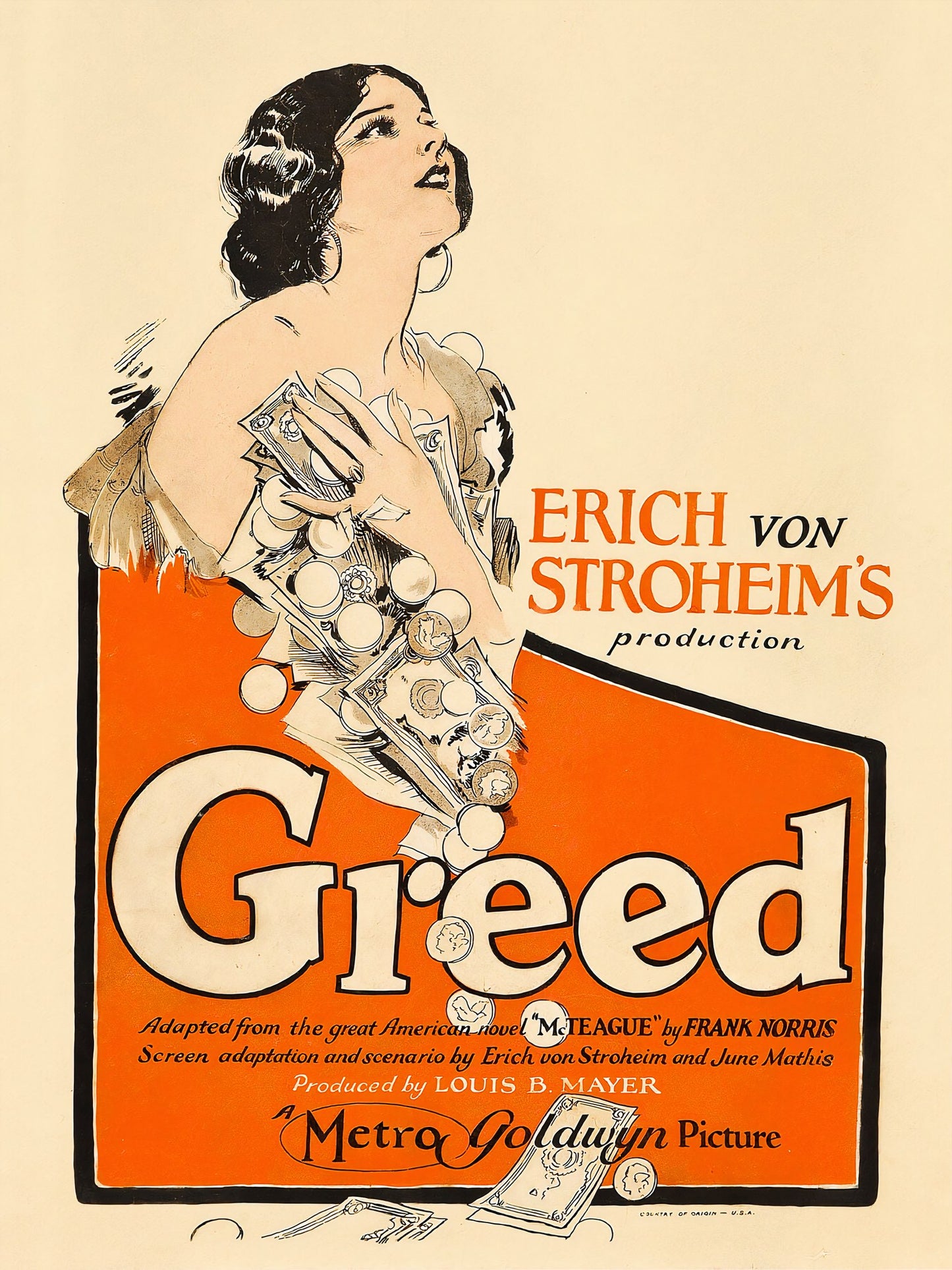
A woman in a strapless gown, illustrated in fine black ink with careful cross-hatching, tilts her head back and clutches banknotes and gold coins against her chest. Below her, a flat burnt-orange rectangle carries the title in large outlined white lettering. Coins and banknotes scatter across the boundary between the cream upper ground and the orange lower panel, the figure herself bridging both zones. At the foot, the Metro Goldwyn logotype in elegant cursive, and a full credit block in italic type.
Erich von Stroheim directed Greed for Metro Goldwyn in 1924, adapting Frank Norris's 1899 novel McTeague. Produced by Louis B. Mayer, with screenplay by von Stroheim and June Mathis, the film was rendered entirely on location across San Francisco and Death Valley, running to over nine hours before being cut to a theatrical release against von Stroheim's wishes. The US release poster bears 'Country of Origin, U.S.A.' at lower right; the illustrator of this edition is unattributed in the public record. A Danish edition of the same-year release was illustrated by Sven Brasch, printed by Kruckow-Waldorff, confirming that multiple national release editions were produced.
The poster's graphic language sits firmly in early 1920s Hollywood one-sheet practice: a flat divided ground, hand-rendered illustration, a mix of display lettering styles, and the saturated orange field that several Metro and Goldwyn release posters of the period favoured. The composition is spare and direct, with the figure study carrying the emotional weight and the typographic lower half handling the commercial information.
Reproduced from archival source on 200gsm Enhanced Matte Fine Art Paper, a natural-white matte surface suited to the flat colour and fine line work of this design. An apt addition to any collection focused on 1920s silent cinema, American graphic design history, or the visual culture of early Hollywood.
Couldn't load pickup availability
Share
A woman in a strapless gown, illustrated in fine black ink with careful cross-hatching, tilts her head back and clutches banknotes and gold coins against her chest. Below her, a flat burnt-orange rectangle carries the title in large outlined white lettering. Coins and banknotes scatter across the boundary between the cream upper ground and the orange lower panel, the figure herself bridging both zones. At the foot, the Metro Goldwyn logotype in elegant cursive, and a full credit block in italic type.
Erich von Stroheim directed Greed for Metro Goldwyn in 1924, adapting Frank Norris's 1899 novel McTeague. Produced by Louis B. Mayer, with screenplay by von Stroheim and June Mathis, the film was rendered entirely on location across San Francisco and Death Valley, running to over nine hours before being cut to a theatrical release against von Stroheim's wishes. The US release poster bears 'Country of Origin, U.S.A.' at lower right; the illustrator of this edition is unattributed in the public record. A Danish edition of the same-year release was illustrated by Sven Brasch, printed by Kruckow-Waldorff, confirming that multiple national release editions were produced.
The poster's graphic language sits firmly in early 1920s Hollywood one-sheet practice: a flat divided ground, hand-rendered illustration, a mix of display lettering styles, and the saturated orange field that several Metro and Goldwyn release posters of the period favoured. The composition is spare and direct, with the figure study carrying the emotional weight and the typographic lower half handling the commercial information.
Reproduced from archival source on 200gsm Enhanced Matte Fine Art Paper, a natural-white matte surface suited to the flat colour and fine line work of this design. An apt addition to any collection focused on 1920s silent cinema, American graphic design history, or the visual culture of early Hollywood.
