Vintage Poster Archives
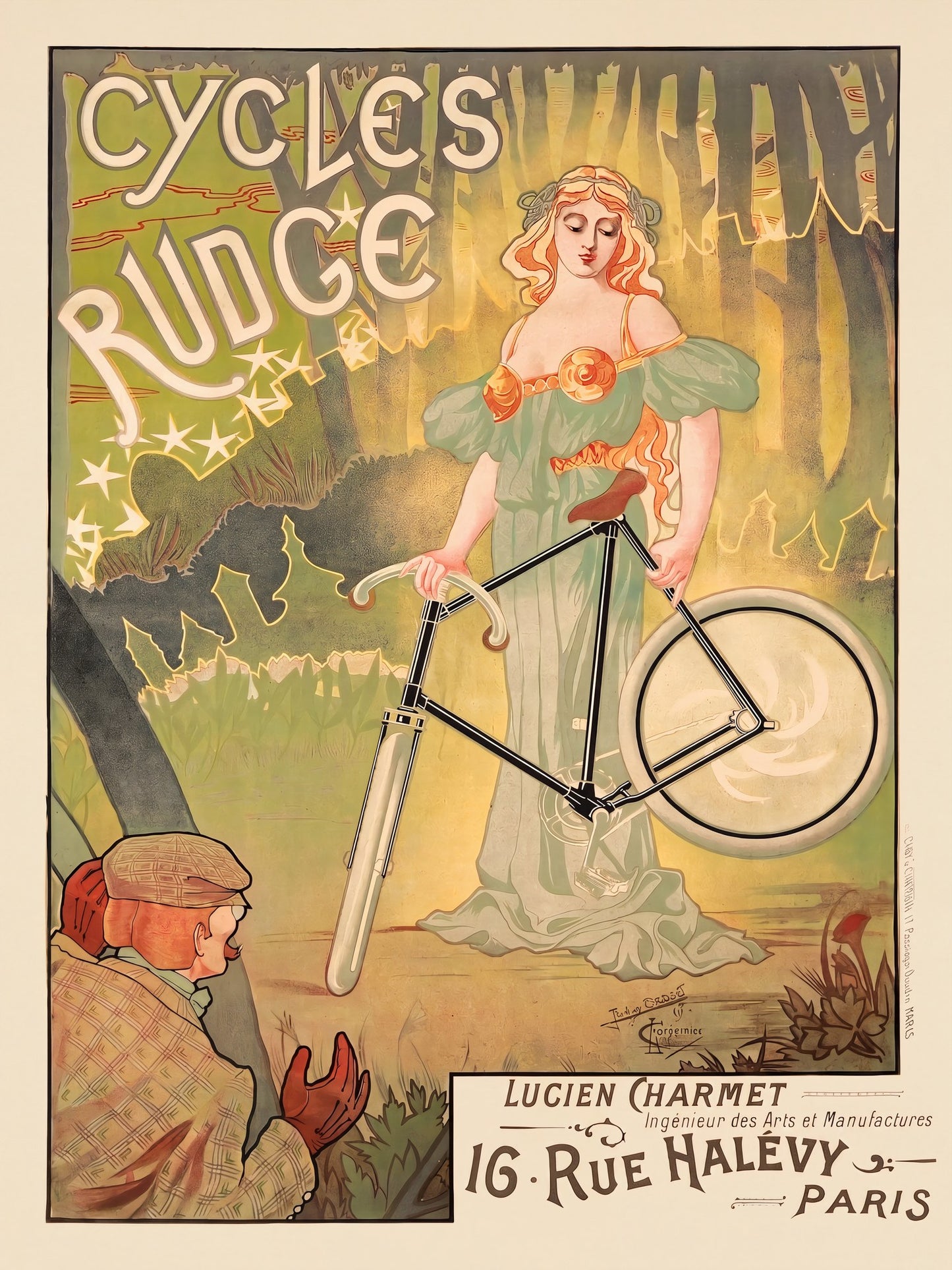
Cycles Rudge 1897 | Jacques Debut Art Nouveau Bicycle Poster
This service is currently unavailable,
sorry for the inconvenience.
Pair it with a frame
Frame options are for visualization purposes only.
FRAME STYLE
MATTING SIZE
BUILDING YOUR EXPERIENCE
powered by Blankwall
Take a few steps back and let your camera see more of the scene.
powered by Blankwall
Was this experience helpful?
A red-haired goddess in a sage-green off-shoulder gown stands in a sun-dappled woodland, holding a black diamond-frame safety bicycle with both hands. The background resolves into tall, abstracted tree forms and washes of warm gold light. In the lower-left corner, a male figure in a tweed flat cap leans forward from behind a tree trunk, watching the scene. The bicycle is rendered with precise technical line, its frame a stark black against the organic curves of the gown and foliage.
Designed by Jacques Debut in 1897, the poster was lithographed by L. Charbonnier at the Imprimerie Caby et Chardin, 17 Passage Daudin, Paris, and produced for Lucien Charmet, the Paris distributor for the British Rudge cycle company. Charmet operated from 16 Rue Halevy in the 9th arrondissement and held the title Ingenieur des Arts et Manufactures. Rudge had been manufacturing cycles in Britain since the 1860s and established a French commercial presence by the mid-1890s. The pose of the central figure, a goddess presenting the bicycle to the world, belongs to a well-established strand of 1890s French cycle advertising that used mythological allegory to position the safety bicycle as an object of aspiration rather than utility.
Debut's signature and the date '97 are inscribed in stone in the lower right. The poster is held in the collections of the Bibliotheque Forney, Ville de Paris, and has been offered through the Matthews Gallery with full chromolithograph attribution confirmed. Reproduced here as a vintage advertising poster archival print on 200gsm Enhanced Matte Fine Art Paper.
The palette of sage green, ochre gold, and warm cream makes the poster a natural companion for interiors that draw on natural tones and period illustration. It resonates equally with collectors of Belle Epoque graphic design and those drawn to the social history of the cycling boom that reshaped European leisure culture in the 1890s.
Couldn't load pickup availability
Share
A red-haired goddess in a sage-green off-shoulder gown stands in a sun-dappled woodland, holding a black diamond-frame safety bicycle with both hands. The background resolves into tall, abstracted tree forms and washes of warm gold light. In the lower-left corner, a male figure in a tweed flat cap leans forward from behind a tree trunk, watching the scene. The bicycle is rendered with precise technical line, its frame a stark black against the organic curves of the gown and foliage.
Designed by Jacques Debut in 1897, the poster was lithographed by L. Charbonnier at the Imprimerie Caby et Chardin, 17 Passage Daudin, Paris, and produced for Lucien Charmet, the Paris distributor for the British Rudge cycle company. Charmet operated from 16 Rue Halevy in the 9th arrondissement and held the title Ingenieur des Arts et Manufactures. Rudge had been manufacturing cycles in Britain since the 1860s and established a French commercial presence by the mid-1890s. The pose of the central figure, a goddess presenting the bicycle to the world, belongs to a well-established strand of 1890s French cycle advertising that used mythological allegory to position the safety bicycle as an object of aspiration rather than utility.
Debut's signature and the date '97 are inscribed in stone in the lower right. The poster is held in the collections of the Bibliotheque Forney, Ville de Paris, and has been offered through the Matthews Gallery with full chromolithograph attribution confirmed. Reproduced here as a vintage advertising poster archival print on 200gsm Enhanced Matte Fine Art Paper.
The palette of sage green, ochre gold, and warm cream makes the poster a natural companion for interiors that draw on natural tones and period illustration. It resonates equally with collectors of Belle Epoque graphic design and those drawn to the social history of the cycling boom that reshaped European leisure culture in the 1890s.
