Vintage Poster Archives
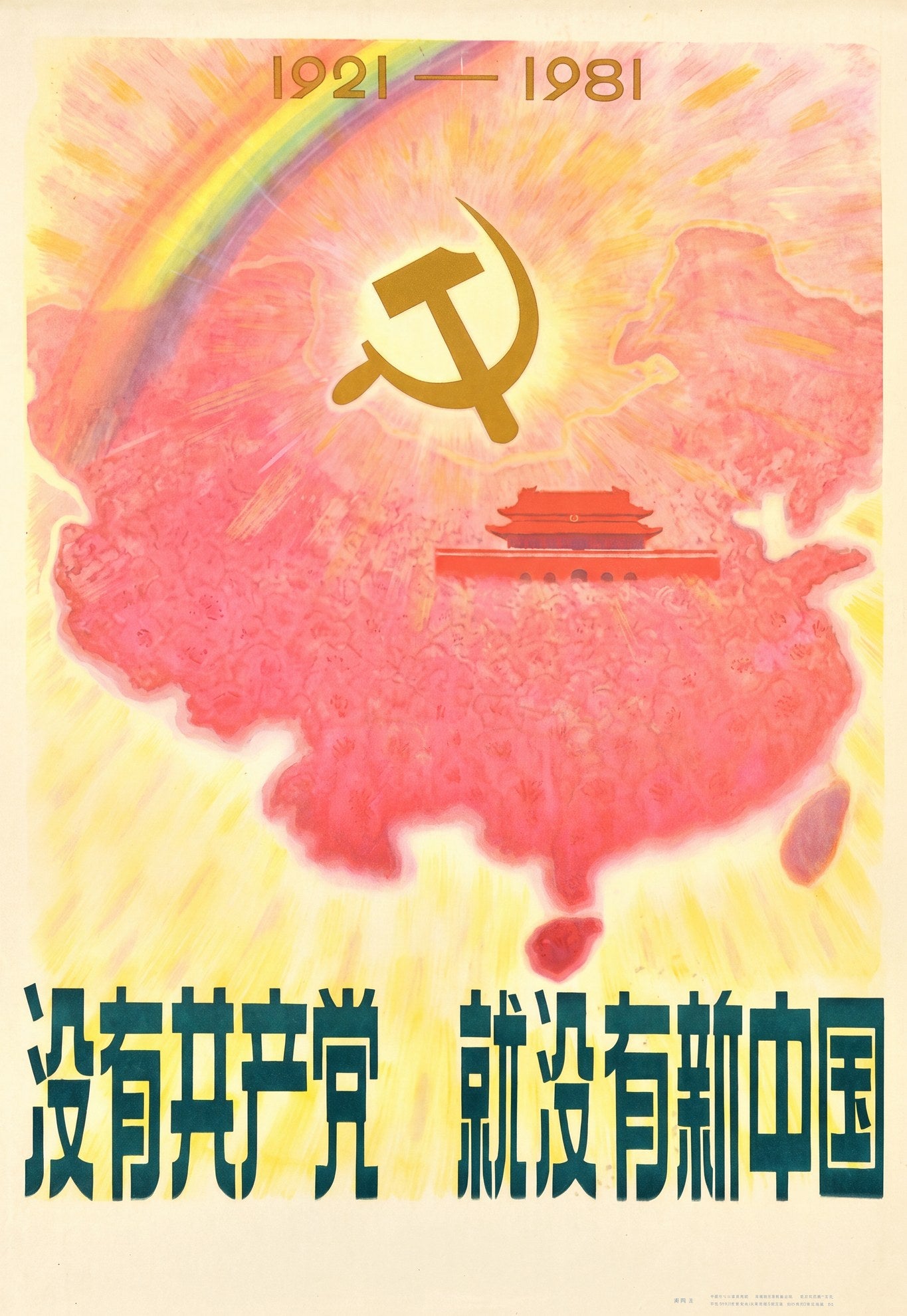
Chinese Communist Party 60th Anniversary 1981 | Pan Xiaoqing Poster
This service is currently unavailable,
sorry for the inconvenience.
Pair it with a frame
Frame options are for visualization purposes only.
FRAME STYLE
MATTING SIZE
BUILDING YOUR EXPERIENCE
powered by Blankwall
Take a few steps back and let your camera see more of the scene.
powered by Blankwall
Was this experience helpful?
A radiant hammer and sickle shines over the red outline of China, with the Forbidden City marking Beijing and rainbow bands arching across cream paper. This commemorative design celebrated the Chinese Communist Party's 60th anniversary in 1981.
Designed by Pan Xiaoqing for Jiangsu People's Publishing House during the early reform period following the Cultural Revolution. The optimistic palette and symbolic rainbow represent the party's vision of progress for the nation, balancing traditional Communist iconography with a more hopeful aesthetic that reflected China's opening to the world.
The composition exemplifies the socialist realism style that defined Chinese propaganda art of the early 1980s. Created during a pivotal moment when China was transitioning from Maoist revolutionary fervour to Deng Xiaoping's pragmatic modernisation policies.
Reproduced as an archival print on 200gsm Enhanced Matte Fine Art Paper using pigment-based inks. A significant piece for collectors of Chinese political ephemera and students of Communist visual messaging.
Couldn't load pickup availability
Share
A radiant hammer and sickle shines over the red outline of China, with the Forbidden City marking Beijing and rainbow bands arching across cream paper. This commemorative design celebrated the Chinese Communist Party's 60th anniversary in 1981.
Designed by Pan Xiaoqing for Jiangsu People's Publishing House during the early reform period following the Cultural Revolution. The optimistic palette and symbolic rainbow represent the party's vision of progress for the nation, balancing traditional Communist iconography with a more hopeful aesthetic that reflected China's opening to the world.
The composition exemplifies the socialist realism style that defined Chinese propaganda art of the early 1980s. Created during a pivotal moment when China was transitioning from Maoist revolutionary fervour to Deng Xiaoping's pragmatic modernisation policies.
Reproduced as an archival print on 200gsm Enhanced Matte Fine Art Paper using pigment-based inks. A significant piece for collectors of Chinese political ephemera and students of Communist visual messaging.
