Vintage Poster Archives
Cherry Rocher Liqueur 1922 | Paul Mohr Advertising Poster
Cherry Rocher Liqueur 1922 | Paul Mohr Advertising Poster
Couldn't load pickup availability
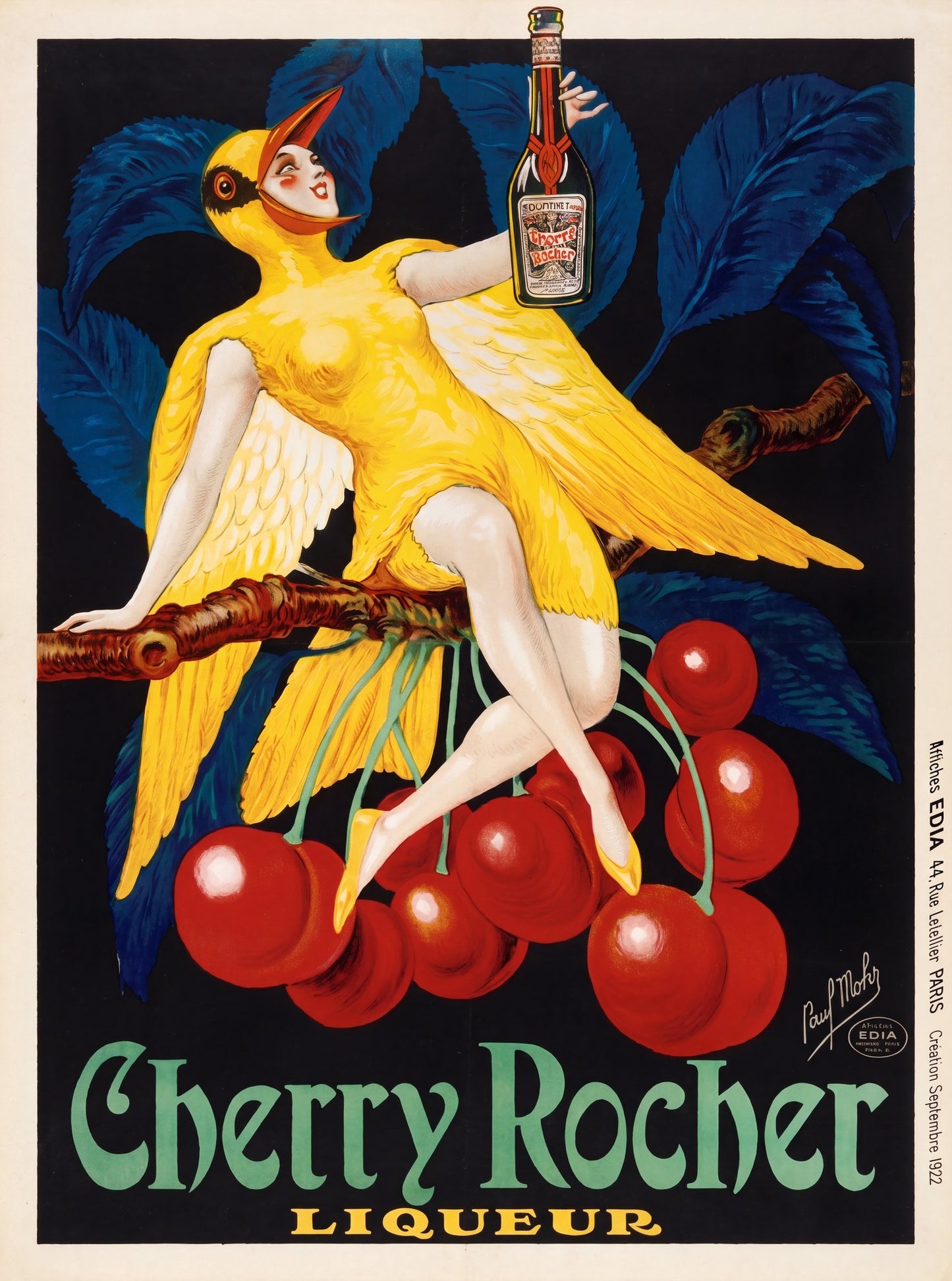
A woman costumed as a yellow canary perches on a cherry-laden branch, raising a bottle of Cherry Rocher Liqueur above her head. Her face, framed by a white carnival half-mask and a red crest, turns outward from beneath the foliage. Behind her, flat cobalt-blue leaves spread against a solid black ground. The red cherries, rendered in full round volumes, hang in the foreground, their stems looping in green arcs. The composition is stark: deep black opposing cadmium yellow, with no atmospheric blending between the two.
Designed by Paul Mohr and printed by Ateliers EDIA, 44 Rue Letellier, Paris, in September 1922. The commission came from Cherry Rocher, a distillery founded in La Côte-Saint-André, Isère, in 1705, one of the oldest in France. By 1922 the company had been producing its cherry liqueur for over two centuries, and the advertising brief Mohr received was to fix that heritage in a Paris street audience's eye through a single, arresting image.
Mohr's solution draws on the flat graphic conventions of the early 1920s French affiche: no tonal gradients, colour zones printed in clean chromolithographic fields, the figure silhouetted rather than modelled. The bird-woman character, a variation on the theatrical fantastical types associated with Cappiello's generation, was a recognised device in French spirits advertising of the period, designed to anchor the brand name through an image that could not be mistaken for anything else.
Reproduced from the archival source as a fine art print on 200gsm Enhanced Matte Fine Art Paper, using pigment-based inks. The design sits in the tradition of early 1920s French liqueur posters, and resonates with collectors of Interwar graphic design and anyone drawn to the commercial art of the Belle Époque-to-Art Deco transition.