Vintage Poster Archives
Jules Cheret Olympia 1892 | Belle Epoque Theatre Poster
This service is currently unavailable,
sorry for the inconvenience.
Pair it with a frame
Frame options are for visualization purposes only.
FRAME STYLE
MATTING SIZE
BUILDING YOUR EXPERIENCE
powered by Blankwall
Take a few steps back and let your camera see more of the scene.
powered by Blankwall
Was this experience helpful?
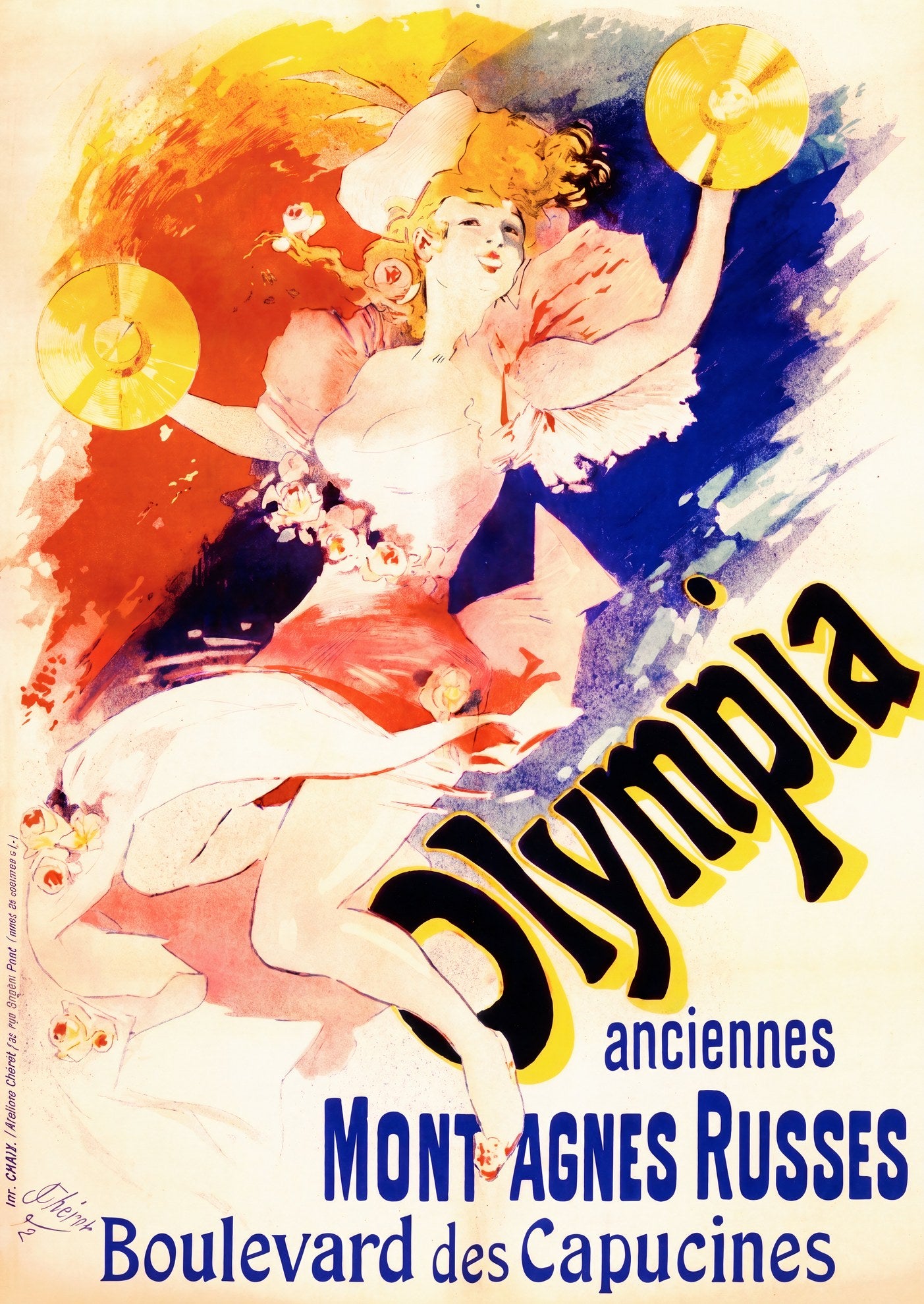
A red-haired 'Chérette' lifts two gold cymbals against a swirling field of cadmium red-orange and deep cobalt blue, white roses scattered across her gown. The bold diagonal 'Olympia' logotype in black and gold bisects the lower composition, with 'anciennes Montagnes Russes' and 'Boulevard des Capucines' set in navy below. The figure is rendered with the loose, energetic confidence Chéret perfected across more than a thousand lithographic commissions.
Designed by Jules Chéret in 1892 and printed at his Imprimerie Chaix atelier on the rue Bergère, Paris, this poster marked a pivotal moment for the venue on the Boulevard des Capucines: the Montagnes Russes entertainment hall, which had operated as an indoor roller-coaster attraction since 1888, was in the process of reinventing itself as the Olympia concert hall, formally opening under that name in April 1893. Chéret, already awarded the Légion d'honneur in 1890 for his contributions to graphic art, was commissioned to announce the transition. The work is held in the permanent collections of the Victoria and Albert Museum, MoMA New York, the Philadelphia Museum of Art, and the Bibliothèque nationale de France.
The chromolithographic technique Chéret developed at Imprimerie Chaix allowed him to produce saturated, multi-colour compositions at a scale that changed how Parisians experienced public advertising. This poster sits within that achievement: the warm-cool contrast of the background, the spontaneous figure work, and the integration of hand-lettered display type with the pictorial field are all characteristic of the Belle Époque affiche tradition that placed France at the centre of modern poster design.
Reproduced as an archival print on 200gsm Enhanced Matte Fine Art Paper. Collected by those interested in the origins of French graphic design and the visual world of 1890s Paris.
Couldn't load pickup availability
Share
A red-haired 'Chérette' lifts two gold cymbals against a swirling field of cadmium red-orange and deep cobalt blue, white roses scattered across her gown. The bold diagonal 'Olympia' logotype in black and gold bisects the lower composition, with 'anciennes Montagnes Russes' and 'Boulevard des Capucines' set in navy below. The figure is rendered with the loose, energetic confidence Chéret perfected across more than a thousand lithographic commissions.
Designed by Jules Chéret in 1892 and printed at his Imprimerie Chaix atelier on the rue Bergère, Paris, this poster marked a pivotal moment for the venue on the Boulevard des Capucines: the Montagnes Russes entertainment hall, which had operated as an indoor roller-coaster attraction since 1888, was in the process of reinventing itself as the Olympia concert hall, formally opening under that name in April 1893. Chéret, already awarded the Légion d'honneur in 1890 for his contributions to graphic art, was commissioned to announce the transition. The work is held in the permanent collections of the Victoria and Albert Museum, MoMA New York, the Philadelphia Museum of Art, and the Bibliothèque nationale de France.
The chromolithographic technique Chéret developed at Imprimerie Chaix allowed him to produce saturated, multi-colour compositions at a scale that changed how Parisians experienced public advertising. This poster sits within that achievement: the warm-cool contrast of the background, the spontaneous figure work, and the integration of hand-lettered display type with the pictorial field are all characteristic of the Belle Époque affiche tradition that placed France at the centre of modern poster design.
Reproduced as an archival print on 200gsm Enhanced Matte Fine Art Paper. Collected by those interested in the origins of French graphic design and the visual world of 1890s Paris.
