Vintage Poster Archives
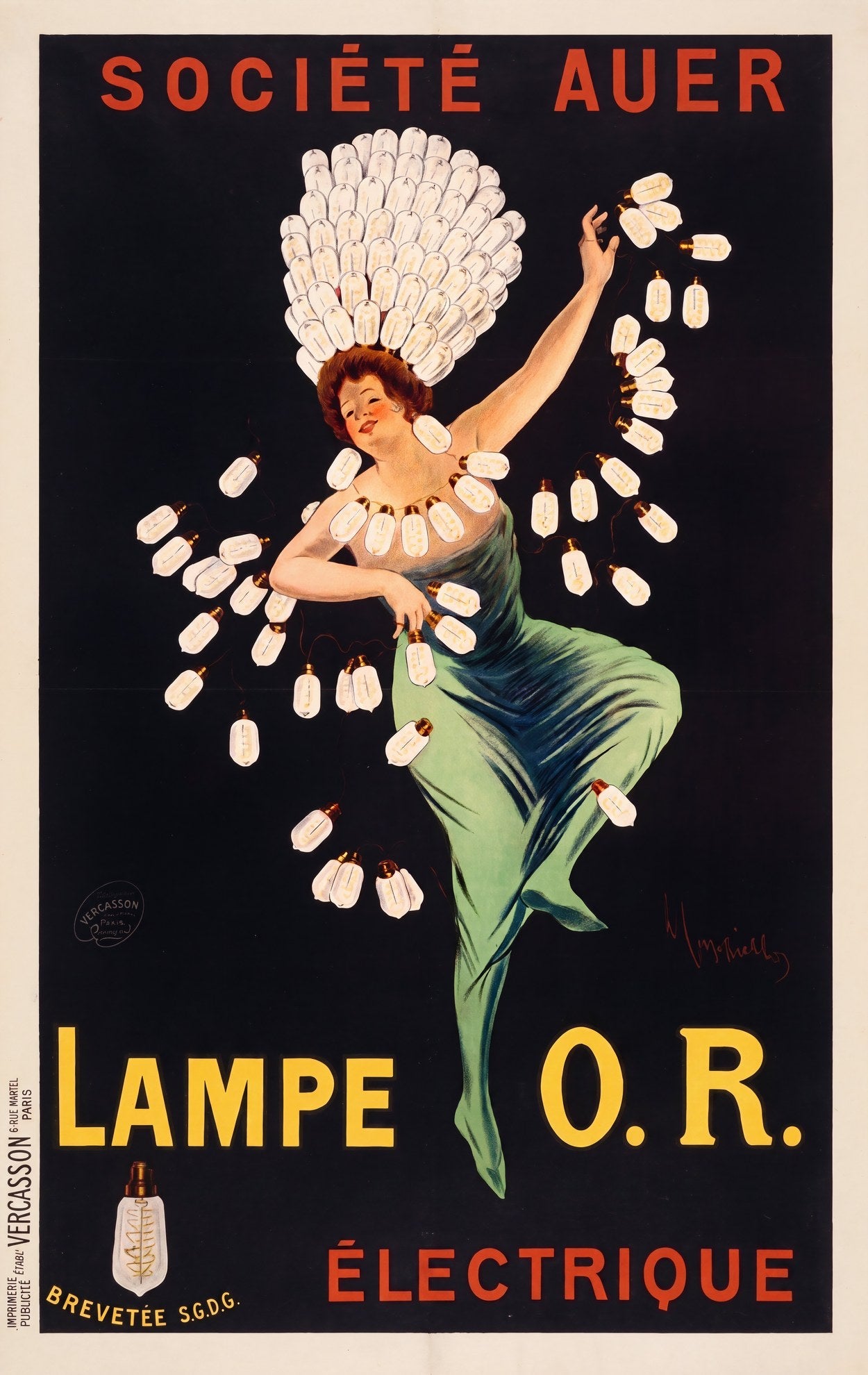
Cappiello Lampe O.R. 1912 | Société Auer Advertising Poster
This service is currently unavailable,
sorry for the inconvenience.
Pair it with a frame
Frame options are for visualization purposes only.
FRAME STYLE
MATTING SIZE
BUILDING YOUR EXPERIENCE
powered by Blankwall
Take a few steps back and let your camera see more of the scene.
powered by Blankwall
Was this experience helpful?
A woman dances against a solid black ground, her body encircled by strings of glowing electric light bulbs. Her headdress, a full fan of bulbs arranged in a radiating arc, sits above auburn hair. A teal-blue and green draped gown sweeps behind her raised leg, and a further string of bulbs rings her neck as a necklace. At lower left, a single filament bulb sits in careful isolation. The composition depends entirely on Cappiello's signature device: bold figure against void, the product worn as costume.
Leonetto Cappiello (1875–1942) designed this poster for Société Auer and it was printed by Vercasson, Paris, in 1912. Cappiello had pioneered the black-background technique from around 1903, creating advertising figures with an almost theatrical presence on Parisian walls. Société Auer, better known for gas mantles under the Auer von Welsbach name, was extending into electric lamps at a moment when domestic electrification was reshaping French household life. Cappiello's solution was to make the invisible, artificial light, physically present as jewellery and costume on a dancer.
The poster sits within the broader current of Belle Époque French advertising, where the Vercasson studio commissioned Cappiello for some of the most commercially effective posters of the pre-war decade. The Vercasson circular cartouche is visible in the composition, and the printer's imprint runs vertically along the left margin, confirming the relationship.
Reproduced here as an archival print on 200gsm Enhanced Matte Fine Art Paper, using pigment-based inks for colour stability. A natural fit for those drawn to early French poster design, the history of electrical advertising, or the broader Cappiello canon.
Couldn't load pickup availability
Share
A woman dances against a solid black ground, her body encircled by strings of glowing electric light bulbs. Her headdress, a full fan of bulbs arranged in a radiating arc, sits above auburn hair. A teal-blue and green draped gown sweeps behind her raised leg, and a further string of bulbs rings her neck as a necklace. At lower left, a single filament bulb sits in careful isolation. The composition depends entirely on Cappiello's signature device: bold figure against void, the product worn as costume.
Leonetto Cappiello (1875–1942) designed this poster for Société Auer and it was printed by Vercasson, Paris, in 1912. Cappiello had pioneered the black-background technique from around 1903, creating advertising figures with an almost theatrical presence on Parisian walls. Société Auer, better known for gas mantles under the Auer von Welsbach name, was extending into electric lamps at a moment when domestic electrification was reshaping French household life. Cappiello's solution was to make the invisible, artificial light, physically present as jewellery and costume on a dancer.
The poster sits within the broader current of Belle Époque French advertising, where the Vercasson studio commissioned Cappiello for some of the most commercially effective posters of the pre-war decade. The Vercasson circular cartouche is visible in the composition, and the printer's imprint runs vertically along the left margin, confirming the relationship.
Reproduced here as an archival print on 200gsm Enhanced Matte Fine Art Paper, using pigment-based inks for colour stability. A natural fit for those drawn to early French poster design, the history of electrical advertising, or the broader Cappiello canon.
