Vintage Poster Archives
Cappiello Ideal-Boule 1913 | Vintage Advertising Poster
This service is currently unavailable,
sorry for the inconvenience.
Pair it with a frame
Frame options are for visualization purposes only.
FRAME STYLE
MATTING SIZE
BUILDING YOUR EXPERIENCE
powered by Blankwall
Take a few steps back and let your camera see more of the scene.
powered by Blankwall
Was this experience helpful?
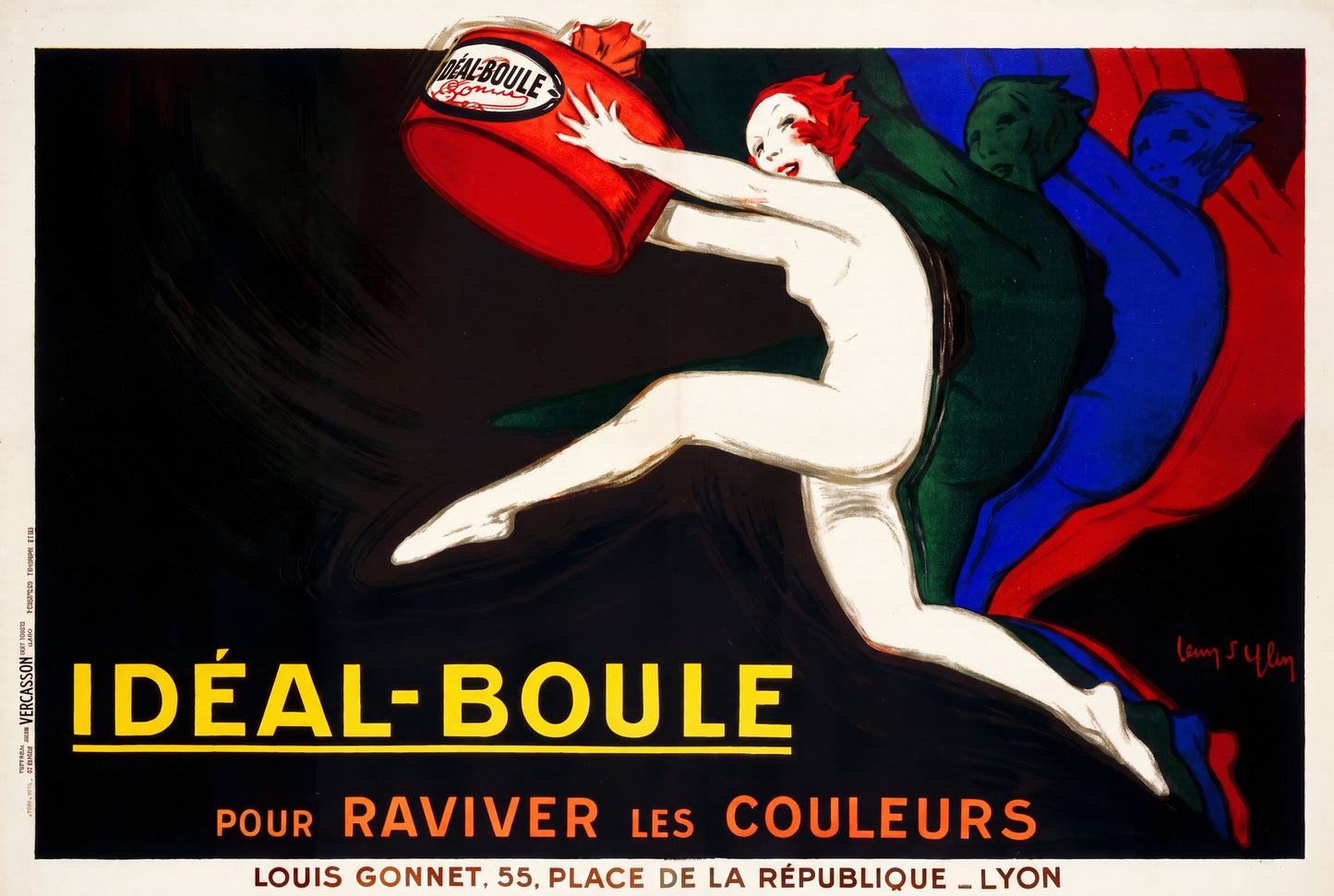
A white nude figure with flame-red hair leaps across a near-total black ground, arms extended to grip a large red circular tin of Idéal-Boule. Two spectral companions in dark green and cobalt blue billow at the right edge, their saturated hues a deliberate visual demonstration of the product's promise: "Pour Raviver les Couleurs" (to revive colour). The composition is stark and bold, the product barely secondary to the kinetic figure Cappiello has placed at the centre.
Leonetto Cappiello (1875–1942) designed this lithograph for Louis Gonnet, Lyon-based fabricant of Idéal-Boule household dye and colour reviver, with the address given as 55 Place de la République, Lyon. Printed by P. Vercasson, Paris, as part of the prolific poster output Cappiello produced under his exclusive Vercasson contract, a working relationship that ran from 1900 until the First World War disrupted it in 1914. The design dates from approximately 1913, placing it at the height of Cappiello's pre-war commercial output, when he was producing several hundred lithographs in a style that separated him from every other advertising artist of the era: black background, single kinetic figure, product name large and unavoidable.
Cappiello is credited as the originator of the modern advertising poster, using bold silhouettes against dark grounds at a time when his contemporaries were still working in the intricate organic mode of Art Nouveau. The Idéal-Boule design is an exemplar of that approach: the product's function (reviving colour) becomes the entire visual argument, embodied in a leaping figure whose companions seem to dissolve into spectral hues before the product does its work.
Reproduced on 200gsm Enhanced Matte Fine Art Paper with pigment-based archival inks. A natural choice for a study, dining room, or any space where early 20th-century French graphic design has a home.
Couldn't load pickup availability
Share
A white nude figure with flame-red hair leaps across a near-total black ground, arms extended to grip a large red circular tin of Idéal-Boule. Two spectral companions in dark green and cobalt blue billow at the right edge, their saturated hues a deliberate visual demonstration of the product's promise: "Pour Raviver les Couleurs" (to revive colour). The composition is stark and bold, the product barely secondary to the kinetic figure Cappiello has placed at the centre.
Leonetto Cappiello (1875–1942) designed this lithograph for Louis Gonnet, Lyon-based fabricant of Idéal-Boule household dye and colour reviver, with the address given as 55 Place de la République, Lyon. Printed by P. Vercasson, Paris, as part of the prolific poster output Cappiello produced under his exclusive Vercasson contract, a working relationship that ran from 1900 until the First World War disrupted it in 1914. The design dates from approximately 1913, placing it at the height of Cappiello's pre-war commercial output, when he was producing several hundred lithographs in a style that separated him from every other advertising artist of the era: black background, single kinetic figure, product name large and unavoidable.
Cappiello is credited as the originator of the modern advertising poster, using bold silhouettes against dark grounds at a time when his contemporaries were still working in the intricate organic mode of Art Nouveau. The Idéal-Boule design is an exemplar of that approach: the product's function (reviving colour) becomes the entire visual argument, embodied in a leaping figure whose companions seem to dissolve into spectral hues before the product does its work.
Reproduced on 200gsm Enhanced Matte Fine Art Paper with pigment-based archival inks. A natural choice for a study, dining room, or any space where early 20th-century French graphic design has a home.
