Vintage Poster Archives
Cappiello Abatilles 1926 | Vintage Advertising Poster
This service is currently unavailable,
sorry for the inconvenience.
Pair it with a frame
Frame options are for visualization purposes only.
FRAME STYLE
MATTING SIZE
BUILDING YOUR EXPERIENCE
powered by Blankwall
Take a few steps back and let your camera see more of the scene.
powered by Blankwall
Was this experience helpful?
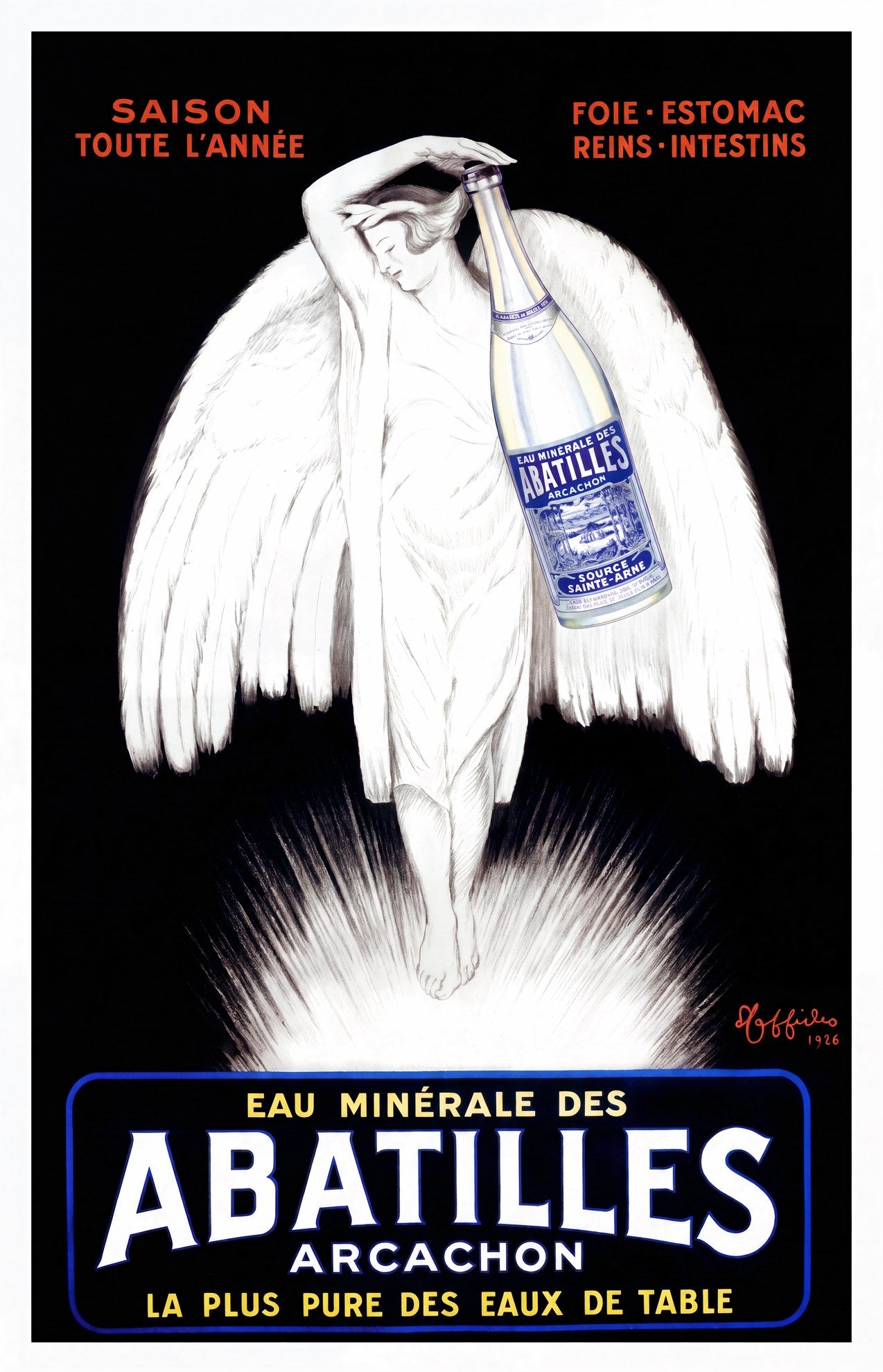
A white-winged angel rises from a burst of radiant light against an unbroken black ground, her robes shaded in pearl-grey, one arm raised to cradle a tall glass bottle of Abatilles mineral water. The bottle's blue label, 'Source Sainte-Arne, Arcachon', is the product's only explicit identification; everything else in the composition argues purity through image alone. Red-orange text at the upper corners lists the spring's claimed health benefits: liver, stomach, kidneys, intestines. At the base, a rounded blue-bordered panel carries 'ABATILLES' in large white display type above the tagline 'La plus pure des eaux de table.'
Leonetto Cappiello (1875–1942) designed this lithograph in 1926 for the bottling company established at Arcachon the previous year, after a 1922 accidental discovery of a pure mineral spring on the Atlantic coast near Bordeaux. Printed by Imprimerie Devambez, Paris, the same house behind his Campari and Bouillon Kub posters, and catalogued as Cappiello/Rennert 430, this work belongs to his mature Art Deco output: a single high-contrast figure isolated against blackness, the product woven into gesture rather than placed on display. By 1926 Cappiello had been working this formula for over two decades, and the Abatilles angel shows how fully he had absorbed it: the whiteness reads not as decoration but as argument, the figure's luminosity equated with the spring's claimed purity.
The design is reproduced here as a giclée print on 200gsm Enhanced Matte Fine Art Paper, using pigment-based archival inks without optical brighteners, on natural white stock.
Cappiello's black-ground advertising posters from the 1920s are held in collections including the Musée de la Publicité, Paris, and appear regularly at Swann and Poster Auctions International. This design draws collectors of French inter-war advertising and anyone drawn to the bold, pared-back graphic vocabulary that Cappiello pioneered and that the 1920s Art Deco movement refined.
Couldn't load pickup availability
Share
A white-winged angel rises from a burst of radiant light against an unbroken black ground, her robes shaded in pearl-grey, one arm raised to cradle a tall glass bottle of Abatilles mineral water. The bottle's blue label, 'Source Sainte-Arne, Arcachon', is the product's only explicit identification; everything else in the composition argues purity through image alone. Red-orange text at the upper corners lists the spring's claimed health benefits: liver, stomach, kidneys, intestines. At the base, a rounded blue-bordered panel carries 'ABATILLES' in large white display type above the tagline 'La plus pure des eaux de table.'
Leonetto Cappiello (1875–1942) designed this lithograph in 1926 for the bottling company established at Arcachon the previous year, after a 1922 accidental discovery of a pure mineral spring on the Atlantic coast near Bordeaux. Printed by Imprimerie Devambez, Paris, the same house behind his Campari and Bouillon Kub posters, and catalogued as Cappiello/Rennert 430, this work belongs to his mature Art Deco output: a single high-contrast figure isolated against blackness, the product woven into gesture rather than placed on display. By 1926 Cappiello had been working this formula for over two decades, and the Abatilles angel shows how fully he had absorbed it: the whiteness reads not as decoration but as argument, the figure's luminosity equated with the spring's claimed purity.
The design is reproduced here as a giclée print on 200gsm Enhanced Matte Fine Art Paper, using pigment-based archival inks without optical brighteners, on natural white stock.
Cappiello's black-ground advertising posters from the 1920s are held in collections including the Musée de la Publicité, Paris, and appear regularly at Swann and Poster Auctions International. This design draws collectors of French inter-war advertising and anyone drawn to the bold, pared-back graphic vocabulary that Cappiello pioneered and that the 1920s Art Deco movement refined.
